

For freelancers and the clients who hire them: on one marketplace, AI-linked work pays more for judgment and less per job for execution, and this is who keeps the gain.
2026-11-26T11:48:46.632919Z
By Noah Solace · Labor & Society Desk · roiscale.ai
- Where the pay goes when AI makes freelance work more valuable
- How clients and the platform take a share
- What freelancers, clients and platforms can each do
Two freelancers, one tool, opposite years
Adam Richardson went freelance four years ago, after he was made redundant. This November the art director told Prolific North that "at least 75%, if not more, of my work is AI-based." That side of his business, he said, has "exploded" in the past six months [1]. He put it down to skill: "Anyone can do AI, but some people can do it well."
Gabriella Tavini, a copywriter trained at two big agencies, told the same reporter a different story. Clients still pay her for tone of voice and ideas, but routine social posts are going to machines. Those small jobs were how she learned the trade [1].
I believe both of them. So my question is narrower than whether AI is good for freelancers. When it makes skilled work worth more, who ends up with the extra money: the freelancer, the client, or the platform between them?
The best public numbers come from one marketplace. In July 2026, Upwork published a survey of 2,400 skilled U.S. workers, run in March and April with a margin of error of 2 points. It released its own platform data alongside [2].
In that platform data, a separate dataset from the survey, freelancers doing AI work earned 34% more per hour than those who didn't [2]. That is an association on one platform, and it says nothing about what learning AI would do to your own rate.
The detail underneath tells the story, though Upwork labels "AI work" with an automated classifier that can misfile jobs. In its data, contract starts in generative AI and creative production rose 90% in a year, but earnings per contract in that work fell 13% [2]. On more complex AI-augmented work, earnings rose 45%.
Experts who fold AI into an established field gained too. Upwork counts this as AI-augmented professional services, where volume grew 72% and earnings 22% [2].
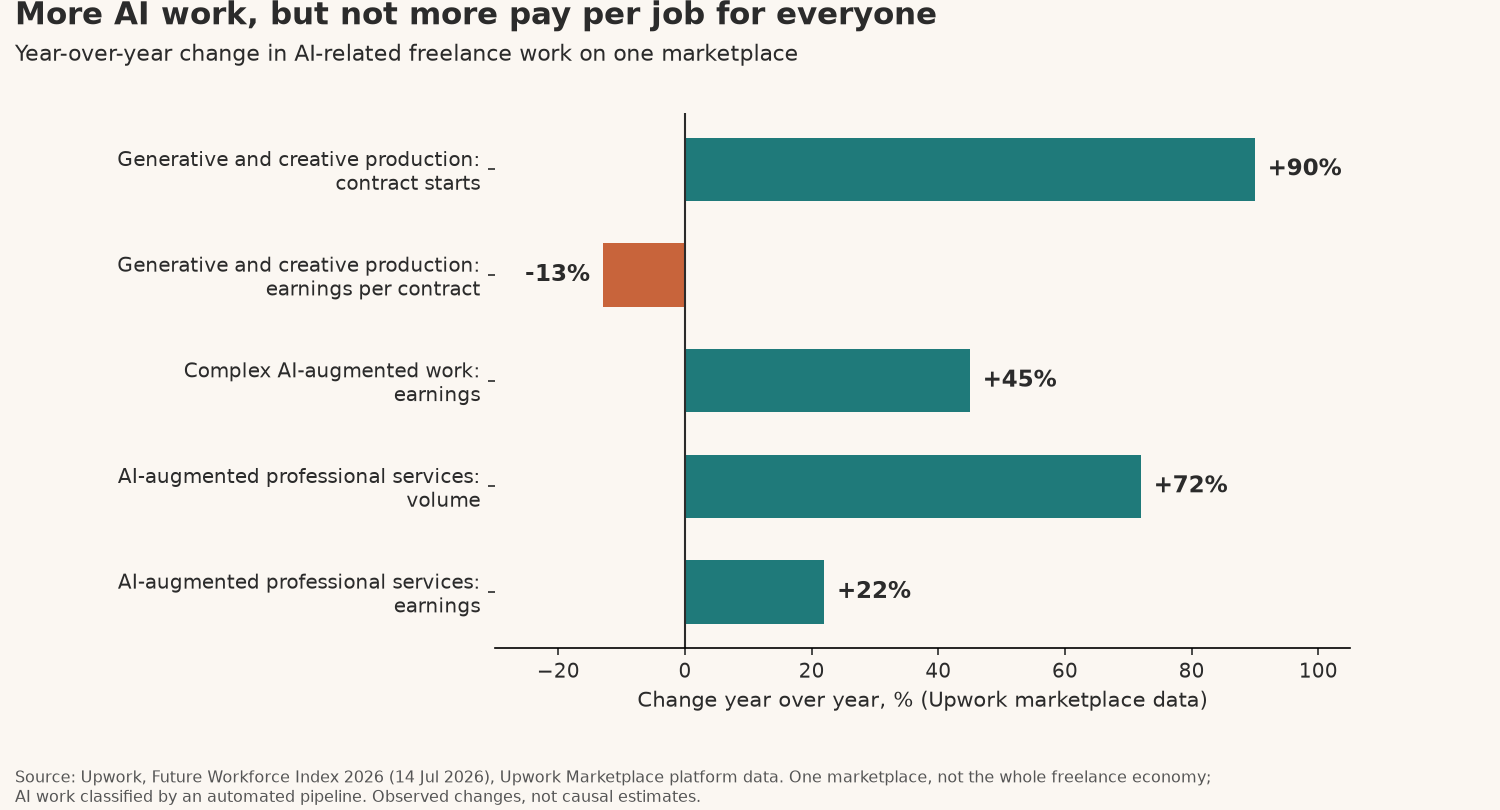
The extra jobs went to execution, and the better pay went to judgment. Richardson and Tavini stand on opposite sides of that line.
Scope and limits: All of these figures are one company's data, and the company benefits when freelancing looks like it's growing. Its "AI work" classifier is built on a language model [2].
Stanford economist Nick Bloom sits on Upwork's advisory council. In the release, he put it carefully: the value "is not showing up evenly; it is concentrated in more complex work" [2].
The client gets more out of the same day
If a freelancer doing routine work earns less per contract, somebody keeps the difference. The client is the first place to look.
Kyna Palin, a creative director, said it in one line to Prolific North: "The day rate hasn't changed, but the expectations are changing" [1]. Tavini described a client who wanted four medical articles a day, some close to 1,000 words, with research, fact-checking and revisions included. "That actually isn't reflected in a human capacity," she said [1].
In the U.S., a designer identified as Sekendur spoke to Fast Company in July. Budgets "have gotten significantly smaller, maybe like 50% or more than they were even last year," Sekendur said. Clients now take "two months, not two weeks" to sign [3].
The magazine surveyed nearly 1,300 independent designers. More than half said AI is pushing their rates down, and 22% said they had already lost work to it [3]. Those answers describe people's own experience, and nobody measured their pay.
An hourly average hides this. A client may pay the same day rate and get more out of the day. The freelancer's hourly figure can look steady on paper, but the productivity gain has gone to the client.
The platform's cut now changes from job to job
Since May 2025, Upwork has charged freelancers a fee of 0% to 15% on each new contract. Its 2025 annual report says the rate depends on "platform-specific supply and demand factors, such as project type, job availability, and client demand" [4]. Freelancers see the fee before they bid, and it stays fixed for that contract [5]. Contracts signed before May 2025 keep a flat 10%.
Routine AI work draws the most competition, and a fee set by demand has the most room to rise where competition is heaviest. That would put a bigger cut on the very contracts already paying less. Upwork doesn't publish fees by category, so I can't show that it's happening, and I'd put it to the platform as a question.
The freelancer who sells judgment is in the strongest spot, because clients pay for the part a machine can't do. The freelancer who sells execution is pressed by clients who expect more per day. If the fee does rise with crowding, that freelancer is pressed from the platform's side too, though the published data can't yet show it.
What would change my mind
The first test is hourly earnings for routine AI work: if they held while contracts shrank, the jobs got smaller and the pay didn't fall. Upwork's actual fee take by category would show whether its cut rises where work is crowded. And a second marketplace, or tax records, showing the same split would turn one platform's signal into something I'd call a pattern.
What this means for you
If you freelance, charge for judgment rather than hours. Quote a result, such as an approved concept or a reviewed document, rather than output a client assumes a machine could make.
Keep a short log, per client, of what you deliver in each paid day. A rising load then becomes a dated record you can bring to the next negotiation. And check the fee on each new contract before you bid.
If you hire freelancers, decide on purpose how much of the time AI saves you want to buy back, and write it into the scope. Asking for more each day at the same rate lowers what you pay per deliverable, and you keep the whole productivity gain. It also pushes out the people you'll need later to check the machine's work.
If you run a platform, publish actual fees and hourly earnings by type of work, so freelancers can see where the money goes.
If you run an agency, the short jobs that trained Tavini's generation are going. Build a new way in for juniors on purpose, or the people who can judge the machine's work will stop arriving [1].
Sources
- Karl Holbrook, "AI isn't replacing creatives – but it is rewriting the freelance day (for better and worse)," Prolific North, 6 Nov 2026. prolificnorth.co.uk
- Upwork, "Upwork's Future Workforce Index 2026: How AI is Redefining the Value of Work as Skilled Freelancing Accelerates," press release and methodology, 14 Jul 2026. upwork.com
- "'Almost everyone is having an existential crisis': Designers share how they're surviving an industry in constant flux," Fast Company, 29 Jul 2026. fastcompany.com
- Upwork Inc., Form 10-K for fiscal 2025, Item 7, Marketplace revenue, filed 13 Feb 2026. sec.gov filing
- Upwork Help, "Learn about the Freelancer Service Fee," retrieved 25 Nov 2026. support.upwork.com