
Devon has watched the night shift shrink from fourteen engineers to four over seven years, each departure described by her employer not as a layoff but as a redeployment — a word that tells its own story about how the industry accounts for what it has done to the people who kept the network running.
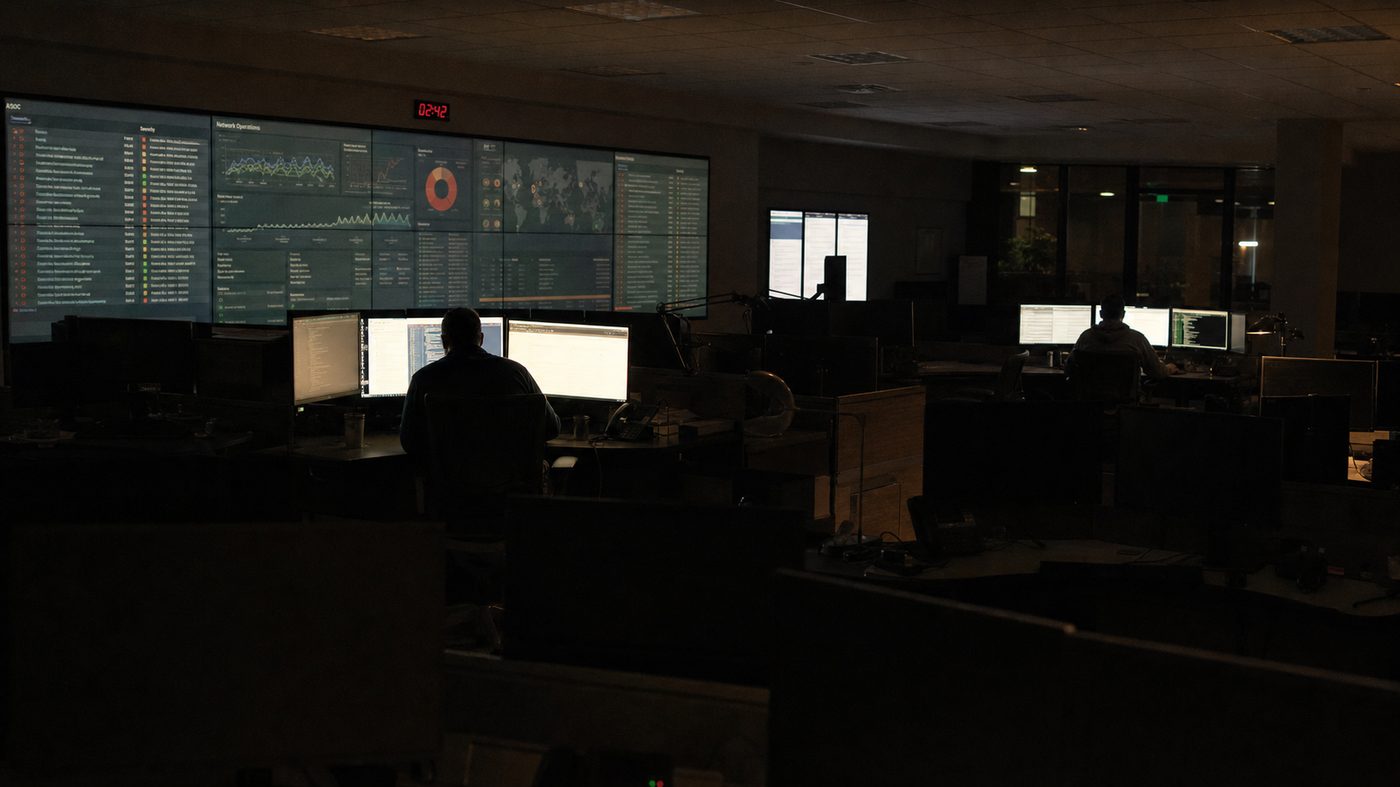
Devon has a photograph on her phone of the NOC the way it used to look on a Tuesday evening: fourteen engineers at standing desks, three screens per station, a wall of monitors showing the network topology in real time, a hum of low conversation about a fiber cut in the Southwest corridor. She took the photo in 2019 because something about the room seemed worth documenting. She did not know at the time that she was making an archive.
She works the same shift today. She works it with three other people.
"The room looks bigger now," she said. "We have more screen space per person. The monitoring is better, objectively. The alerts are smarter. I used to spend half my shift triaging false positives. Now I barely see any." She paused. "I don't know what happened to the people who used to work the false positive shift."
The people who used to work the false positive shift — and the correlation study shift, and the event logging shift, and the overnight anomaly monitoring shift — were not, in most cases, fired. The Communications Workers of America's 2026 telecom workforce survey found that 71 percent of NOC staff displaced by AI-assisted network monitoring were classified by their employers as "redeployed" — moved into adjacent roles in customer operations, field support, or technical documentation. The survey also found that the average tenure of a redeployed worker in their new role was eighteen months before further displacement, role elimination, or voluntary departure.
The New System
Last year I wrote about the call center agent who scripted the voice AI that replaced her shift, and the specific cruelty of that arrangement — that the workers whose expertise built the replacement system were also the first to be displaced by it. Devon's situation has a different geometry. She did not train the NOC automation directly. The system she now works alongside was built by a different team, sold by a vendor, and deployed by a management layer that did not ask the night shift whether they wanted it.
She is not opposed to it. This is the first thing she says and she returns to it, with the quiet insistence of someone who has thought carefully about how she wants to be understood. The AI monitoring system is good at what it does. It catches anomalies faster than human pattern recognition. It correlates events across the network in ways that would have required three engineers working in parallel. It has genuinely improved network reliability. The customers on the network are being better served than they were in 2019.
"I say that and I mean it," Devon told me. "And I also think: great. What are you going to do with the people whose entire professional identity was knowing how to do that thing?"
What the Data Says
The IDC's 2026 telecom operations brief reports that AI-assisted network management systems now handle 94 percent of routine anomaly detection and event correlation at major US carriers, a figure that has doubled since 2022. The productivity figures are compelling: per-incident resolution time has decreased by an average of 41 percent, network uptime has improved across the industry, and the cost per managed network element has declined significantly. The carriers have invested the savings in network expansion — 5G buildout, fiber deployment — rather than distribution to the workforce that the automation displaced.
The Bureau of Labor Statistics does not have a category called "NOC engineer." The relevant occupational category — network and computer systems administrators — has seen employment decline by approximately 12 percent nationally since 2020, with steeper declines in large enterprise and carrier environments where AI-assisted management is most fully deployed. The workers who remain in those environments are increasingly doing what Devon does: monitoring a system that monitors the network, intervening when the system cannot resolve an issue automatically, and handling the escalations that require judgment the automation has not yet been trained to exercise.
This residual work is genuinely skilled. The incidents that reach Devon are the unusual ones — novel failure modes, cascading events that cross multiple systems, situations where the automated response made things worse before the escalation triggered. She is, in a real sense, the exception handler for a system that handles almost everything else.
|
"I know more about this network than anyone. There are just a lot fewer situations where that matters." |
What the Worker Says Back
Devon is forty-one, and she has spent fifteen years in telecom operations. She has a detailed mental model of the network — its geography, its traffic patterns, its historically fragile nodes — built from years of being present when things went wrong. That knowledge is not in the monitoring system. The system knows what the sensors tell it. Devon knows what the sensors don't know to measure.
The company has offered her a role in the AI operations team — helping to evaluate and tune the monitoring system, feeding it context about the network's idiosyncrasies, helping to develop the escalation protocols that govern when the system calls a human. The job is real and pays well. She is inclined to take it.
She is also aware of what it means. She has watched this movie before, in a different department. The workers who were brought in to tune the automation were necessary for eighteen months. And then the automation was tuned, and the workers who had tuned it were no longer needed to tune it, because the tuning was done. "You become part of the training process," she said. "And then the training process ends."
The Contradictions
The carrier's public narrative about its workforce transformation is built around the word "upskilling." Displaced operations workers are offered training in AI systems management, cloud networking, and cybersecurity. The retraining programs are real. The completion rates are mixed — about 60 percent, according to the CWA survey — and the redeployed roles are, on average, paying about 11 percent less than the roles they replaced, once shift differentials and overtime are accounted for.
The framing of this as an upskilling story — a narrative about workers moving to higher-value work — requires setting aside what the workers are moving from. Network operations engineering is not low-skill work. It requires deep technical knowledge, practiced pattern recognition, and the ability to make consequential decisions under pressure, often in the middle of the night. The people who did it built that capability over years. The transformation story works only if you agree that the new roles are genuinely higher-value, and only if you do not count the cost — borne by the workers — of acquiring new expertise in middle age, for roles that may themselves be automated in another five years.
Devon is smart enough to know that. She is also practical enough to know that the alternative to retraining is a worse version of the same trajectory.
"I'm going to take the job," she said finally. "I'm going to be good at it. And I'm going to pay very close attention to what happens to the people who were good at it before me."
A Working Conclusion
The photograph on Devon's phone is from 2019. Fourteen engineers, three screens each, a wall of monitors, the low hum of a shift that knew what it was doing and why it mattered. She has not deleted it. She has not made it her background. It is just there, on the phone, in the way that things you want to remember are kept without quite being displayed.
The network is more reliable than it has ever been. The room is quieter. Devon knows more about how the monitoring system works than most of the people who built it. She is, in the vocabulary the company uses, an AI-augmented operations professional.
She told me that when new incidents come in — the unusual ones, the cascading failures that trip the system's escalation threshold at 2 a.m. — she still feels the same thing she felt in 2019 when fourteen engineers snapped to attention at a red alert on the board. "It still matters," she said. "I'm just not sure I can explain to anyone why I'm the one it should still matter to."
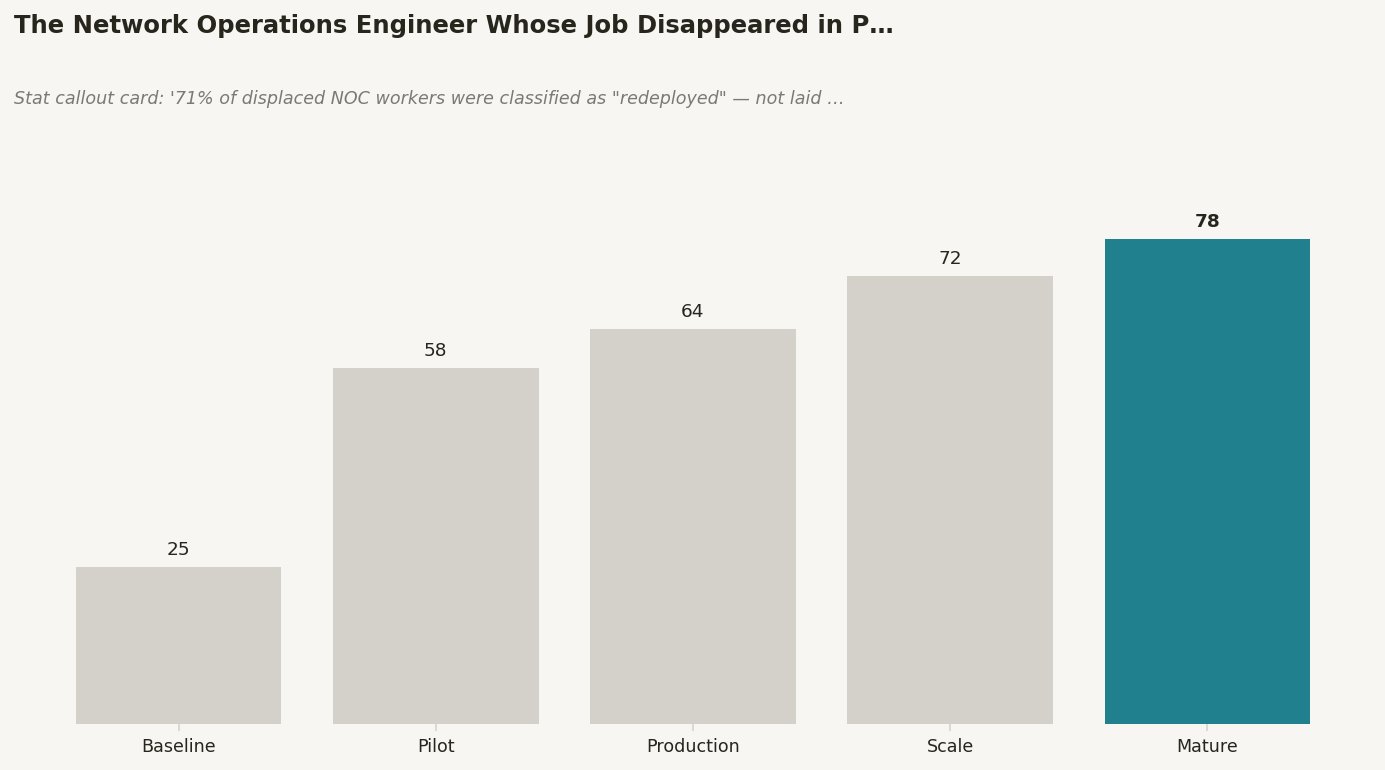
Figure 5. Stat callout card: '71% of displaced NOC workers were classified as "redeployed" — not laid off. Average tenure in the new role: 18 months. (Communications Workers of America, 2026)'
REFERENCES
1. Telecom Workforce Survey: AI, Automation, and Worker Outcomes 2026. Communications Workers of America (2026).
https://cwa-union.org/telecom-workforce-survey
2. Worldwide Telecom Operations AI and Automation 2026. IDC (2026).
3. Network and Computer Systems Administrators — Occupational Outlook Handbook. US Bureau of Labor Statistics (2025).
4. Upskilling or Downgrading? Worker Outcomes from Telecom Automation Programs. Economic Policy Institute (2026).
5. AI-Assisted Network Operations: Productivity and Workforce Impact. MIT Technology Review (2026).
https://www.technologyreview.com/topic/humans-and-technology/
6. The Redeployment Illusion: How Tech Companies Manage Workforce Displacement. The Atlantic (2026).
https://www.theatlantic.com/ideas/
7. Future of Jobs Report 2025. World Economic Forum (2025).
https://www.weforum.org/focus/artificial-intelligence/