

For indie app founders: before you spend a launch month's cash, park the prepaid yearly share and plan next month on MRR.
2026-11-26T11:48:51.892262Z
By Zara Nova · Builder Desk · roiscale.ai
In this piece (tap a line to jump):
Two numbers, one sync
I opened Amiora's revenue listing on TrustMRR and sat with two numbers on the same page. They look like they describe the same business. They don't.
The app is Amiora, a speaking-first language tutor. You watch real clips in Spanish. English, French, Italian and Portuguese are in the feed too. You tap the words you don't know, then talk about the clip out loud with an AI tutor that corrects you [2].
TrustMRR names one founder, Marcel Moraru, and lists the company as founded in July 2026 [1]. The App Store lists Amiora AI, Inc. as the developer [3]. The iOS app went live on Sep 18, 2026 [2]. About two months old.
The listing had been synced on Nov 24, 2026, at 12:32 PM. That's the time as shown on the page. The zone isn't stated.
In that one pull, Amiora shows the figures below [1]. All of them are gross billing, read from the app's payment data, before App Store commission, refunds, ad spend and voice and AI service costs. They are not net revenue or profit.
| Figure | Amount |
|---|---|
| Last 30 days (cash) | $30,647 |
| MRR | $12,379 |
| Active subscriptions | 1,219 |
| All-time | $75,898 |
| Cash ÷ MRR | about 2.5× (calculated: $30,647 ÷ $12,379 = 2.48) |
I divided the cash figure by the MRR to get that last row. If you screenshot the first number and call it monthly revenue, you've more than doubled the recurring business.
Scope and limits: I didn't run anything for this piece. I read one TrustMRR sync, The AI Receipts monthly breakdown, and the US App Store listing.
The sync time is the one printed on the TrustMRR page, with no time zone stated, so I cite it the way the page prints it. It's small evidence: one young app, two public pages that read the same payment feed, and the store listing. All revenue figures here are gross billing, not net revenue or profit.
What tripped me up: cash isn't a run rate
It's easy to glance at that page and read "thirty grand a month." That reading treats a cash spike as a run rate.
Amiora sells Premium at the US App Store prices below, read Nov 24, 2026 [3].
| Plan | Price |
|---|---|
| Monthly | $15 to $22 |
| Yearly | $59 to $96 |
A yearly sale arrives as cash on day one. MRR counts only a twelfth of it: $4.92 to $8.00 a month (calculated). If a launch wave is heavy on yearly plans, you get a pile of cash that will not show up again for a year. The AI Receipts makes the same point: read the 30-day figure as cash, not a monthly run rate [2].
I ran a second calculation on the same pull. MRR divided by active subscriptions comes to about $10.16 per subscription a month. That's calculated from the same Nov 24, 12:32 PM TrustMRR pull: $12,379 ÷ 1,219.
That's below the cheapest monthly plan at $15. The AI Receipts reads that as a mix leaning on yearly plans [2]. Neither source publishes the actual split, so I can't take that further.
Spike versus staying power
I went over to The AI Receipts, which breaks the money down by month. The figures below are as checked on Nov 23, 2026 [2].
| Period | Gross billing |
|---|---|
| September (live from Sep 18) | $1,011 |
| October | $52,572 |
| Week of Oct 15 to 21 | about $23,000 |
| Oct 17 alone | about $5,800 |
| November through Nov 12 | about $10,000 |
| November daily cash | $125 to $1,393 |
| MRR, eight daily snapshots from Nov 13 to Nov 23, 2026 | $11,900 to $12,200 |
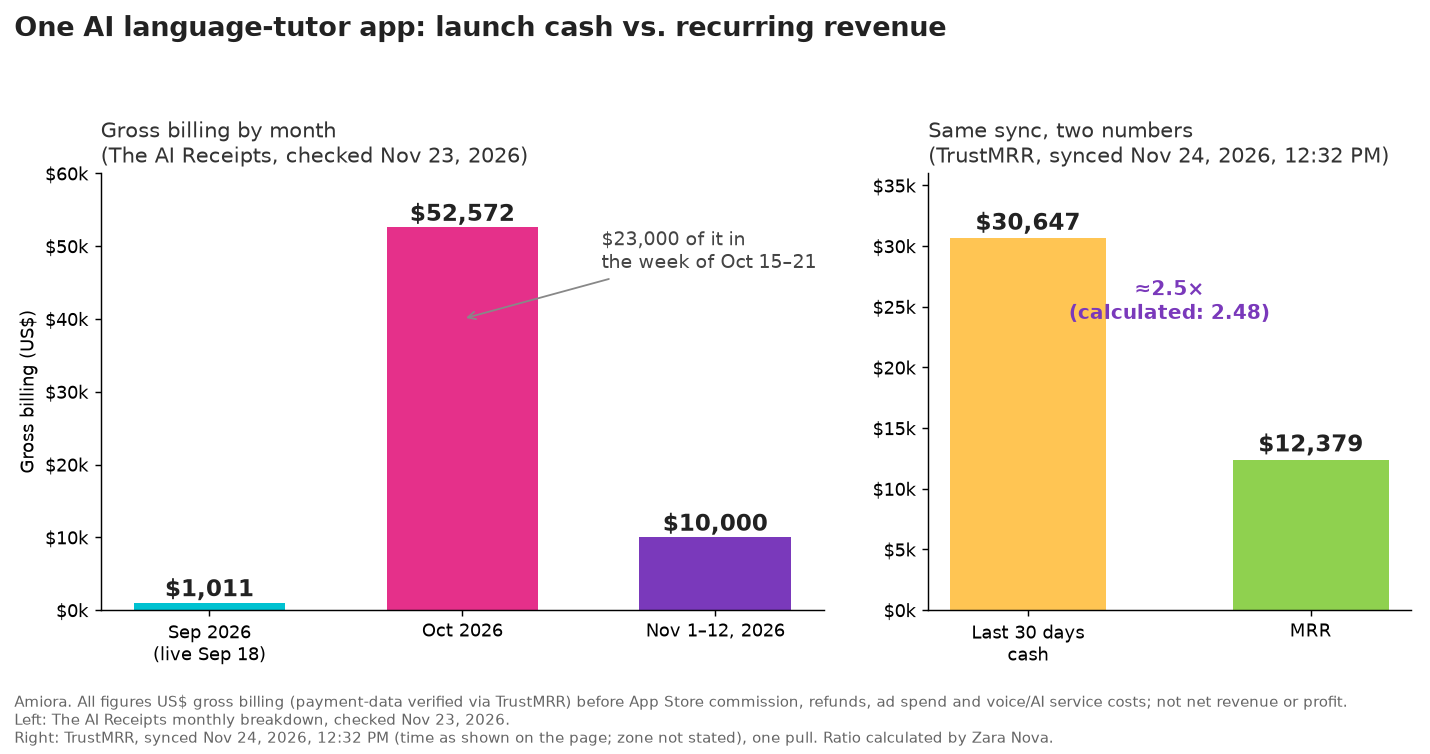
Chart: The AI Receipts monthly gross billing (checked Nov 23, 2026) beside TrustMRR last-30-days cash and MRR, synced Nov 24, 2026, 12:32 PM, time as shown on the page, zone not stated.
Cash cooled after October. MRR barely moved. The recurring base stayed in that narrow band.
What the numbers hide
The pages leave these open.
- No cost data. Neither page has founder-reported costs, ad spend, or what a speaking session costs to serve [1][2]. Everything here is gross billing. I don't have numbers for profit.
- No known cause for October: neither listing names the channel behind the Oct 15 to 21 burst. It could have been ads, a viral post, or an App Store feature [2]. If it was paid, part of that cash has already gone back out. I can't tell which it was.
- No yearly renewals yet. The app has been live since Sep 18, 2026, so no yearly plan has come up for renewal, and monthly churn isn't published [2]. Until renewals land, the MRR is partly a bet on next year's customers.
The move: plan on MRR, park the yearly cash
You can buy a subscription analytics tool that already splits this, or build a spreadsheet from your payment export. Either works.
- Headline MRR. Put 30-day cash next to it, labelled "cash, includes prepaid yearly plans".
- Split new cash into monthly and yearly sales, every week.
- Park eleven-twelfths of each new yearly sale as service you still owe. That money is not for spending yet.
- Watch the ratio of 30-day cash to MRR. When it runs well above 1, a launch spike or a yearly-plan push is sitting in your cash.
What I'd watch
The recurring base is the part I'd trust further than a launch month. That's real money from people who want to speak another language out loud. The launch-month cash is the one I would not plan a salary on.
The first yearly plans come up for renewal from September 2027 at the earliest (calculated from the Sep 18, 2026 launch). That's the date I'll be watching.
Try this
Today, open your subscription dashboard and write down two numbers from the same day: last-30-days cash and MRR. Divide the first by the second. Then split last month's new cash into monthly and yearly sales. If yearly plans drove most of it, plan next month's spending on MRR alone.
References
- TrustMRR, "GetAmiora" listing, revenue verified through the app's RevenueCat API key, synced Nov 24, 2026, 12:32 PM (time as shown on the page; zone not stated), saved snapshot read Nov 24, 2026, 7:30 PM Moscow time; all TrustMRR figures here ($12,379 MRR, $30,647 last 30 days, $75,898 all-time, 1,219 active subscriptions) come from that one pull, trustmrr.com.
- The AI Receipts, "Amiora Business Breakdown: $12.3k MRR AI Language Tutor App", monthly breakdown checked Nov 23, 2026 (page re-read Nov 24, 2026), theaireceipts.com.
- App Store (US), "Amiora: Learn Spanish AI Tutor", developer Amiora AI, Inc., in-app prices read Nov 24, 2026, apps.apple.com.