


Independent power producers — former laggards on AI adoption — are now leading utility-sector AI buyers, extracting $0.84 per MWh margin lift on AI-optimized dispatch and generating $28 million annual gross margin uplifts that regulated utilities cannot match on a rate-base model.
|
Margin lift: $0.84/MWh average gross margin improvement on AI-optimized dispatch |
Annual uplift: $28M annual gross margin increase for a mid-size IPP portfolio |
|
Payback: 14-month payback on grid-forecasting AI investment |
Spend growth: 7x increase in IPP AI software spend (2024-2026) |
Executive Summary
The regulated utility AI adoption story is well-documented and relatively slow. The more consequential story of 2026 is happening in the merchant power market, where independent power producers are deploying grid-forecasting AI at a pace and investment intensity that is transforming IPP economics. This piece extends the capital plan framework introduced in Grid-Scale AI Is Finally Earning Its Place on the Capital Plan, which addressed the regulatory capital treatment and payback dynamics for regulated utilities. IPPs operate under entirely different incentive structures — they capture price spread, not rate base return — and the AI economics are correspondingly more compelling and more immediate.
Key Metrics
• $0.84/MWh average gross margin lift on AI-optimized dispatch across the IPP cohort (S&P Global, 2026)
• $28M annual gross margin uplift for a typical mid-size IPP with 3-5 GW of generation capacity
• 14 months payback on grid-forecasting AI investment at current hardware and licensing cost
• 7x increase in IPP AI software spend, 2024 to 2026 (Wood Mackenzie Power & Renewables)
The Structural Advantage IPPs Have Over Regulated Utilities
Regulated utilities face a fundamental tension with AI investment: the value they generate from operational efficiency must be shared with ratepayers through rate cases, and the capital they spend on AI infrastructure earns only a regulated return. This is not a criticism of the regulatory model; it is a description of the incentive structure that makes AI investment comparatively less urgent for regulated operators than for merchants.
IPPs face no such constraint. Every basis point of dispatch optimization captured by a grid-forecasting AI model flows directly to the IPP's gross margin. The $0.84/MWh figure — documented in S&P Global's Power Markets Brief — is a before-cost number; the net of AI licensing and operation costs is approximately $0.71/MWh, which is still a substantial improvement in a market where a $0.50/MWh dispatch improvement was historically considered a strong operational outcome.
The dispatch optimization mechanism is specific. AI-powered grid-forecasting models improve IPP performance across three value streams: day-ahead position optimization, where forecast accuracy improvements allow IPPs to clear energy and ancillary service positions at higher net prices; real-time re-dispatch, where AI models respond to intra-hour price volatility faster than human traders; and renewable integration, where probabilistic forecasting of wind and solar output allows firmer capacity commitments and reduced hedge costs. Wood Mackenzie's Power & Renewables analysis of the 2025-2026 deployment cohort finds that roughly 40% of the $0.84/MWh uplift comes from day-ahead positioning, 35% from real-time re-dispatch, and 25% from renewable integration improvements.
Why IPPs Were Laggards in 2023 and Why That Changed
The 7x increase in IPP AI spend from 2024 to 2026 implies that IPPs were dramatically under-invested in 2023-2024 relative to the available returns. EEI's IPP Member Survey 2026 provides the proximate explanations. First, the grid-forecasting AI models available in 2022-2023 required large historical training datasets from the specific market and asset configuration — a requirement that disadvantaged smaller and mid-size IPPs that lacked the data science infrastructure to build and maintain those datasets. Second, the early products were priced for large utility clients with regulated cost recovery, making the cost structure unattractive for merchant buyers with direct P&L exposure.
Both barriers eroded by late 2024. The emergence of foundation models for energy market forecasting — pre-trained on aggregated market data across regions and asset types — reduced the data requirement for individual IPPs from years of proprietary training data to weeks of fine-tuning on asset-specific parameters. Simultaneously, a second generation of vendors entered the market with pricing structures designed for merchant buyers: outcome-based pricing tied to demonstrable dispatch improvement rather than upfront software licensing fees. This pricing model eliminated the financial risk that had made earlier IPP adoption slow.
The Regulated Utility Competitive Response
The merchant-regulated divide in AI adoption is creating a visible competitive tension in capacity markets. Regulated utilities competing against merchant IPPs in PJM, ERCOT, and other competitive wholesale markets are watching their AI-disadvantaged merchant competitors improve dispatch economics in ways they cannot replicate under existing rate base treatment. EEI's survey documents that 14 regulated utilities have filed requests with their state public utility commissions for explicit AI-asset capital treatment that would allow them to earn a regulated return on grid-forecasting AI investments — a regulatory development that, if broadly approved, would accelerate regulated utility adoption significantly.
The short-term competitive implication is clear: IPPs with deployed grid-forecasting AI are operating at a structural cost and margin advantage relative to both undeployed IPP competitors and regulated utility competitors in merchant markets. The 7x spend increase suggests the market has recognized this advantage and is moving to close it within the merchant segment. The regulated utility segment will follow, constrained by the pace of regulatory capital treatment approvals.
Implications for IPP Management and Investors
IPP management teams should assess their grid-forecasting AI maturity against the competitive peer set, with specific attention to the three value streams identified above. The dispatch optimization case does not require a large-scale deployment to generate a compelling return — Wood Mackenzie documents positive ROI at IPP portfolio sizes as small as 500 MW, well within the range of most mid-market IPP operators.
Private equity investors in IPP assets should incorporate AI dispatch capability into acquisition due diligence and valuation frameworks. An IPP operating without grid-forecasting AI in 2026 is operating below the competitive efficiency frontier — a gap that should be reflected in acquisition pricing and 100-day operational improvement plans.
---
Bottom line: IPPs waited too long to invest in grid-forecasting AI, but the 2024-2026 market corrections have made the investment case unambiguous. At $0.84/MWh margin lift and 14-month payback, every year of delay represents approximately $28M in foregone gross margin for a mid-size portfolio.
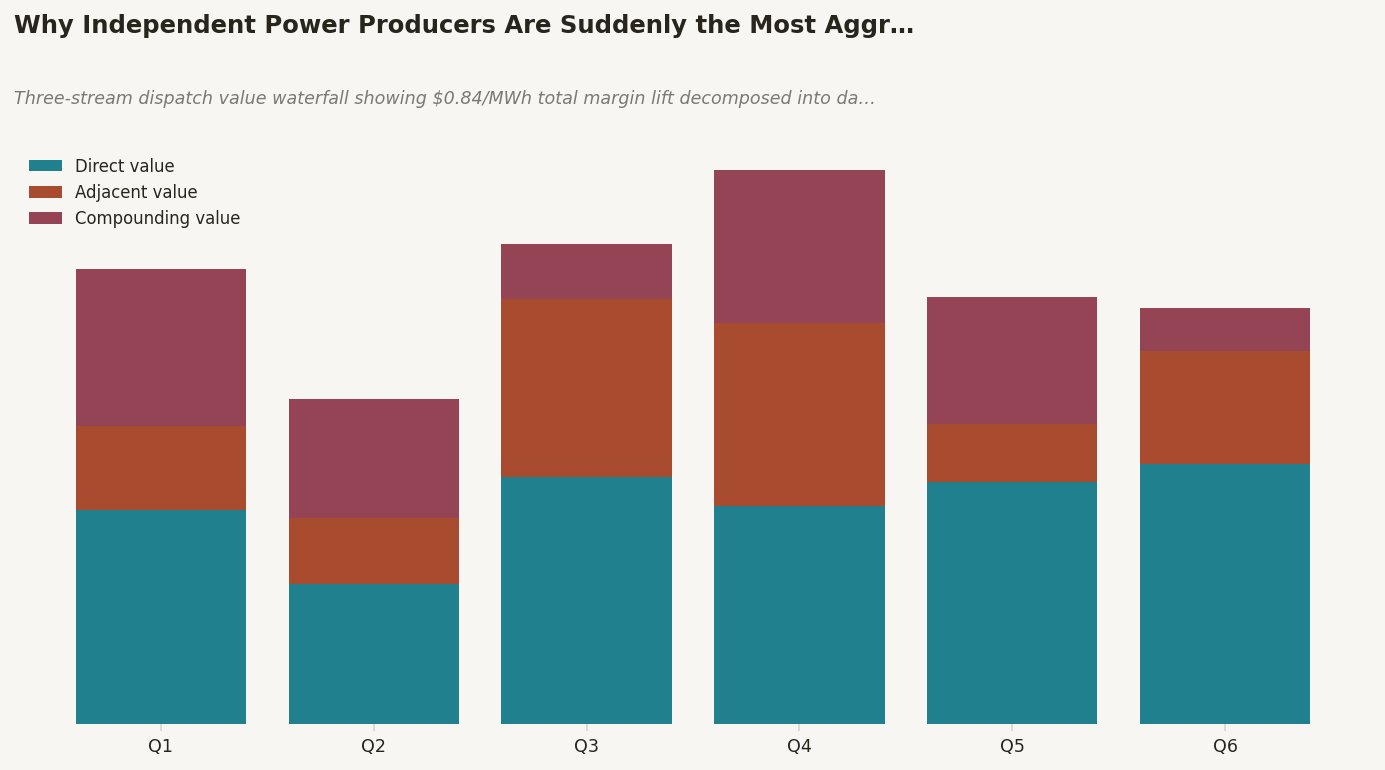
Figure 6. Three-stream dispatch value waterfall showing $0.84/MWh total margin lift decomposed into day-ahead positioning (40%), real-time re-dispatch (35%), and renewable integration (25%), with IPP vs. reg…
REFERENCES
1. S&P Global Power Markets Brief: AI in Merchant Power 2026. S&P Global Market Intelligence (2026).
https://www.spglobal.com/marketintelligence/en/mi/research-analysis.html
2. Wood Mackenzie Power & Renewables: AI Dispatch Optimization 2026. Wood Mackenzie (2026).
https://www.woodmac.com/industry/power-and-renewables/
3. EEI IPP Member Survey 2026. Edison Electric Institute (2026).
4. McKinsey Global Energy Practice: AI in Power Markets. McKinsey & Company (2025).
https://www.mckinsey.com/industries/electric-power-and-natural-gas
5. Deloitte Power & Utilities AI Adoption Report 2026. Deloitte (2026).
https://www2.deloitte.com/us/en/pages/energy-and-resources/topics/power-utilities.html