


AI has inverted the consulting cost stack so that junior labor is now more expensive per unit of output than the AI performing equivalent tasks, compressing the traditional pyramid into a diamond and forcing a fundamental rethinking of leverage, pricing, and partner economics.
|
BUILDS ON What the Big Four Did to Their AI Economics in 2025 (V1) |
|
Junior hours: 43% reduction in junior consultant hours per engagement |
Margin impact: 21% gross margin lift on fixed-fee engagements |
|
Partner productivity: $280K average revenue per partner, up 18% YoY |
Hiring reduction: 33% reduction in entry-level consulting hiring across major firms |
Executive Summary
The consulting pyramid — a few expensive senior partners leveraged across a broad base of cheap junior associates — has been the structural organizing principle of the professional services industry for fifty years. That model is breaking. AI tools performing research synthesis, financial modeling, document drafting, and data analysis at a cost of $0.02-0.08 per task have exposed the fundamental economics of junior consulting labor: tasks that billed at $150-250 per hour when performed by a first or second-year analyst can now be completed at a fraction of that cost by a model. This piece extends the competitive dynamics explored in What the Big Four Did to Their AI Economics in 2025, which documented the Big Four's investment posture. The structural implication — that the pyramid itself is no longer the right organizational form — was visible but not yet fully articulated at the time of that piece.
Key Metrics
• 43% reduction in junior consultant hours per engagement across AI-augmented firms (Source Global 2026)
• 21% gross margin lift on fixed-fee work as junior labor is replaced by AI-assisted partner delivery
• $280K average revenue per partner at leading AI-augmented consulting firms, up 18% YoY
• 33% reduction in entry-level hiring across major consulting firms (Kennedy Research 2026)
The Inversion Logic
The traditional consulting pyramid operated on a simple leverage principle: junior associates performed the data gathering, analysis, and document production work that consumed the majority of engagement hours, while senior partners provided judgment, client relationships, and quality control. The economics worked because junior labor was cheap (billing at 3-4x cost) and the work itself — while valuable — was largely procedural.
AI has disrupted the procedural work category comprehensively. A research synthesis that took a first-year analyst 8-12 hours takes a well-prompted AI system with access to appropriate data sources 20-40 minutes. Financial model construction that required 2-3 days of analyst time for a standard DCF or scenario analysis is now a 2-3 hour AI-assisted task. The productivity differential is not marginal; it is structural.
The cost inversion becomes visible when task economics are compared directly. A first-year consultant at a mid-tier professional services firm fully loaded (salary, benefits, overhead, supervision cost) costs approximately $180 per hour to deploy. An AI-assisted workflow performing equivalent analytical tasks costs $2-8 per hour of equivalent output, depending on model choice and prompt architecture. At that cost differential, the junior labor premium is not a leverage instrument — it is a liability on fixed-fee engagements.
The Diamond Replaces the Pyramid
The organizational response is playing out in real time. Source Global's Consulting Market Report 2026 documents a 33% reduction in entry-level hiring across major consulting firms — not attributable to demand reduction, but to restructured delivery models. The firms reporting the strongest margin improvement are not running engagements with fewer total people; they are running them with a compressed base of junior staff performing higher-value coordination and quality-assurance work, a larger proportion of experienced managers and senior consultants performing AI-assisted analysis, and the same or larger senior partner presence for client relationship and judgment work.
This is the diamond structure: narrow at the entry level, wider in the middle experience bands, and maintained at the top. It is not an end state — it is an inflection toward a model where the ratio of senior to junior labor continues to shift as AI capability expands.
The 21% gross margin lift on fixed-fee work is the arithmetic consequence of this shift. Fixed-fee engagements were historically loss leaders or thin-margin work for consulting firms because the engagement economics were set before AI productivity was available. Re-priced with AI-assisted delivery models, the same fixed-fee scope that required 40 junior hours and 8 partner hours can be delivered with 22 junior hours and 10 partner hours — holding the same quality and outcome while improving margin by roughly the cost difference between the eliminated junior hours and the incremental AI infrastructure.
Implications for Partnership Economics and Promotion Tracks
HBR's Professional Services 2026 analysis identifies a secondary consequence that is beginning to register in talent markets: the promotion pathway to partnership is lengthening and narrowing simultaneously. Partners are managing more revenue per head, which means fewer partnership slots are needed at any given revenue level. And the traditional proof point for partnership readiness — demonstrating the ability to manage a team of analysts and associates through complex engagements — is no longer a reliable signal of partner-level capability because those teams are smaller and the analytical work they perform is AI-assisted.
The firms that are navigating this transition most effectively are building explicit AI competency requirements into their promotion criteria, redefining the junior-to-senior transition around judgment development and AI workflow orchestration rather than analytical output volume, and investing in structured training programs that teach associates to work effectively with AI systems as the primary productivity tool rather than as a supplement to manual analysis.
The 18% year-over-year improvement in revenue per partner at AI-augmented firms is the proof point that the model adjustment is working. Partners who can orchestrate AI-assisted delivery effectively are generating materially more client value per unit of their own time — the fundamental definition of leverage has not changed, but the input being leveraged has.
---
Bottom line: The consulting pyramid did not survive AI because AI is better than junior analysts at the work that justified the pyramid. The firms that acknowledge this structure change and redesign their delivery models accordingly will capture the $280K-per-partner revenue premium that early movers are already reporting.
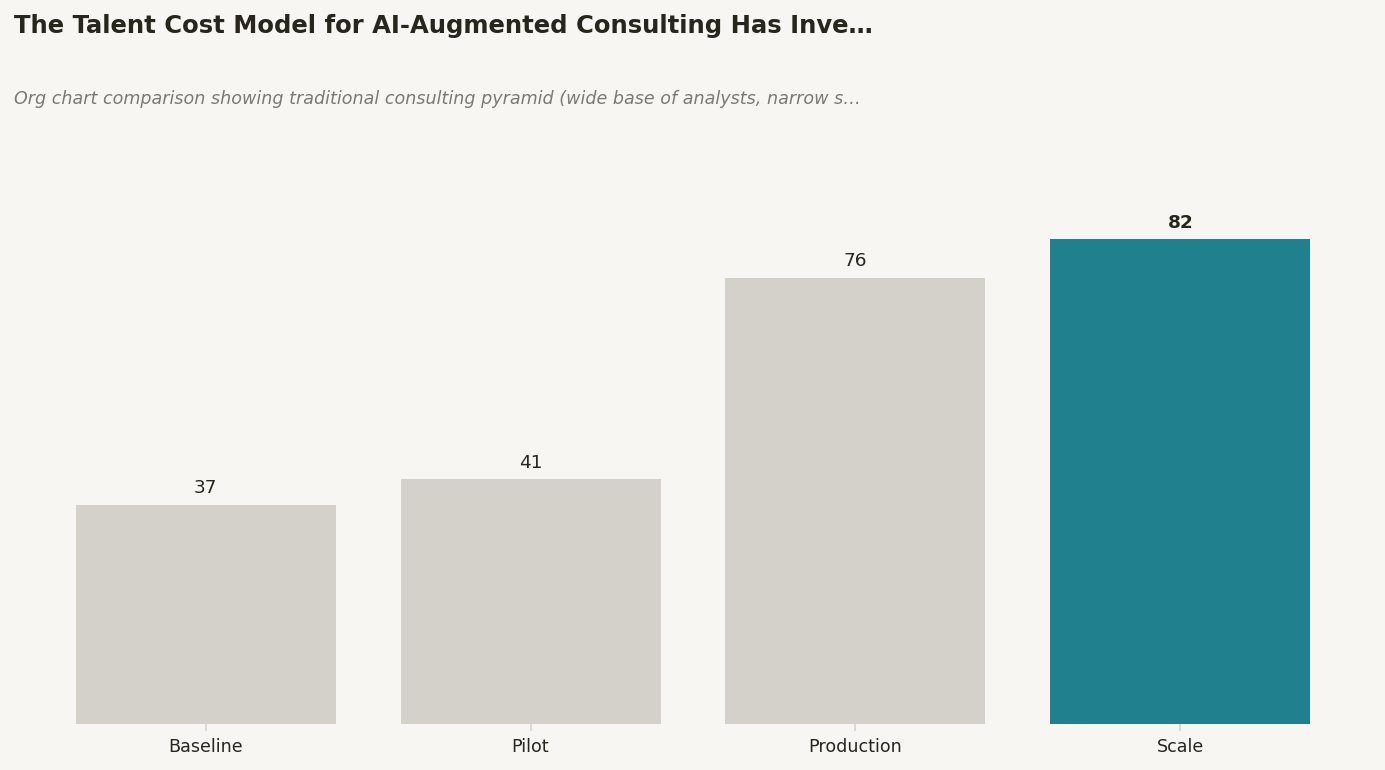
Figure 7. Org chart comparison showing traditional consulting pyramid (wide base of analysts, narrow senior layer) versus emerging diamond model (compressed analyst base, wider senior associate/manager band,…
REFERENCES
1. Source Global Research: Consulting Market Report 2026. Source Global Research (2026).
https://www.sourceglobalresearch.com
2. Kennedy Research: Consulting Industry Brief 2026. Kennedy Research (2026).
3. Harvard Business Review: The End of the Consulting Pyramid. Harvard Business Review (2026).
https://hbr.org/topic/ai-and-machine-learning
4. McKinsey Global Institute: AI and the Future of Professional Services. McKinsey Global Institute (2025).
https://www.mckinsey.com/mgi/our-research
5. Deloitte Consulting AI Workforce Transformation Survey. Deloitte (2026).
https://www2.deloitte.com/us/en/pages/consulting/topics/generative-ai.html
6. PwC AI Jobs Barometer: Professional Services Impact. PwC (2026).
https://www.pwc.com/gx/en/issues/artificial-intelligence.html