
For owners and the developers who build their sites: four AI accuracy studies count four different things. Here is which number to quote, and why the rates differ.
2026-11-21T08:32:45.807302Z
Summary: the article in four points
- The same "11%" means two different things in two studies: one counts businesses, the other counts questions.
- Per-claim and per-business rates never match. In Empirank's August 2026 audit, at about seven claims per business, a 1.9% claim error becomes roughly 12% of businesses.
- Hours are the field that breaks. Addresses and phone numbers held in the one study that checked them field by field.
- Quote per-business rates to owners and per-claim rates to engineers, and never put the two on one scale.
The same 11% means two different things
I didn't run a new test for this piece. I read the four studies everyone in this release is quoting and lined up what each one actually counted. The small print matters more than the headline. In Empirank's audit, 11.0% is the share of recommended businesses with at least one wrong claim. In Searchable's study, 11 in 100 is the share of questions about small firms that came back false or missing. The number is the same and the denominator isn't, so the two say different things about your risk.
Caveat up front: all four studies were run by companies that sell visibility or reputation services, and none is a random sample of all businesses. Treat every number below as one team's measurement on one setup, on one date.
The four studies, side by side
| Study | What it counted | Sample | Search on? | Captured | Headline rate |
|---|---|---|---|---|---|
| Empirank AIV-009 [1][2] | Claims checked against evidence | 1,257 claims, 182 recommended businesses, one assistant setup | Yes | Aug 2026 (published Aug 18) | 24 of 1,257 claims wrong (1.9%). 20 of 182 businesses (11.0%) with at least one |
| Searchable [3] | Answers rated false, incomplete or missing | 13,365 answers, 165 London firms, three assistants | Not stated | Not stated (reported Jun 25, 2026) | Half of SMEs got at least one false fact, and 11 in 100 SME questions were false or missing. Vendor data |
| sbw studio [4][5] | Facts the assistant stated, checked against the site and the listing profile | 238 stated facts, 12 Australian businesses picked by sbw, four assistants | Yes | Oct 5, 2026 | 14 of 238 facts wrong (5.9%), and hours wrong for 5 of 12 businesses |
| SOCi 2026 Local Discovery Index [6] | What people say happened to them | 1,000+ U.S. consumers, weighted | n/a (survey) | Not stated (PDF dated Aug 26, 2026) | 67% of AI users say they got wrong info at least once, and 30% say it caused a real problem |
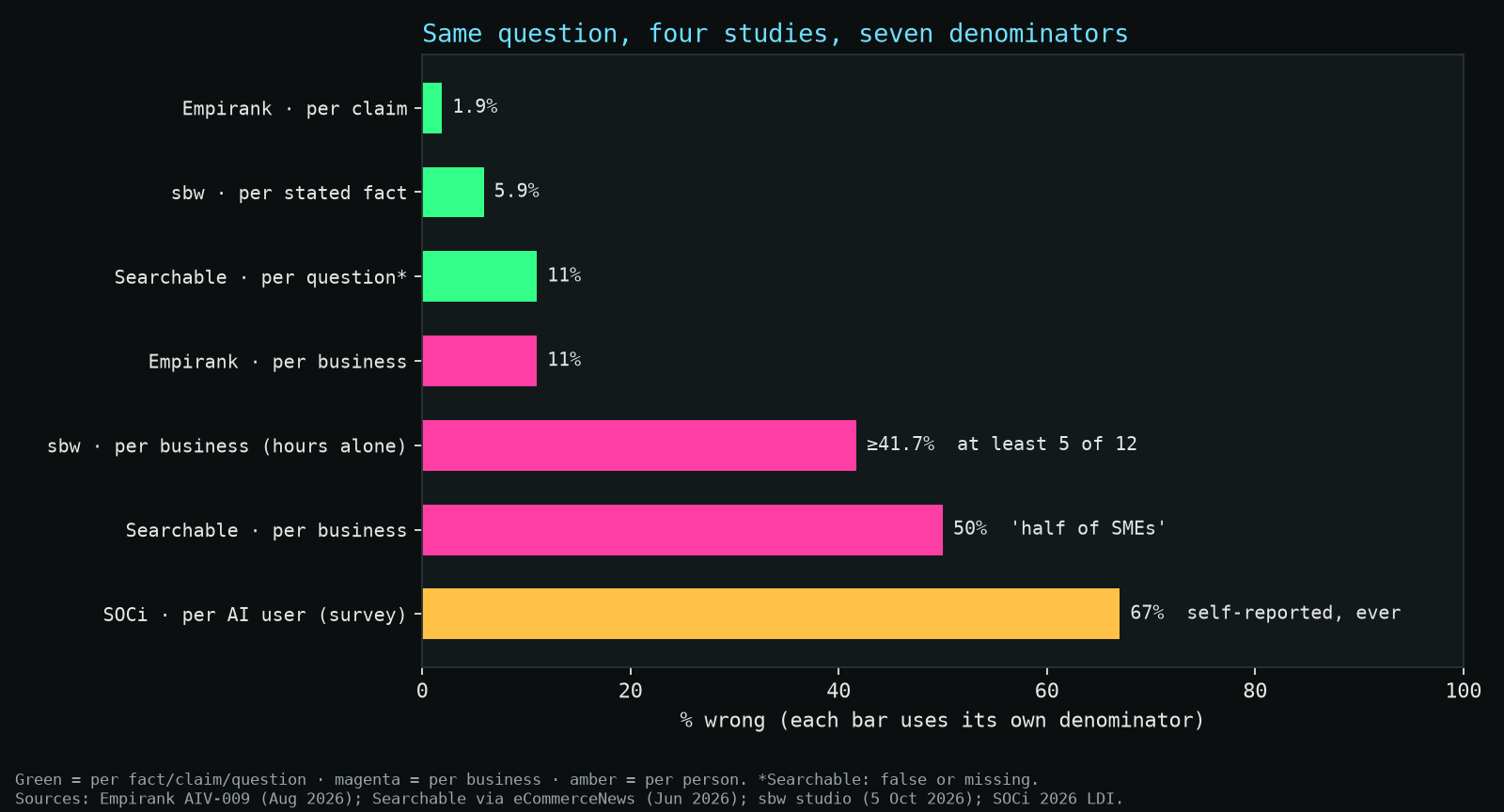
Two of these figures look scary and aren't comparable to the others. Searchable counts "incomplete" as inaccurate, which is a listing that names at least 30% fewer of a firm's services [3]. That's a missing-information problem, not a made-up one. SOCi is a self-report of anything a person ever got wrong, from any assistant, at any time [6]. It tells you how many people have run into the problem, not how often it happens.
Why per-claim and per-business rates never match
The gap comes down to arithmetic. If every claim had the same small chance of being wrong, the share of businesses with at least one bad claim grows with the number of claims per business:
def share_of_businesses_hit(p_claim_wrong: float, claims_per_business: float) -> float:
    # assumes errors are independent across claims
    return 1 - (1 - p_claim_wrong) ** claims_per_business

# Empirank: 24 wrong of 1,257 claims, across 182 businesses
print(share_of_businesses_hit(24 / 1257, 1257 / 182))   # 0.125
At about 6.9 claims per business, that predicts 12.5% of businesses hit. Empirank observed 11.0%, close enough that the independence assumption roughly holds in that sample. The sbw numbers break it. At 5.9% per fact and about 20 stated facts per business, independence predicts about 70% of businesses with an error. Errors hit at least 5 of 12 businesses (hours alone); sbw doesn't publish the per-business total. The 7 of 12 figure is site and listing-profile disagreement, not businesses with an error. The errors still cluster in one field instead of spreading out. That's my arithmetic on their published counts, not a test I ran.
Hours are the field that breaks
In the sbw test, addresses and phone numbers were never wrong across four assistants. Every wrong fact was about opening hours, Saturday hours or services [4]. Seven of the 12 businesses had a website and a listing profile that disagreed on at least one detail, usually hours [5].
Which number to quote
For owners: quote a per-business rate with its study and date, such as "In Empirank's August 2026 audit, 20 of 182 recommended businesses had at least one wrong claim." That's the risk of your business being the one an assistant gets wrong.
For engineers: quote per-claim or per-fact rates, and say whether unsupported claims count. Empirank left its 479 unsupported claims (38.1%) out of the 1.9%, and adding them would push the rate to about 40% [2].
Don't chart all four on one axis without saying so, or use SOCi's 67% as an error rate.
Sector pieces
- Healthcare: "Do you take my insurance?"
- Retail & e-commerce: Price, stock and returns
The free AI listing audit asks the same questions about your own business and marks each answer right, wrong or missing: AI listing audit.
References
- Empirank, "Local business recommendation accuracy study (one AI assistant)", Aug 18, 2026. Empirank, Local business recommendation accuracy study
- PPC Land, "1 in 9 businesses an AI assistant recommended carried a wrong claim, audit finds", Aug 2026. PPC Land, 1 in 9 businesses an AI assistant recommended
- eCommerceNews, "London SMEs suffer AI misinformation in search tests", Jun 25, 2026. https://ecommercenews.uk/story/london-smes-suffer-ai-misinformation-in-search-tests
- sbw studio, "When an AI assistant gets your business wrong", updated Nov 2, 2026. sbw studio, When an AI assistant gets your business wrong
- sbw studio, "How AI picks local businesses: 733 answers", Oct 2026. https://score.sbw.studio/findings/
- SOCi, "2026 Local Discovery Index" (PDF). https://golocal.soci.ai/rs/355-TUF-572/images/2026_LDI.pdf