
For dental practice owners and managers: in one Sep 2026 study of 600 small businesses, 20% to 27% of AI answers stated a fact the business never published.
2026-11-21T08:32:48.357942Z
By Av Ledger, Enterprise ROI Desk, roiscale.ai
Summary: the article in four points
- In one Sep 2026 study of 600 small businesses, 200 of them dental practices, one AI assistant got a fact wrong in 20% of answers and a search engine's AI answers in 27%. The rate is blended across sectors.
- The insurance error is manufactured from silence: when a practice writes "most major plans," the engines fill in a carrier list from third-party directories 80% to 88% of the time.
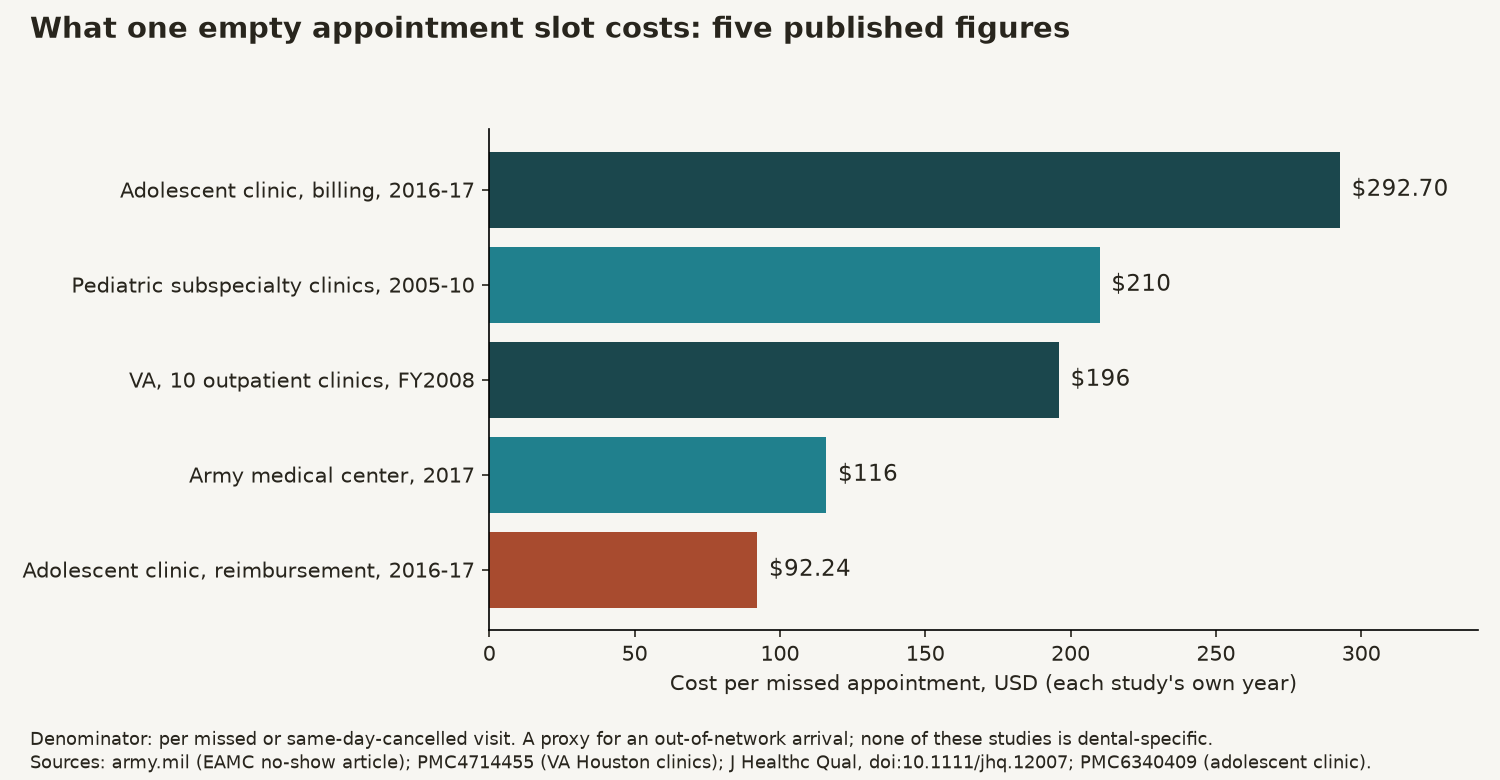
- Each wrong answer that turns into a booking can cost a chair slot. Four published no-show studies, giving five figures, put an empty slot at $92 to $293, a historical proxy we label as such.
- The fix costs staff time, not media spend: name your carriers, correct four directories, and check both engines monthly. In Herringbone's Sep 2026 study, clear publishers reached 84% to 89% accuracy.
An AI answer that says your practice takes a patient's plan is not a marketing problem. It is a scheduling-loss problem with a published unit cost. The error is mostly self-inflicted: practices that do not name their carriers leave a gap, and the engines fill it from directories nobody at the practice maintains. The owner of this line is the practice manager, not the marketing agency.
| AI ANSWERS WITH AN UNPUBLISHED FACT | FILLED IN WHEN THE SITE WAS VAGUE | PATIENTS WHO DON'T VERIFY | COST OF AN EMPTY SLOT |
|---|---|---|---|
| 20% to 27% (600 businesses, Herringbone, Sep 2026, blended) | 80% to 88% (same study) | 60% of 465 AI users (rater8 survey, vendor, Jun 2026) | $92 to $293 per missed visit (5 figures from 4 no-show studies, proxy) |
What the published rate covers
Herringbone, a digital marketing agency, tested 600 small businesses in September 2026: 200 dental and orthodontic practices, 200 personal injury firms and 200 home service companies [1]. It asked two engines the questions a new client asks first, including "do you take my insurance?", graded 1,200 answers against each business's own website, and checked 601 by hand. Twenty percent of one AI assistant's answers and 27% of a search engine's AI answers contained a fact the business does not publish.
The denominator matters. That is a per-answer rate, blended across three sectors. The study publishes no dental-only figure, so no dental-only figure appears here. It is also a vendor study, and the agency sells the audit it recommends. Treat the rate as the best public number, not a settled benchmark.
Patients act on these answers. In a rater8 patient survey reported in June 2026, 66% of 465 people who had used AI to research a provider said they had met wrong details, including insurance, and 60% said they trust AI summaries without checking [2]. That is self-reported experience from a vendor survey, not measured error.
The mechanism: the gap gets filled from a directory
Nearly every practice writes some version of "we accept most major insurance plans" and names none. The sentence is accurate and legally careful. It also leaves the one fact the patient needs unanswered.
The engines answer anyway. Where a business's site was vague, the search engine's AI answers filled in specifics 88% of the time and stated them as fact, naming no source, 80% of the time. The AI assistant filled in specifics 80% of the time but named its source in most cases: only 10% went unattributed [1]. The carrier lists came from Sharecare, WebMD, the ADA's find-a-dentist tool and an insurer's own directory, all listings the practices had never claimed.
The study also found multi-location groups exposed in a specific way: one location's insurance list applied to another, including plans that location explicitly does not accept [1]. For a dental service organization, that is not a listing error. It is a network-status error on every location the engine conflates.
Before and after: what one wrong answer costs
A patient books on the strength of the answer, arrives, and learns the practice is out of network. The practice loses the slot if the patient leaves, and loses front-desk time either way. No study has published the cost of that event. The closest published unit cost is a missed appointment, and we use it as a labelled proxy.
| Line item | Silent on carriers | Carriers named, directories corrected |
|---|---|---|
| Answers matching what the practice publishes | 73% for the AI assistant (vague or silent publishers) [1] | 84% search engine, 89% AI assistant (clear publishers) [1] |
| Source of the carrier list a patient sees | Third-party directory | The practice's own page |
| Cost of a wrong answer that becomes a booking | $92 to $293 per slot (5 figures from 4 no-show studies, proxy) [3]-[6] | Same unit cost, fewer events |
| Cost of the fix | Nil | Staff time; under an hour for the first three steps, the agency's own estimate [1] |
We do not multiply these into a per-practice loss. No public source says how often a wrong carrier answer becomes a booking, and inventing that conversion rate would turn a proxy into a forecast. Run the numbers on your own book instead: new-patient bookings per month, times the share of those patients who found you through an AI answer, times the share of those AI-found patients who arrived out of network, times your cost per empty slot. Measure the third input inside the AI-found group, not across your whole book, because the two shares may move together. Treat the result as a ceiling, not a loss: some out-of-network patients pay out of pocket and some slots get refilled. Your scheduling system holds three of the four inputs.
The risk
Three gaps remain open. There is no published dental-only error rate for insurance answers. There is no published cost of an out-of-network arrival, only the no-show proxy, and the newest of those studies is from 2016 to 2017. No published ruling binds a practice to what a third-party assistant says about it. The engines also change: the study notes the same question can return a different answer next month, so one check is not a control.
The decision
This is not a visibility budget question. It is a front-desk control with a known unit cost. The practice manager owns it. Three actions:
- Name every accepted carrier, by location, on the practice's own pages, and date the list.
- Correct the four directories the study traced, before rewriting site copy.
- Ask both engines "do you take [plan]?" for your top five plans every month, and log the answers.
The shared findings behind this release, including why the published audits disagree, are in Rex Circuit's overview.
What we sell
roiscale.ai's free AI listing audit kit, linked below this article, has a healthcare pack built for this article: the “do you take my plan?” questions, including a plan you do not accept and, for groups, a plan only another location takes, a shared answer log, a corrections tracker, and the four-input worksheet above as a fill-in sheet.
The Takeaway
- Number: 20% to 27% of AI answers in one blended Sep 2026 study stated a fact the business never published; an empty slot costs $92 to $293 across five figures from four published no-show studies, a historical proxy.
- Mechanism: "Most major plans" leaves a gap, and the engines fill it from directories the practice never claimed.
- Risk: No dental-only rate, no published cost of an out-of-network arrival, and answers that change month to month. Measure your own.
Sources
- Herringbone Labs, study of AI answers about 600 small businesses, Sep 14, 2026. herringbone.com
- TechTarget, "Almost half of patients use AI for online provider search" (rater8 survey), Jun 3, 2026. techtarget.com
- U.S. Army, "'No-show' appointments cost EAMC $3.8M last year" (2017 data). army.mil
- "Prevalence, predictors and economic consequences of no-shows" (VA clinics, FY1997 to 2008). PMC4714455
- "Characteristics and Direct Costs of Academic Pediatric Subspecialty Outpatient No-Show Events," Journal for Healthcare Quality, Mar 29, 2013. doi.org
- "Prevalence, Predictors, and the Financial Impact of Missed Appointments in an Academic Adolescent Clinic" (Nov 2016 to Oct 2017). PMC6340409