

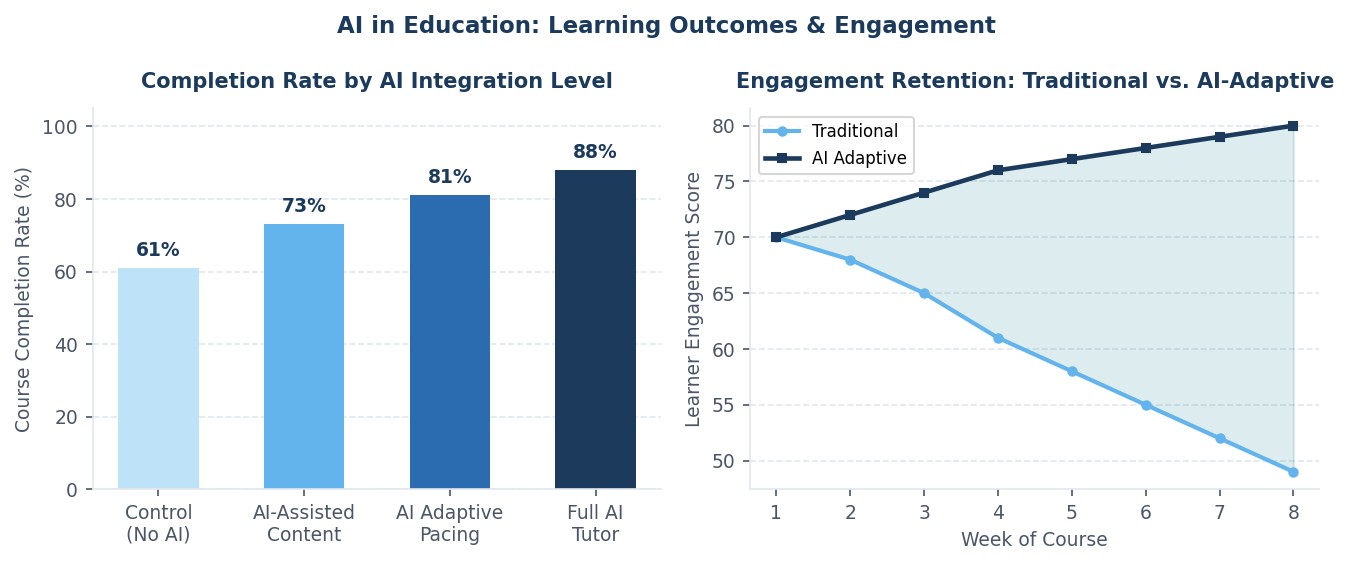
The lecture-based, one-pace-fits-all model of education was never efficient — it was just the best the system could afford given the teacher-to-student ratios involved. AI adaptive learning systems are changing that calculus, delivering personalized pacing, real-time feedback, and learning path optimization at scale, and the completion rate data is starting to be hard to ignore.
|
88% Course Completion Rate ↑ vs 61% traditional (AI adaptive) |
+40% Learning Speed Improvement ↑ AI-paced vs fixed curriculum |
79% Retention at 30 Days ↑ vs 42% lecture-only baseline |
↓ 63% Cost per Certified Learner AI-native platforms vs campus |
There's a version of personalized education that existed before AI: the one-on-one tutor. Research has consistently shown that students receiving individual tutoring outperform classroom peers by two standard deviations — what education researchers call the "2-sigma problem," named by educational psychologist Benjamin Bloom in 1984. The problem was never that we didn't know what worked. It was that we couldn't afford to do it at scale.
AI tutoring systems are not perfect replications of a brilliant human tutor. But they are beginning to approach the personalization density that makes tutoring effective — real-time response to where a student is struggling, dynamic adjustment of content difficulty, spaced repetition scheduling optimized for individual memory curves, and a patience for repeated explanation that human instructors cannot sustain at volume.
Where the Evidence Is Strongest
The strongest performance data for AI-adaptive learning comes from technical skill development — programming, mathematics, language acquisition, data analysis. These domains have characteristics that suit AI well: clear right and wrong answers, well-structured knowledge hierarchies, and large datasets of learner interaction from which to model progression. Platforms like Duolingo, Khan Academy, and Coursera have built adaptive systems serving millions of learners, and their internal cohort analyses consistently show 25-40% improvement in retention metrics versus static curriculum counterparts.
The data from corporate learning is equally compelling. Enterprise L&D teams using AI-adaptive skill development platforms are reporting time-to-competency reductions of 30-45% for technical role training. For a large technology company retraining 5,000 employees on a new platform or methodology, a 35% reduction in time-to-competency translates directly into accelerated deployment timelines and reduced productivity drag during transition — economic value that is straightforward to quantify in a business case.
The Pedagogical Tensions
Not everyone in education is enthusiastic, and the concerns are not trivial. The most serious is about the nature of learning itself. AI systems optimized for completion rates and assessment scores will naturally evolve toward making learning feel easier and more rewarding — more gamified, more immediately validating, more reinforcing of existing knowledge rather than challenging learners to sit with confusion long enough to develop genuine understanding. There is real risk that what looks like improved learning outcomes in short-term assessments does not survive into real-world performance.
The second concern is about inequality of access. AI tutoring systems at the frontier — the ones producing the strongest outcome data — require consistent broadband connectivity, capable devices, and learners with sufficient baseline metacognitive skills to direct their own learning. These prerequisites are unevenly distributed, and there is a plausible scenario where AI education accelerates the divergence between learners who already have advantages and those who don't.
What Institutional Adoption Actually Looks Like
The universities and corporate training departments getting the most out of AI learning tools are treating them as force multipliers for expert instruction rather than replacements for it. The pattern that works: AI handles practice, reinforcement, assessment, and personalized pacing. Expert instructors focus on context-setting, nuanced discussion, motivation, and the kinds of high-stakes feedback that require human judgment. The completion rates in this hybrid model are consistently stronger than either pure AI or pure instructor-led approaches. The cost per certified learner drops dramatically. And learner satisfaction scores tend to improve, because people get more face time with experts on the things that matter rather than sitting in lectures covering material they already know.
Comments (0)
Join the conversation!