
AI is collapsing early-stage drug discovery timelines from years to weeks, enabling small biotech teams to run target identification, molecule generation, and preliminary trial design with tools accessible to anyone willing to learn. The six-month pre-clinical research phase that once required a full wet lab is increasingly a laptop problem.
|
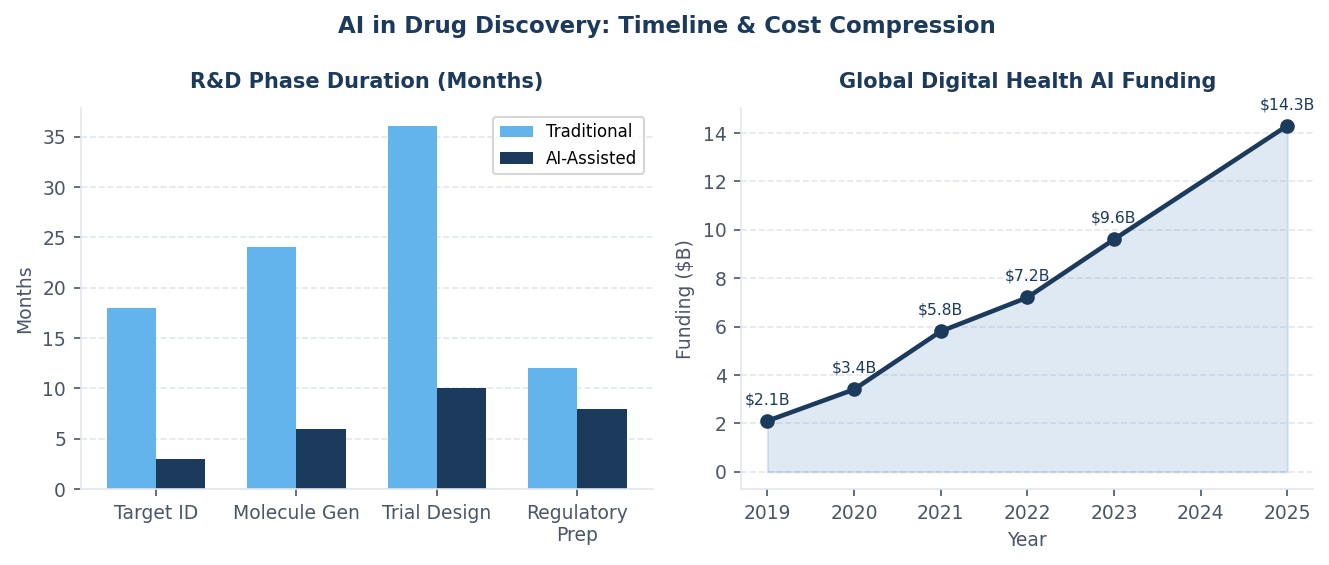
~83% Early R&D Time Saved ↓ 18 mo → 3 mo (target ID) |
10,000s Candidate Molecules ↑ generated per AI run vs dozens |
$14.3B AI Drug Discovery Funding ↑ 581% since 2019 |
4 Successful AI-Initiated Trials ↑ Phase II completions (2025) |
Two people. A weekend. A short list of candidate molecules for a rare autoimmune target that would have taken a team of six the better part of six months to produce through conventional literature review and wet-lab hypothesis generation. That's what a small biotech team I spoke with demonstrated last year using nothing more than a foundation model fine-tuned on PubChem data, a protein structure predictor, and a docking simulation tool they ran on a cloud GPU rental.
The pharmaceutical industry has spent decades building fortress-like walls around early-stage research — specialized instruments, deep institutional knowledge, libraries of proprietary compound data. AI is not exactly tearing those walls down, but it is building very effective ladders over them. And the people climbing those ladders first are not the big pharma incumbents.
The Compression of Early Research
Classical drug discovery follows a sequence that hasn't fundamentally changed in decades. You identify a biological target — usually a protein involved in disease pathology. You screen compound libraries to find something that binds to it. You optimize for binding affinity, selectivity, and pharmacokinetic properties. You run toxicity assays. Then, if everything holds, you enter pre-clinical animal studies before even thinking about a human trial. The first three phases of that sequence routinely take five to seven years.
AI interrupts this at the target identification and hit generation stages most dramatically. Large language models trained on biomedical literature can synthesize thousands of papers to generate ranked hypotheses about disease mechanisms — work that previously required a specialist team doing manual literature review over months. AlphaFold and its successors have effectively solved the protein structure prediction problem for most common proteins, removing a major experimental bottleneck. Generative models can now produce novel molecular candidates de novo, not by screening what already exists but by designing new chemical entities optimized for specific properties.
What a Two-Person Proof of Concept Looks Like
The weekend experiment described earlier followed a structured workflow that any technically literate team can now replicate. Day one: use a biomedical LLM to survey the literature on the target, generate ranked hypotheses about binding mechanisms, and shortlist candidate protein pockets. Day two: run AlphaFold or ESMFold to validate structure predictions, generate 2,000 candidate molecules using a diffusion-based molecular generation model, and score them against binding affinity predictors. By Sunday evening, a ranked list of 50 candidates with preliminary ADMET (absorption, distribution, metabolism, excretion, toxicity) predictions exists on a spreadsheet.
None of this replaces wet-lab validation. The candidates still need to be synthesized and tested. But the value is not in replacing the lab — it's in entering the lab with a far better-informed shortlist, reducing the experimental cycles required to find a viable lead compound. Rock Health's 2025 funding data shows that early-stage biotech startups using AI-first research workflows are raising at earlier stages and with smaller team sizes than their predecessors, suggesting the market has started to price in the efficiency differential.
Where the Real Opportunity Sits
The most underserved area in this space isn't cancer or cardiovascular disease, where everyone is pointing their models. It's rare diseases — conditions affecting fewer than 200,000 patients in the US — where traditional economics make drug development commercially unviable at conventional costs. AI fundamentally shifts that calculus. If you can compress the pre-clinical research phase from 18 months to 3 months with a team of three rather than thirty, you open up disease targets that were previously economically inaccessible.
Several biotech startups are already building explicitly around this thesis, targeting rare genetic disorders, neglected tropical diseases, and pediatric conditions with AI-native research pipelines. The early results are promising enough that established players are starting to acquire rather than compete — a sign that the moat is real, even if it's not yet clear exactly where it runs.
Comments (0)
Join the conversation!