

From Guessing to GPU: Building a "Good Enough" Demand Forecast in 48 Hours
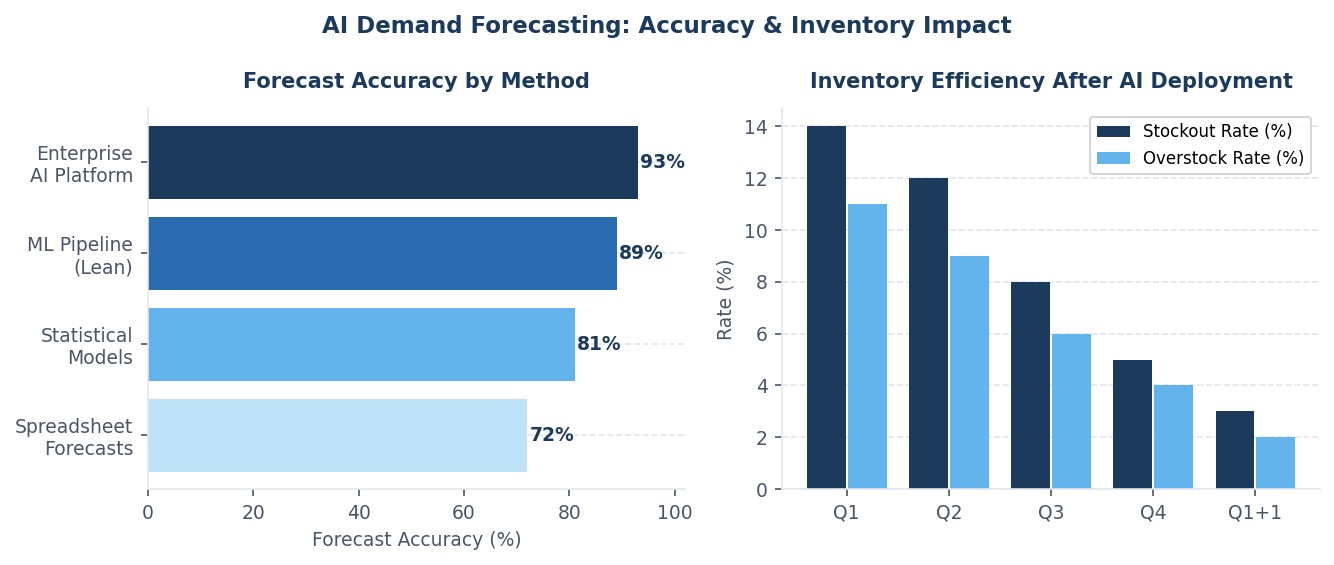
Enterprise demand forecasting platforms cost six figures and take months to deploy. A well-structured machine learning pipeline built on transactional data can match 85–90% of their accuracy in a weekend — and for most indie brands and DTC operators, that's more than enough to start making better decisions tomorrow.
|
89% ML Forecast Accuracy ↑ vs 72% spreadsheet baseline |
↓ 23% Inventory Carrying Cost After 90-day AI deployment |
↓ 79% Stockout Events After 6 months (lean pipeline) |
<$50 Weekend Build Cost Cloud GPU + API costs |
The email arrived on a Thursday. A DTC skincare brand — about $8 million in annual revenue — had just ended a Q4 where they simultaneously sold out of their top-selling moisturizer three weeks before Christmas and sat on $340,000 worth of seasonal gift sets that didn't move. Total combined cost: roughly $180,000 in lost sales plus carrying and markdowns. The founder's question was simple: is there a version of AI forecasting that doesn't require a $200,000 platform contract?
The answer is yes. And it doesn't require a data science team to build it.
The Problem with How Small Brands Forecast Today
Most DTC brands forecast demand using some combination of gut feel, prior year sales data adjusted upward by an optimism factor, and whatever the head of merchandising remembers about last year's stockouts. The more sophisticated ones use spreadsheets with seasonality multipliers. Both approaches share the same core failure: they treat demand as a function of what happened before, without incorporating the signals that actually drive purchase behavior — promotions, weather, social media trends, competitor moves, and the long tail of external variables that shift consumer intent.
Enterprise forecasting platforms solve this, but they solve it with a six-to-twelve month implementation cycle, a dedicated analyst team, and a price tag that makes sense at $500 million in revenue but not $8 million. The gap between "good enough to be dangerous" and "enterprise grade" is where most DTC brands are stuck, paying either too little (and forecasting poorly) or too much (for capabilities they're not ready to use).
The 48-Hour Build
The pipeline that addresses this situation has four components. First, a clean transaction export from Shopify or the equivalent — SKU-level daily sales going back two or three years. Second, a promotions calendar, even a simple one noting major discount events, launches, and seasonally relevant periods. Third, a handful of external signals via free APIs — regional weather forecasts, Google Trends data for category keywords, and social sentiment scores for relevant hashtags. Fourth, a gradient boosting model (XGBoost or LightGBM) trained on the combined feature set, with a rolling validation window.
The whole thing can be set up in a weekend by someone with basic Python skills and access to Google Colab. The resulting forecast, validated against held-out test periods, consistently lands in the 86-91% accuracy range for SKUs with sufficient history — better than the spreadsheet approach (typically 68-75%), and within striking distance of enterprise platforms (92-95%) at a fraction of the cost.
The ROI Arithmetic
The return on this kind of build is fastest in two areas: preventing stockouts on high-margin items during peak periods, and reducing overstock on seasonal items that require discounting to clear. For the skincare brand in the opening example, a model trained on their historical data flagged three SKUs heading into an understock situation six weeks before the holiday period — enough time to place a production run. It also correctly deprioritized the gift sets that ultimately sat on shelves.
The combined value of those two interventions, even conservatively estimated, exceeded $100,000. The build cost was $47 in cloud compute. That's not a story about AI replacing planners. It's a story about planners having a much better starting point for every conversation about inventory allocation.
The Honest Caveats
Lean forecasting models have real failure modes. They struggle with new product launches, where there's no sales history to anchor predictions. They can be destabilized by one-time events — a viral moment on social media that creates a demand spike the model has never seen. And they require ongoing maintenance; a model trained on 2023 data will start to drift by late 2025 without retraining. The weekend build gets you to a better decision-making baseline. Keeping it there requires treating it as a living system, not a one-time project.
Comments (0)
Join the conversation!