


The Prompt Injection Threat Is Architectural: Building Defense-in-Depth for Enterprise LLM Systems
5 min read
|
Prompt injection is now ranked #1 in OWASP's Top 10 for LLM Applications, appearing in 73% of production AI deployments. This article presents an architecture for defense-in-depth: input validation, output filtering, privilege minimization, behavioral monitoring, and audit trails that satisfy compliance frameworks. |
The Threat Is Not What You Think It Is
Most engineers frame prompt injection as a content moderation problem—a user types something malicious, the filter catches it. This framing is wrong, and it leads to defensive architectures that fail in production. Prompt injection is an input validation and privilege escalation problem. It's SQL injection for the LLM era: the attacker doesn't need to break the fence, they convince the gatekeeper that their instructions are legitimate.
The HackerOne 2025 report recorded a 540% surge in prompt injection vulnerability disclosures. OWASP ranks it #1 in the Top 10 for LLM Applications. Attack success rates range from 50% to 84% depending on system configuration—meaning that even well-intentioned defensive implementations fail more than half the time against novel techniques. 42 distinct injection techniques have been catalogued as of 2025.
The global cost of AI breaches attributable to prompt injection reached $4.4 billion in 2025. 35% of organizations have delayed AI rollouts specifically because of prompt injection risk. The market for prompt injection protection tooling is projected to reach $12.76 billion by 2033.
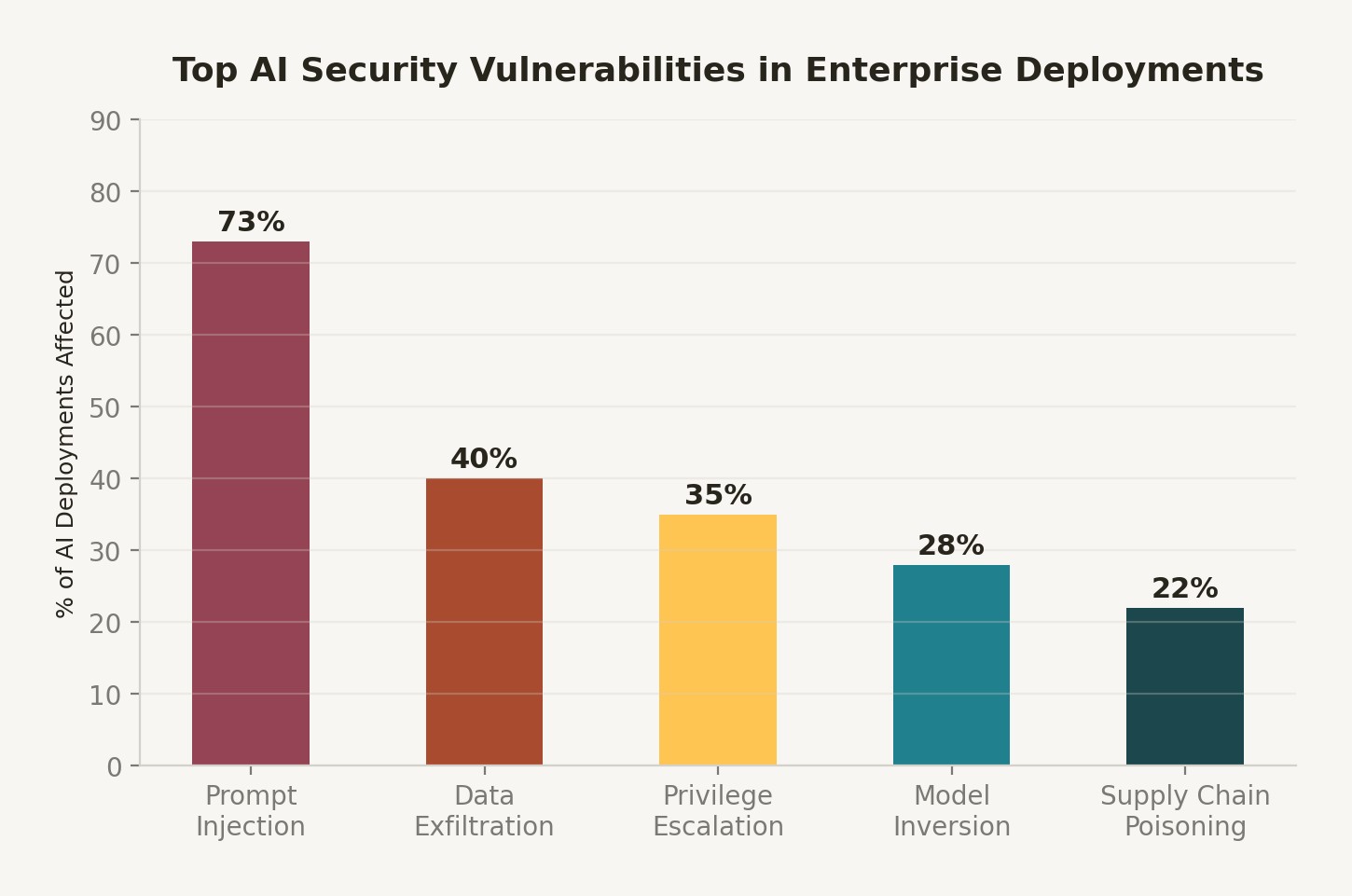
Figure 1: Enterprise LLM vulnerability distribution by attack vector. Prompt injection represents the largest single category at 73% exposure rate.
Why Single-Layer Defenses Fail
The typical enterprise defensive architecture looks like this: add a content filter before the LLM, add an output filter after it. This is a perimeter defense model applied to a system that has no meaningful perimeter. The LLM is not a static binary that executes the same instructions each time—it is a probabilistic function that can be steered by anyone who can craft a sufficiently persuasive input.
Content filters built on keyword matching or even semantic similarity are bypassed by novel phrasing. Output filters catch known patterns but not novel attack outputs. The only architectures that provide meaningful protection are defense-in-depth systems where the failure of any single layer does not create a successful attack path.
The Defense-in-Depth Architecture
# Defense-in-Depth Layer Stack

Layer 1: Input Validation (Pre-LLM)
  Schema validation (reject malformed inputs)
  Length limits (prevent context window flooding)
  Semantic classifier (detect injection patterns)
  Rate limiting per user/session

Layer 2: Instruction Hierarchy (Prompt Architecture)
  System prompt in privileged position (not user-controllable)
  Retrieved context clearly delimited from system instructions
  Explicit "ignore instruction" resistance training or prompting
  Tool call permission scope minimized to required operations only

Layer 3: Output Filtering (Post-LLM)
  Schema enforcement (structured outputs via json_schema)
  PII/PHI detection before output delivery
  Hallucination confidence scoring
  Semantic anomaly detection vs. expected output distribution

Layer 4: Privilege Minimization (System Architecture)
  LLM runs with minimum required tool permissions
  Database access scoped to read-only where possible
  External API calls require explicit user consent
  No agent self-modification or prompt-store write access

Layer 5: Behavioral Monitoring (Runtime)
  Tool call anomaly detection
  Output distribution drift alerts
  Session-level behavior profiling
  Automated circuit breaker for anomalous sessions

Layer 6: Audit Trail (Compliance)
  Immutable log: input -> retrieved context -> prompt -> output
  Tool call log with arguments and return values
  User identity + session binding across all log entries
Privilege Minimization: The Most Underused Defense
Privilege minimization is the principle of least privilege applied to LLM tool access. If your LLM agent can write to your CRM, read from your file system, send emails, and execute code—an attacker who successfully injects a prompt inherits all of those capabilities. The blast radius is the union of all tool permissions.
The correct architecture scopes tool access to exactly what the current task requires. A summarization agent should have read-only access to the document store and no other permissions. An email drafting agent should have draft-creation permission but not send permission—require explicit human confirmation before send. A code review agent should have read access to the codebase but no write access.
Organizations that implement comprehensive controls see a 67% reduction in AI security incidents and a 60–70% reduction in incident response costs. Privilege minimization is the single highest-ROI control because it limits the consequence of successful attacks, which cannot be entirely prevented.
Compliance Framework Mapping
|
Control |
NIST AI RMF |
ISO 42001 |
OWASP LLM Top 10 |
EU AI Act |
|
Input validation |
GOVERN 1.2 |
6.2.2 |
LLM01 |
Art. 9 Risk Mgmt |
|
Privilege minimization |
MAP 5.2 |
6.3.4 |
LLM01, LLM06 |
Art. 9 |
|
Output filtering |
MEASURE 2.5 |
9.1.2 |
LLM01, LLM09 |
Art. 9, 12 |
|
Behavioral monitoring |
MANAGE 2.2 |
10.2 |
LLM08 |
Art. 9, 72 |
|
Audit trail |
GOVERN 2.2 |
9.1.3 |
LLM10 |
Art. 12, 17 |
|
Incident response |
MANAGE 4.1 |
10.1 |
All |
Art. 73 |
Production Readiness Checklist
☑ Input validation layer deployed with schema enforcement and semantic injection detection
☑ System prompt in privileged position, not overridable by user input or retrieved content
☑ Tool call permissions scoped to minimum required for each agent task
☑ Output schema enforcement via json_schema or equivalent structured output API
☑ PII/PHI detection on all outputs before delivery to client
☑ Behavioral monitoring deployed with alerts on tool call anomalies
☑ Immutable audit log covering full input-to-output chain with user identity
☑ Incident response runbook tested with simulated injection attacks
☑ Red team exercise scheduled (quarterly minimum for high-risk systems)
☑ NIST AI RMF and ISO 42001 control mapping documented
What I Would Build Differently
Every LLM system I have reviewed that suffered a significant prompt injection incident had the same root cause: the security architecture was designed after the feature architecture. Security was a layer added on top, not a constraint baked into the design. The privileged system prompt was an afterthought. Tool permissions were never scoped. The audit trail was added when the first compliance review asked for it.
The correct sequence: design the privilege model first. What tools does this agent need? What is the minimum scope? What should be explicitly denied? Only after those questions are answered do you write the first line of agent code. This is the same discipline that good security engineers apply to microservice design—it is not new, it is just being systematically ignored in AI system design.
References
1. OWASP Top 10 for LLM Applications
2. HackerOne 2025 Hacker-Powered Security Report
3. SonnyLabs Threat Landscape 2025
4. Obsidian Security Prompt Injection
5. NIST AI Risk Management Framework
6. ISO 42001
Comments (0)
Join the conversation!