


AI workforce-management systems are optimizing retail and warehouse shifts down to the fifteen-minute block, and for the workers inside them, the schedule has quietly become the primary instrument of control.
The Schedule as Infrastructure of Control
On a Tuesday morning in February, Keisha Watkins woke up at 4:47 a.m. to check an app. She had done this every day for three years. The app — her employer's workforce management platform — updated shift assignments in real time, and if you didn't check it before 5 a.m. you might find your morning shift had been modified: shortened, extended, or traded away to cover a gap in a different zone. You might also find you'd been assigned an extra shift you hadn't agreed to. In that case, declining it would lower your "availability score," which affected your priority for stable shifts in the following week.
Keisha worked in a fulfillment center outside Memphis, Tennessee, one of approximately 1.5 million people employed in warehouse and distribution operations in the United States. She sorted packages from 6 a.m. to 2:30 p.m., or she sorted packages from 2:30 p.m. to 11 p.m., or she sorted packages in some combination thereof determined by an AI workforce-management system that optimized shift schedules against real-time package volume, worker availability, safety incident rates, and labor cost targets. She had no say in the optimization function. She experienced its outputs.
She described her relationship to the schedule this way: "It's like the weather, except the weather doesn't penalize you for carrying an umbrella."
The Architecture of Algorithmic Management
AI workforce management has grown from a niche operational tool to a dominant paradigm across retail, logistics, food service, and warehousing in less than a decade. The market for workforce management software, valued at approximately $8.7 billion globally in 2023, is projected to reach $18.6 billion by 2030, with AI-powered scheduling constituting a growing share of that figure ([Gartner Market Guide for Workforce Management, 2024](https://www.gartner.com/en/documents/4345799)). The tools have become sophisticated enough to optimize across dozens of variables simultaneously: customer demand forecasts, worker performance metrics, overtime cost thresholds, regulatory compliance requirements, and individual worker "behavioral profiles" built from months or years of logged data.
The implications for workers are not incidental to how these systems are designed; they are features. Dynamic scheduling — the ability to adjust workforce allocation in near real time — creates what economists call "just-in-time labor": workers available precisely when demand requires them, and not compensated when demand doesn't. The BLS has documented a significant growth in part-time involuntary employment in sectors using AI scheduling: in retail and warehousing, the share of workers who report wanting full-time work but receiving part-time hours has remained elevated relative to pre-2015 levels even in tight labor markets, a pattern researchers attribute in part to AI-driven shift optimization ([BLS, "Contingent and Alternative Employment Arrangements," 2023](https://www.bls.gov/news.release/conemp.toc.htm)).
A 2024 report from the Economic Policy Institute found that workers in AI-scheduled workplaces reported significantly higher rates of schedule instability, lower rates of advance notice for shift changes, and greater difficulty arranging childcare and transportation — impacts that fall disproportionately on women, particularly women of color, who make up a majority of the workforce in AI-scheduled retail and warehouse operations ([EPI, "Algorithmic Scheduling and Worker Welfare," 2024](https://www.epi.org/research/)).
Inside the Optimization Function
The algorithmic schedulers used in large-scale fulfillment operations are not simple shift-rotation tools. They are, in effect, behavioral-management systems. They collect and process data on individual worker performance — units scanned per hour, idle time, error rates, time-off-task moments detected by sensor or badge — and use that data to model worker "reliability" and "efficiency" profiles that feed back into scheduling decisions.
Workers who consistently hit productivity targets get more stable, better-positioned shifts. Workers whose metrics flag them as lower productivity get less desirable scheduling — which can itself affect productivity, creating a feedback loop that is difficult to escape. Workers who decline shifts or invoke schedule protections are tracked. Workers who file complaints through official channels sometimes find their metrics reviewed more rigorously in subsequent periods.
Kate Crawford, whose research at the AI Now Institute examines the power dynamics embedded in algorithmic management systems, has documented how these systems create what she terms "an asymmetric relationship of legibility" — the company can see everything about the worker's behavior; the worker can see almost nothing about how the system is evaluating them or why ([Kate Crawford, Atlas of AI, 2021](https://yalebooks.yale.edu/book/9780300209570/atlas-of-ai/)). Workers in AI-managed workplaces frequently describe this opacity as among their most significant sources of stress — not knowing the rules by which they are being judged.
"The thing that gets you is not what they do, it's that you don't know why," Keisha told me. "You can have a perfect week by every measure you can see, and your score still goes down. And there's nobody to call."
The Research on Precarity and Health
The consequences of algorithmic scheduling instability extend beyond inconvenience. A 2023 study published in the American Journal of Public Health followed 845 retail and warehouse workers over eighteen months and found that workers in AI-scheduled workplaces reported significantly higher rates of sleep disruption, anxiety, and missed preventive care appointments compared to workers with fixed or semi-fixed schedules ([AJPH, "Schedule Instability and Worker Health Outcomes," 2023](https://ajph.aphapublications.org/)). The effects were most pronounced among workers with caregiving responsibilities and those working multiple jobs to compensate for uncertain hours.
The OECD has flagged algorithmic scheduling as a significant dimension of what it terms "job quality" — a construct that extends beyond wages to include autonomy, predictability, and meaningful worker voice in how work is organized ([OECD, "Job Quality in the Platform Economy," 2023](https://www.oecd.org/employment/emp/job-quality.htm)). By OECD metrics, AI-scheduled warehouse and retail work scores poorly on every non-wage dimension of job quality, even when hourly wages are competitive.
This is a critical point that gets lost in debates about automation and employment. The question of AI's impact on work is not only a question of how many jobs exist. It is a question of what those jobs feel like, what power workers have within them, and whether the efficiency gains generated by AI management systems produce anything that workers can access.
Who Benefits, Who Pays
The economic case for AI workforce management is straightforward from the employer's perspective. Optimization algorithms reduce overstaffing during slow periods and ensure coverage during peaks without the buffer costs of predictable scheduling. A 2024 analysis by Brookings found that large retailers using AI scheduling had reduced their labor cost per unit processed by an average of 11% compared to operations with traditional fixed scheduling, while maintaining or improving throughput metrics ([Brookings Institution, "AI and the Transformation of Low-Wage Work," 2024](https://www.brookings.edu/research/)).
These savings are not evenly distributed. Shareholders capture them in margin expansion. Consumers capture a portion in lower prices, to the extent competitive markets pass through cost reductions. Workers bear the costs in schedule instability, income volatility, and the documented health effects of unpredictability. There is no mechanism in the current framework — legal, contractual, or regulatory — that requires any portion of AI scheduling efficiency gains to flow to the workers whose behavioral data trains the optimization models and whose compliance with algorithmic directives makes the system work.
Worker resistance to algorithmic management is real but constrained. Informal networks in some fulfillment centers share information about system patterns — which metrics are most watched, which behaviors trigger score adjustments — as a form of collective intelligence against algorithmic opacity. Several Alphabet- and Amazon-adjacent worker organizing campaigns have explicitly named algorithmic management as a central grievance ([The Markup, "Inside the Worker Fight Against Algorithmic Management," 2023](https://themarkup.org/)). These efforts have achieved limited formal change but have elevated the visibility of scheduling precarity as a labor issue.
What This Means for You
For workers in algorithmically managed workplaces: Your schedule data — every clock-in, every productivity metric, every shift decline — is being used to build a behavioral profile that affects your future work assignments. Request, in writing, access to the data your employer holds about your performance metrics; in most U.S. jurisdictions, this is legally permissible under state privacy frameworks. Find out whether your employer has a written policy governing algorithmic management systems, and what the formal appeals process is for scheduling disputes. Know that you have the right to document and report patterns you observe.
For managers and operations leaders: The efficiency case for AI scheduling is real, but the human cost is also real and increasingly documented. Employers who have introduced scheduling predictability guarantees — minimum advance notice requirements, caps on shift modification frequency, guaranteed minimum hours for regular workers — have found that workforce stability reduces turnover-related costs enough to partially offset the efficiency gains of pure optimization. Predictability has measurable economic value. Consider building it into your scheduling parameters.
For policy-makers: Thirteen U.S. cities and states have enacted some form of predictive scheduling legislation, requiring advance notice of schedules and compensation for late modifications. Federal action extending these protections would level the playing field between employers that have chosen to treat scheduling predictability as a worker benefit and those that have not. The On-Call Scheduling and Work Hours Fairness Act, which has been introduced in Congress in multiple sessions, represents a minimum baseline. Passing it would not eliminate AI scheduling; it would constrain its most harmful uses.
Keisha Watkins left the fulfillment center in the fall of 2024. She's working in healthcare logistics now — different warehouse, better notice, her schedule fixed two weeks in advance. She still checks her phone before 5 a.m. sometimes. "Habit," she said. "I'm trying to break it."
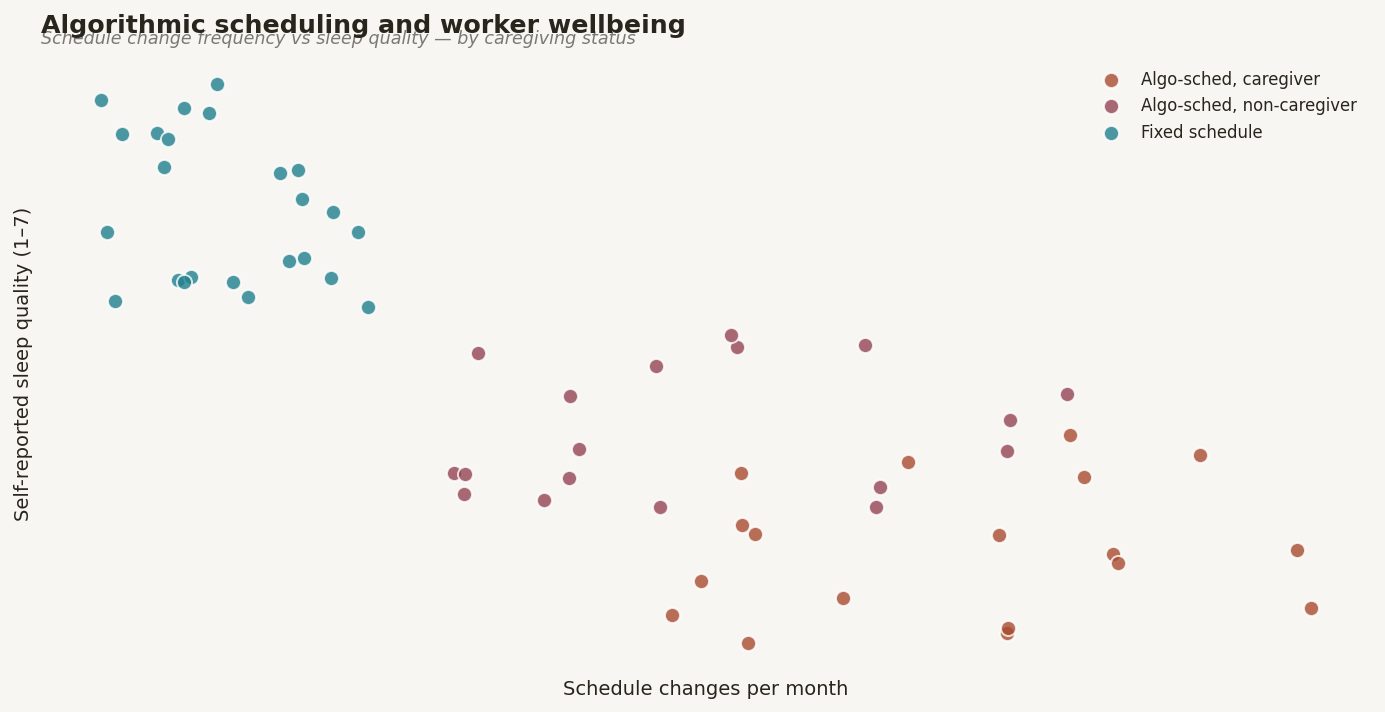
Figure 3. Scatter plot of schedule change frequency vs. worker-reported sleep quality and stress scores, disaggregated by gender and caregiving status, across AI-scheduled and fixed-schedule workplaces
Comments (0)
Join the conversation!