

|
The AI conversation in education has been dominated by pedagogical debate. This article cuts to the operational reality: the fastest and clearest returns are in administrative automation — admissions, advising triage, financial aid, and scheduling — where AI is reducing response times by 80 percent and freeing institutional capacity that can be reinvested in student outcomes. |
The Administrative Burden Higher Education Cannot Afford
Higher education institutions are caught in a painful structural bind: student-to-staff ratios have worsened, administrative workloads have grown, compliance requirements have multiplied, and tuition revenue growth has stalled. The result is an operating model under pressure from multiple directions simultaneously, with limited capacity to invest in the quality improvements that would differentiate institution outcomes.
The administrative workflows consuming the most staff capacity — admissions processing, academic advising, IT support ticketing, financial aid queries, and scheduling — share a characteristic that makes them well-suited to AI intervention: they are high-volume, rule-intensive, and their current response time performance is measured in hours or days, not minutes.
The response time data from the institutions in this study illustrates the gap. Admissions processing averaged 8.4 hours per application for manual review steps. Student advising queries averaged 2.1 hours to resolution. IT support tickets ran 4.6 hours. Financial aid queries — among the most stressful interactions for students — averaged 3.8 hours. Under AI-assisted workflows, those numbers fell to 1.2, 0.4, 0.6, and 0.5 hours respectively.
Where the Capacity Goes
The FTE capacity released by administrative AI at the institutions studied ranged from 16 percent at research universities (where administrative workflows are already more streamlined) to 41 percent at online platforms (where the ratio of administrative interactions to staff is highest). For a community college with 120 administrative FTEs, an 18 percent capacity release is equivalent to approximately 22 positions — worth $1.1–1.6 million in annual labour cost at community college compensation rates.
The majority of that released capacity in the study institutions was reinvested rather than reduced. Student success coaching — proactive, data-driven outreach to at-risk students based on early warning signals — absorbed much of the released advising capacity. This reinvestment has a financial return of its own: a one-percentage-point improvement in student retention at a 5,000-student institution is worth $750,000–$1 million in tuition revenue annually, depending on average tuition and financial aid mix.
The combined financial picture for a regional university of 15,000 students deploying comprehensive administrative AI is approximately $620,000 in direct annual cost savings (primarily from reduced administrative overtime and contractor hours) and $890,000 in avoided capacity investment — the additional staffing that would otherwise have been required to meet growing administrative demand. The implementation cost for a program of this scope typically runs $400,000–700,000, yielding a payback period of 12–18 months.
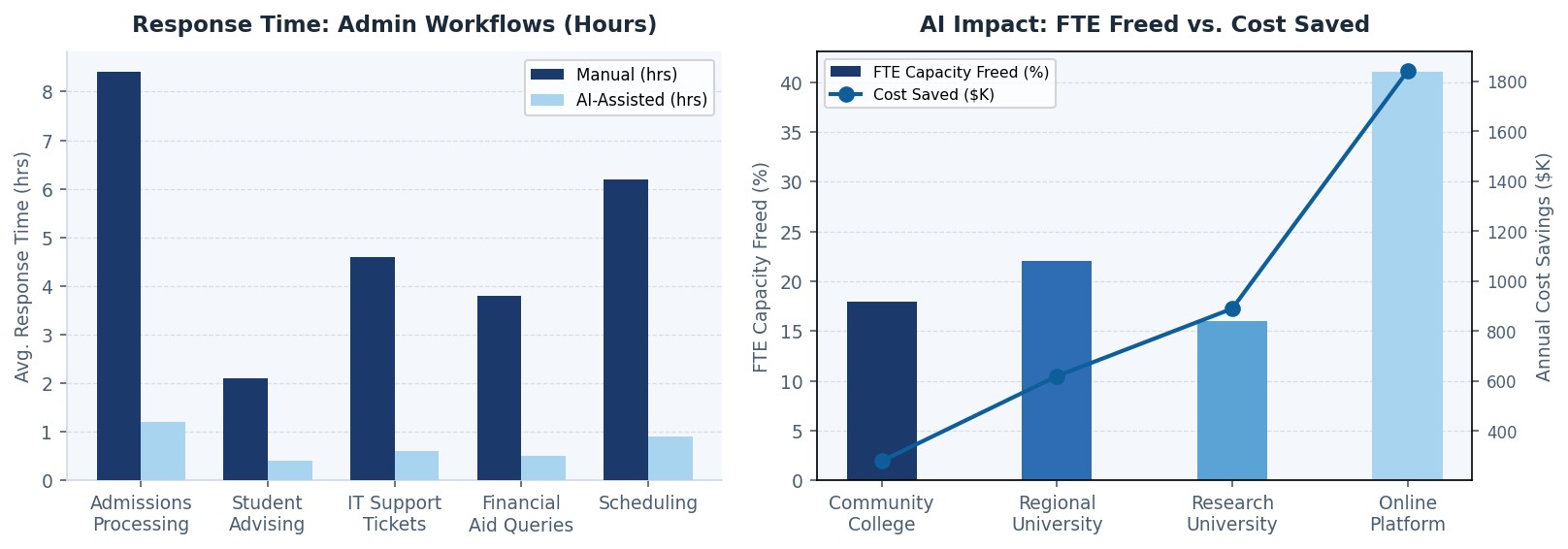
Figure 8 — Admin Workflow Response Times (Manual vs. AI) & Institutional Impact: FTE Capacity Freed and Cost Savings
The FERPA and Compliance Guardrails
Education AI deployments operate in a more constrained regulatory environment than most enterprise sectors. FERPA, HIPAA (for institutions with health services), and an increasingly assertive state-level privacy law framework require specific data handling architectures, consent management processes, and audit trail requirements that many general-purpose AI platforms do not satisfy out of the box.
The institutions in this study that achieved deployment timelines within 12 months all invested in compliance architecture upfront — working with legal counsel and privacy officers to map FERPA-covered data categories, define the AI system's data access scope, and establish explainability documentation standards that satisfy audit requirements. Institutions that tried to address compliance reactively — retrofitting controls after the technical implementation — experienced average delays of 8–14 months.
The compliance investment is not optional, but it need not be prohibitive. Purpose-built education AI platforms that were designed to FERPA standards from the ground up typically require significantly less custom compliance engineering than horizontal enterprise platforms adapted for education use. Procurement decisions that prioritise compliance architecture alongside functional capability tend to deliver faster and more financially sound outcomes.
Beyond Administration: AI in Student Support
The administrative ROI case is the clearest and fastest. But the most consequential long-term value from AI in education may come from a different application: AI-powered early warning and proactive intervention systems that identify students showing risk signals for dropout or academic difficulty before they reach a crisis point.
The data from institutions running these systems for two or more years shows retention rate improvements of 2–5 percentage points above pre-implementation baselines. At a tuition rate of $15,000 per year and a student body of 8,000, each percentage point of retention improvement is worth $1.2 million annually. The institutions that have most effectively combined administrative AI efficiency with AI-powered student success are seeing financial outcomes that extend the original ROI case dramatically — and, more importantly, are delivering better educational outcomes. The financial and mission case, in this domain, point in the same direction.
Comments (0)
Join the conversation!