
The maintenance AI was trained on twelve years of ticket logs, but it missed the thing every veteran technician knows — the sound the compressor makes the week before it fails — and what's lost when embodied expertise is excluded from industrial AI is harder to recover than the data scientists assume.
What the Logs Don't Know
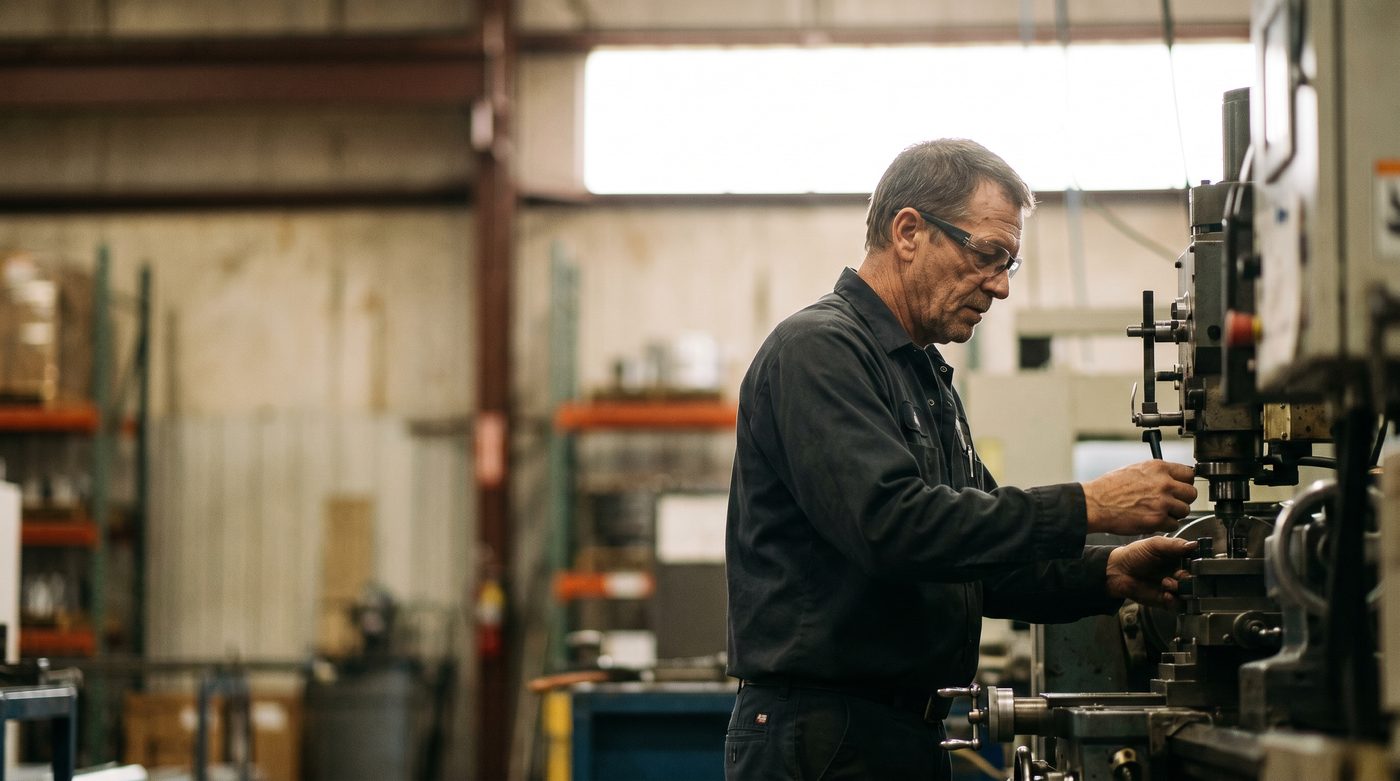
Frank Delvecchio has worked on industrial compressors for thirty-one years, most of them at a paper mill in northern Wisconsin where the air smells like sulfur and hot wood and the machinery runs seven days a week, twenty-four hours a day, in shifts that have not changed since 1987. He can tell when the primary compressor in Building C is about to fail. Not by reading a sensor. By listening.
"There's a sound," he says. "Not a warning sound. More like a change in character. The baseline tone shifts, real subtle, maybe a week before anything shows up in the vibration data." He demonstrated for me once, standing on the catwalk over the machine floor, cupping his ear toward a bank of equipment the way a doctor might press a stethoscope against a chest wall. "Right there," he said. I heard nothing. Three days later, the compressor threw an alarm.
When the mill's management information team rolled out a predictive maintenance AI in 2022, Frank was consulted twice. He answered questions about failure types, maintenance frequency, and what parameters he monitored most closely. His answers were typed into a form. He was thanked for his time. The AI was trained on twelve years of maintenance ticket logs and sensor data. It did not know the sound the compressor makes the week before it fails. Nobody had figured out how to put that in a ticket.
The Limits of Logged Knowledge
Predictive maintenance AI has matured significantly over the past decade. Systems trained on sensor telemetry — vibration, temperature, pressure, acoustic emissions from industrial microphones — have demonstrated genuine effectiveness in reducing unplanned downtime. A 2024 Deloitte survey of manufacturers deploying predictive maintenance found an average 34% reduction in unplanned equipment failures, with participating companies reporting average annual savings of $18 million at large-plant-network scale ([Deloitte, "Manufacturing AI Benchmark Report," 2024](https://www2.deloitte.com/us/en/insights/industry/manufacturing/manufacturing-ai.html)). These are real numbers. They represent real value.
They also represent a particular kind of knowledge: the kind that has been quantified, logged, and translated into a format a machine learning model can process. The question that the industry has not grappled with adequately is what happens to the knowledge that can't be quantified, logged, or translated — the knowledge that lives in Frank Delvecchio's ear.
Cognitive scientists and organizational researchers use the term "tacit knowledge" to describe the class of practical expertise that cannot be fully articulated in explicit, transferable form. The concept goes back to philosopher Michael Polanyi's observation that "we can know more than we can tell" — that expert practitioners routinely operate on a level of embodied, contextual understanding that resists codification ([Michael Polanyi, The Tacit Dimension, 1966](https://press.uchicago.edu/ucp/books/book/chicago/T/bo6035368.html)). In industrial maintenance, this tacit layer is substantial: it encompasses the sensory awareness Frank describes, but also the contextual judgment that comes from knowing a specific machine's history, its quirks, the way it behaves differently in Wisconsin winters versus August heat.
The maintenance AI at Frank's mill is, by design, limited to the knowledge that made it into the training data. Ticket logs record what failed, when, and what repair was performed. They do not record what an experienced technician noticed and acted on before the failure occurred. They do not record the sound. They don't record the judgment calls that prevented tickets from ever being written.
The Apprenticeship Gap
The second-order consequence of predictive maintenance AI is less discussed but potentially more significant: what happens to the next Frank Delvecchio?
Industrial maintenance expertise is transmitted, historically, through formal apprenticeship and informal mentorship — a junior technician working alongside a veteran, absorbing not just the explicit technical curriculum but the embodied knowledge that makes the veteran effective. This transmission takes years. It requires proximity, repetition, and a kind of attentiveness that cannot be rushed.
As AI systems take on more of the routine monitoring and anomaly detection work, they alter the conditions under which apprenticeship happens. Junior technicians who would previously have spent their early years watching gauges, taking readings, and developing an intuitive relationship with equipment behavior are now being assigned to work that sits outside the AI's scope — or to interpreting and acting on the AI's recommendations. This is a different kind of learning, and there is reason to believe it produces a different (and narrower) kind of expertise.
A 2023 report from MIT's Work of the Future documented this pattern across multiple industrial sectors, coining the term "the apprenticeship gap": the disconnect between the expertise that AI systems require workers to have in order to supervise and interpret them, and the expertise that workers can develop in workplaces where AI has taken over the foundational tasks that traditionally built that expertise ([MIT Work of the Future, "The Apprenticeship Gap in Industrial AI," 2023](https://workofthefuture.mit.edu/)). The report found that the gap was widening in manufacturing, utilities, and process industries — precisely the sectors where predictive maintenance AI was most aggressively deployed.
"We're producing operators," said one industrial training director quoted in the report, who oversees workforce development for a chemical manufacturer. "We used to produce engineers. Those are different things."
Who Benefits, Who Pays
The efficiency gains from predictive maintenance AI accrue predominantly to the organizations deploying the systems: reduced downtime, lower maintenance costs, better production reliability. These gains are substantial and well-documented. The ILO has noted that industrial AI adoption correlates with productivity improvements of 10–25% in manufacturing sectors where deployment is most advanced — but also with a hollowing out of middle-skill manufacturing employment, as the routine-monitoring tasks that constituted the foundation of these career ladders are automated away ([ILO, "World Employment and Social Outlook," 2024](https://www.ilo.org/global/research/global-reports/weso/2024/lang--en/index.htm)).
Frank's mill has reduced its maintenance headcount by roughly 30% since the AI system went live. The people who remain are responsible for a larger facility with more complex AI-generated alerts to interpret. Frank is among those who stayed; his specific expertise — the contextual knowledge of a specific plant built over decades — is not easily replaced. But he is approaching retirement. When he leaves, the sound will leave with him.
"I've tried to explain it to the younger guys," he told me. "But you can't explain listening. You have to listen, for a long time, until you hear it." He shrugged. "The AI can tell you what the vibration sensor says. It can't tell you what the air sounds like."
The Data Problem at the Heart of Industrial AI
AI systems are only as good as their training data, and the training data that exists in industrial settings systematically underrepresents the tacit layer of expert knowledge. Maintenance ticket logs capture documented failures. They do not capture the near-misses, the preemptive interventions, the things that never went wrong because an experienced technician noticed something and acted. This creates a training dataset that is systematically incomplete in ways that are invisible to the model — and potentially to the engineers who deploy it.
Ruha Benjamin's framework for examining structural bias in AI systems is useful here, even outside its usual context of social justice applications: she argues that the "double exposure" problem — where marginalized knowledge is both harder to capture and less likely to be sought out — shapes what gets built into AI systems and what gets left out ([Ruha Benjamin, Race After Technology, 2019](https://www.ruhabenjamin.com/race-after-technology)). In industrial AI, the equivalent is the marginalization of embodied, non-quantifiable expertise — knowledge that is harder to capture, less legible to data scientists, and therefore systematically excluded from training sets.
The practical consequence is that predictive maintenance AI systems may be better at detecting the failures that were historically recorded and analyzed, and systematically worse at detecting the subtle early-warning signals that experienced workers detect through non-quantified sensory cues. The NBER has noted that this "tacit knowledge gap" is one of the least-studied dimensions of industrial AI reliability ([NBER Working Paper, "Tacit Knowledge and Industrial AI Performance," 2023](https://www.nber.org/papers/w32115)).
Reskilling Programs That Miss the Point
The standard policy response to industrial automation displacement is reskilling: community college programs, company-sponsored training, state workforce development initiatives. These programs have value. They also tend to focus on the skills that are most legible — technical operation of new systems, data interpretation, basic AI interface competencies — and largely ignore the tacit layer.
A technician who completes a twelve-week predictive maintenance AI operator program learns to interpret sensor dashboards, manage alert queues, and escalate to engineering when the model flags anomalies. She does not learn to hear what Frank hears, and she is unlikely to develop that capacity in an environment where the AI has removed the conditions under which it would be learned. The reskilling program, in other words, trains workers to interface with AI systems without addressing the long-run erosion of the expert judgment those AI systems depend on to be validated.
What This Means for You
For veteran workers in industrial settings: The knowledge you carry is real, finite, and at risk of not being transmitted. If your employer is deploying predictive maintenance AI, push to be included in ongoing calibration and evaluation processes — not just initial training — so that your tacit knowledge can be validated against system outputs over time. Document, as concretely as possible, the signals you track that are not captured in formal monitoring. Mentorship of junior technicians matters more now, not less, even if the formal apprenticeship structures are attenuating.
For operations managers and plant engineers: Training data that doesn't include tacit expert knowledge is incomplete, and you may not find out how incomplete until the system misses something expensive. Structured interviews with veteran technicians — designed specifically to surface non-quantified monitoring practices — are an underutilized tool for improving AI training data quality. The cost of these interviews is trivial relative to the cost of a major unplanned failure.
For policy-makers and workforce developers: Reskilling programs for industrial AI need to grapple with the apprenticeship gap directly. This means funding longer-duration mentorship programs, not just technical certification courses; it means measuring whether workers are developing genuine industrial expertise, not just AI interface competency; and it means creating incentives for manufacturers to maintain conditions in which tacit knowledge can be transmitted even as AI systems take over more routine monitoring tasks.
Frank Delvecchio will retire in two years. He has mentored four technicians formally and a dozen informally over his career. None of them, he says, is quite there yet with the compressor. "Maybe with time," he says. Then he pauses. "You need the time."
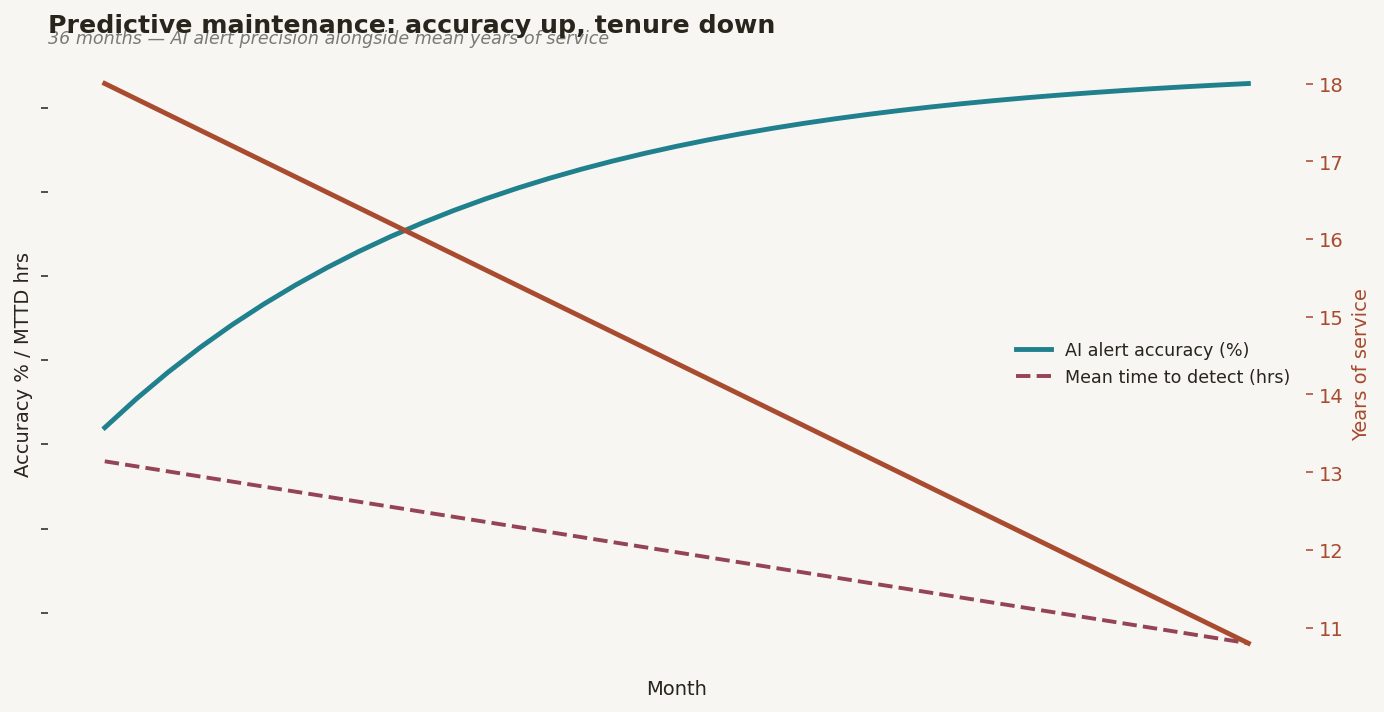
Figure 4. Dual-axis chart showing predictive maintenance AI alert accuracy over 36 months alongside maintenance workforce experience (average years of service) and mean time to detecting pre-failure events n…
Comments (0)
Join the conversation!