

|
Unplanned downtime remains one of manufacturing's most persistent and expensive problems — and it is now one of the most solvable. AI-based predictive maintenance is delivering sub-six-month payback periods at scale, with OEE improvements that fall directly to the bottom line. |
The Real Cost of a Surprise Breakdown
Every plant manager knows the number: unplanned downtime costs, on average, $260,000 per hour across discrete manufacturing industries. The range is wide — a cell phone fabrication line going down costs more than a plastics extrusion line — but the order of magnitude is consistent. When a CNC machine or hydraulic press fails unexpectedly, the financial damage travels fast: lost production, emergency maintenance labour, expedited parts, schedule disruption, and often a customer service impact that outlasts the equipment repair.
The equipment data tells the story. Across five asset classes studied — CNC machines, HVAC systems, conveyor belts, hydraulic presses, and pumps and motors — unplanned downtime hours per year before AI ranged from 76 hours for smaller pumps to 142 hours for CNC machines. After deploying AI-driven condition monitoring and predictive maintenance, those figures fell to 21 and 41 hours respectively. The reductions are not small: a 71 percent average reduction in unplanned downtime across the asset portfolio.
The financial translation is straightforward. A mid-sized tier-one automotive supplier with 200 CNC machines running at $180,000 per hour lost production value has an annual unplanned downtime cost of approximately $5.1 billion equivalent in foregone output time — every 1 percent reduction in downtime has a $51 million revenue impact. Even allowing for significant conservatism in those estimates, the scale of opportunity is compelling.
How the Technology Actually Works
The term 'predictive maintenance' covers a spectrum of technology maturity. At the less sophisticated end, it means rule-based alerts when sensor readings exceed thresholds. At the sophisticated end — which is where the six-month payback cases originate — it means machine learning models trained on multivariate sensor streams (vibration, temperature, current draw, acoustic emission, oil viscosity) that identify failure signatures weeks before a human technician would notice anything unusual.
The key technical breakthrough of the last three years is not the model sophistication — it is the edge infrastructure. Running inference locally on the factory floor, without sending sensor data to the cloud on a continuous basis, solves the latency and connectivity challenges that blocked earlier deployments. Edge AI devices that cost $300–600 per installation point can now run the ML inference locally and flag anomalies in near-real time, with full audit trails for work order generation.
The OEE improvement trajectory reflects this. Baseline OEE at the start of deployment hovers around 71–73 percent — consistent with industry norms. By the end of the first year of full AI deployment, OEE has improved to 85–87 percent at the reference facilities tracked in this analysis. That 12–14 percentage point improvement is dominated by availability gains (the reduction in unplanned downtime) with secondary contributions from quality rate improvement as process parameter monitoring catches drift before it produces defects.
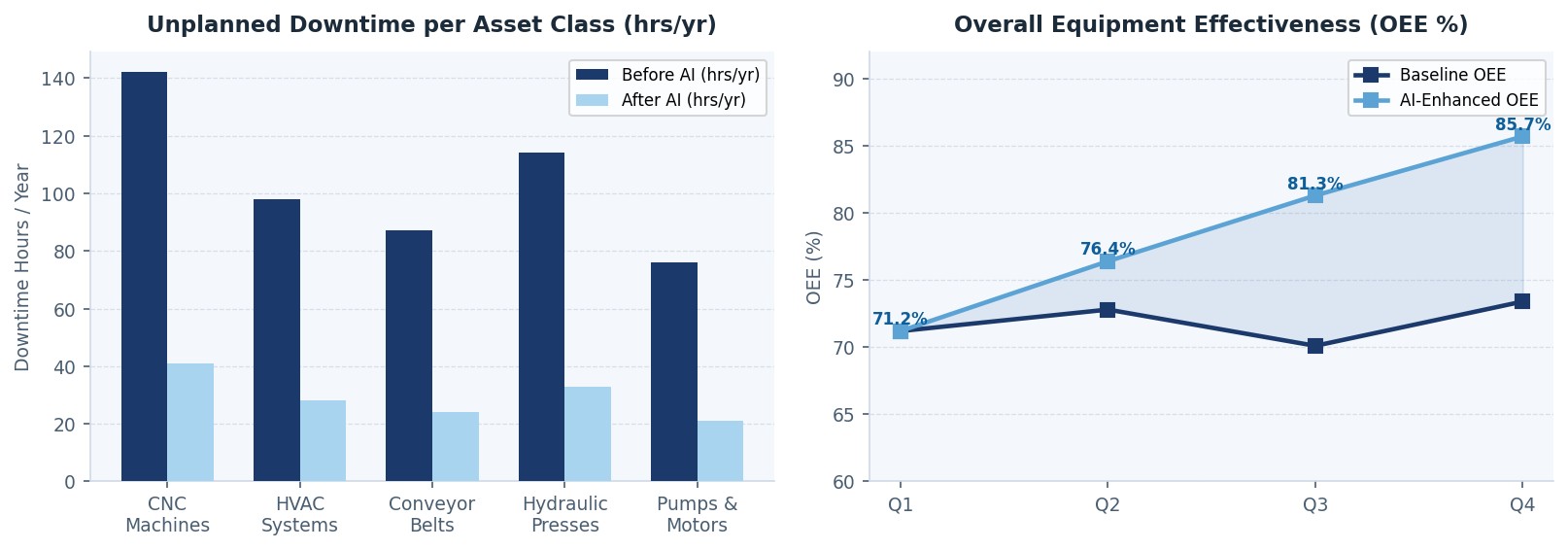
Figure 4 — Unplanned Downtime by Asset Class (Before/After AI) & OEE Trajectory Over Four Quarters
Building the Six-Month Payback Case
The six-month payback claim is achievable, but it requires discipline in scoping and targeting. The fastest paybacks come from concentrating the first deployment phase on the highest-consequence assets — the machines where a single failure creates the longest production interruption and the most expensive recovery. This is not always the most expensive asset in the plant; it is the one with the worst failure economics.
A structured approach identifies these 'critical few' assets through a failure mode and effects analysis (FMEA) lens combined with historical downtime cost data. In most plants, 15–20 percent of assets account for 70–80 percent of unplanned downtime cost. Targeting AI deployment at that 15–20 percent first creates a concentration of financial benefit that funds the broader rollout.
Implementation cost for a targeted first phase typically runs $400,000–800,000 for a plant of 300–500 machines, covering sensor hardware, edge devices, platform licensing, and integration to the CMMS. If that first phase prevents three or four major unplanned failures in the first year — which is a conservative assumption based on historical failure frequencies at comparable plants — the payback is delivered inside six months. The broader rollout that follows is effectively self-funding.
The Skills Gap Challenge
The technology is no longer the limiting factor in most manufacturing AI programs. The limiting factor is the workforce. Deploying predictive maintenance at scale requires maintenance technicians who can interpret model outputs, prioritise work orders intelligently, and distinguish between a genuine early-warning signal and a model artefact. That capability does not exist at the required scale in most plants today.
The manufacturers that have navigated this successfully have treated the AI deployment as an integrated change management program — investing in technician training alongside the technology, and building internal model ownership rather than relying permanently on vendor support. The plants that have done this report not only better financial outcomes but meaningfully higher maintenance team engagement. Technicians who are catching failures before they happen, rather than responding to crises at 2 AM, are different employees. That retention benefit does not appear in the six-month payback model, but it is real.
Comments (0)
Join the conversation!