

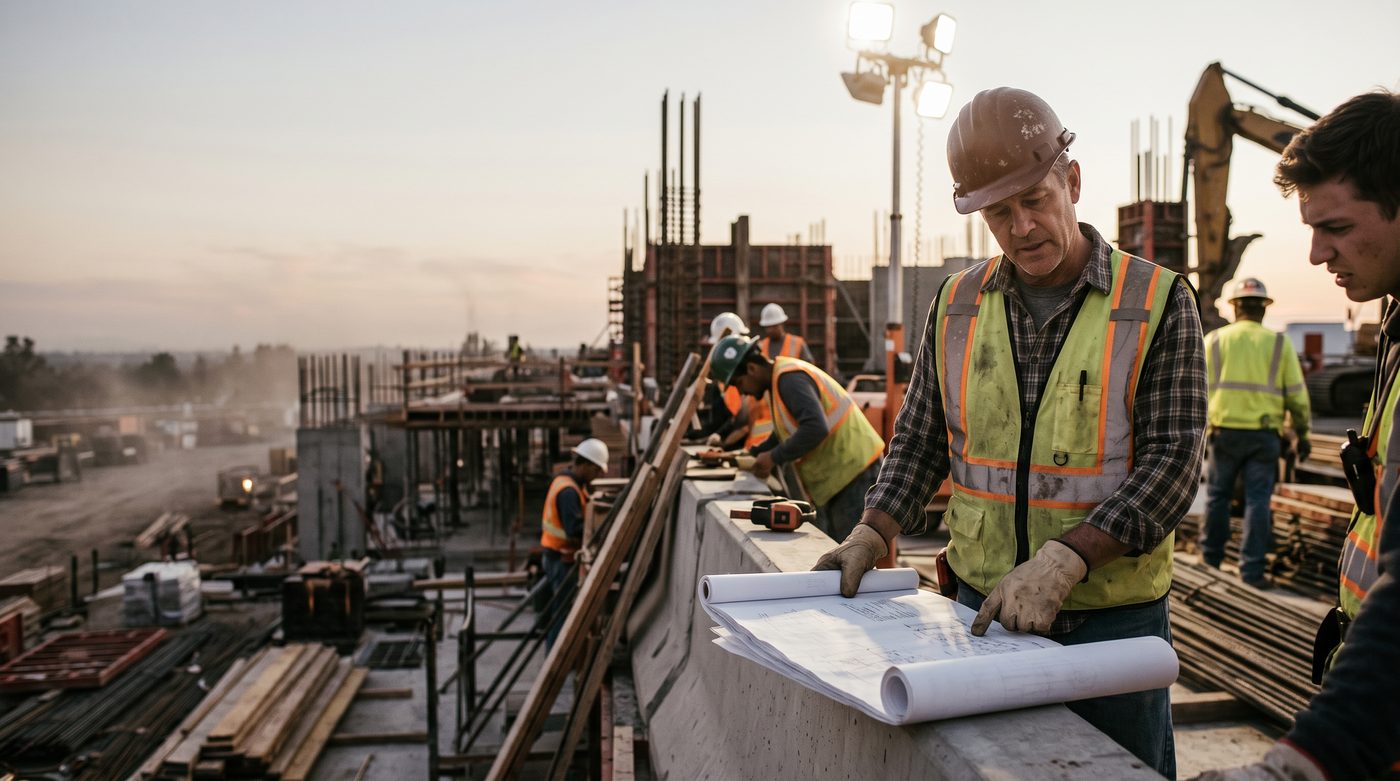
Generative design tools let architects iterate buildings in minutes, but on a construction site with active crews, the efficiency that accrues to the design office arrives in the superintendent's morning as coordination pressure, safety risk, and uncompensated management work.
The Drawings Change Faster Than the Walls
Rosa Figueroa has been in the construction trades for thirty-four years. She started as a laborer in Los Angeles in 1990, worked her way through an apprenticeship, and became a carpenter and then a superintendent — the person responsible for ensuring that a construction site operates safely, on schedule, and in conformance with the drawings. She has built residential towers, hospital wings, parking structures, and, in the last decade, several mixed-use developments in the kind of dense urban neighborhoods where the architecture keeps changing its mind.
The project she manages now is a seventy-three-unit multifamily development in Phoenix. The architect's office uses generative design software that can produce structurally optimized iterations of a building's floor plan, facade, or structural system in minutes. The project has been in the ground for eight months. In that time, the architectural drawings have been formally revised seventeen times. Three of those revisions required already-constructed elements to be altered. Two of them arrived on a Friday afternoon.
"In my thirty years, I've never had drawings change this fast," Rosa told me. "The software makes it easy for them to change their minds. What they don't see is what it looks like on the ground when they do."
Generative Design in Construction: The Technology and Its Discontents
Generative design — the use of AI and computational optimization to produce architectural and structural design alternatives based on specified parameters — has been adopted by a growing share of architecture and engineering firms over the past five years. The technology allows designers to specify goals (minimize material cost, maximize daylight, meet structural load requirements, achieve a target number of units) and produce hundreds of design variants that meet those goals, selecting from among them rather than constructing any single design manually.
The productivity gains for design teams are substantial. A 2024 survey by McKinsey's Capital Projects Practice found that architecture firms using generative design reported a 40% reduction in schematic design time and a 25% reduction in construction document preparation time, compared to traditional design workflows ([McKinsey Capital Projects Practice, "AI in Architecture and Construction," 2024](https://www.mckinsey.com/capabilities/operations/our-insights/ai-construction)). Structural engineers report similar efficiency gains in optimization tasks. The technology has demonstrably expanded what is designable — enabling buildings that would have been prohibitively complex to design manually.
The construction site, however, does not share the design office's relationship to iteration. A concrete pour is not a parametric model. Once rebar is placed and concrete sets, changing the structural geometry is not a software revision; it is demolition and reconstruction. What can be reiterated in minutes on a design workstation can require days or weeks of disruptive, expensive, and potentially dangerous rework on a site with active crews.
The gap between design-side and construction-side iteration speed is not new — architects have always changed their minds — but generative design has widened it dramatically. The ease of producing high-quality, specification-compliant revised drawings reduces the cognitive and administrative friction of revisions. Changes that would previously have required significant design effort are now rapid. The friction that remains is in the field.
The Safety Dimension
Rosa's account of the two Friday afternoon revisions is worth dwelling on. Construction schedule pressure is pervasive and well-documented as a contributor to safety incidents. Workers who are managing plan changes under time pressure — coordinating revised sequences, sourcing substitute materials, briefing crews on new requirements — are workers whose attention is divided and whose safety margin is reduced.
The BLS recorded 1,069 fatal occupational injuries in the construction industry in 2022, the most recent year for which full data is available — a fatality rate of 10.5 per 100,000 full-time equivalent workers, more than three times the all-industry rate ([BLS, "National Census of Fatal Occupational Injuries," 2022](https://www.bls.gov/iif/oshcfoi1.htm)). The relationship between schedule pressure and construction safety is established in the occupational health literature: a 2023 study in Safety Science found that field supervisors in projects with elevated change-order frequency reported significantly higher rates of safety-critical shortcuts and crew distraction events than those in projects with stable drawings ([Safety Science, "Design Change Frequency and Construction Site Safety," 2023](https://www.sciencedirect.com/journal/safety-science)).
Generative design's effect on change-order frequency has not been systematically studied in relation to safety outcomes. But Rosa's account is consistent with a plausible causal mechanism: tools that reduce design friction increase revision frequency; increased revision frequency compresses field coordination timelines; compressed coordination timelines create safety pressure. Whether this chain has materially affected construction safety outcomes is a question that deserves urgent research attention.
"I tell my crews everything that changes," Rosa said. "Every revision, every updated detail. That's my job. But when the drawings change seventeen times in eight months, 'telling the crew' is not a simple thing. It's a management challenge every single time."
Tradeswomen, Seniority, and Invisible Expertise
The construction workforce is predominantly male, but the women who have built careers in the trades — through apprenticeship programs, through persistent navigation of male-dominated jobsite cultures, through decades of demonstrated competency — often occupy the most experience-intensive positions: foremen, stewards, superintendents. Rosa's position is the product of three and a half decades of accumulation. Her expertise is not interchangeable.
It is also, in the current generative design environment, under a particular form of pressure. Generative design changes the nature of the superintendent's coordination task: instead of managing execution against a stable set of drawings, Rosa is managing a moving target while maintaining crew safety and schedule. The increased coordination complexity is not visible in the architect's deliverables. It is not reflected in the superintendent's contract. It is absorbed by the people on the ground.
"The software is in the architect's office," Rosa told me. "The revision shows up in my morning. They don't see what that costs."
Kate Crawford's work on AI's invisible labor costs is applicable here in a construction-specific register: the efficiency gains generated by generative design tools accrue to design firms (in reduced design time) and, partly, to developers (in optimized building performance), while the coordination and management costs of the resulting revision frequency are borne by the field workforce — without recognition in compensation, scheduling, or contractual protection ([Kate Crawford, Atlas of AI, 2021](https://yalebooks.yale.edu/book/9780300209570/atlas-of-ai/)).
Who Benefits, Who Pays
Generative design tools generate genuine value: more optimized buildings, faster design cycles, greater design possibility. Developers benefit from buildings that perform better and cost less to design. Architecture firms benefit from competitive differentiation and productivity gains. Technology vendors benefit from subscription revenue in a growing market.
The costs of generative design's effect on construction coordination are borne by field supervisors, who absorb the coordination burden of increased revision frequency without additional compensation; by construction workers, who face the safety and schedule pressure that revision frequency creates; and, potentially, by building owners and communities who are exposed to safety incidents that the current research does not yet document systematically.
The OECD has flagged what it calls "workflow mismatch" — the phenomenon where AI-enabled productivity gains in one part of a value chain create uncompensated coordination burdens in adjacent parts — as one of the understudied economic effects of AI adoption ([OECD, "AI and Structural Change in Value Chains," 2024](https://www.oecd.org/economy/ai-structural-change.htm)). Construction is a textbook case.
What This Means for You
For construction superintendents and field supervisors: The increased revision frequency associated with generative design is not currently reflected in standard superintendent contracts, which are typically scoped around a fixed construction document set. When negotiating project contracts or reviewing existing ones, seek explicit provisions addressing change-order frequency thresholds, timeline extensions triggered by drawing revisions, and compensation for coordination time consumed by architect-initiated changes. These provisions are not exotic; they belong in any project where the design team is using iterative AI-assisted tools.
For developers and project owners: Generative design's efficiency gains at the design stage come with field coordination costs that should be budgeted explicitly. The conventional approach of treating revision-related coordination as a routine superintendent function — absorbed in the existing contract scope — systematically undervalues the field work and creates safety pressure that represents a liability exposure. Meaningful project contingency planning should account for the revision frequency that generative design tools enable.
For architects and designers: The speed with which generative design tools allow you to produce revised drawings creates a professional obligation that did not exist at the same scale before the technology: an obligation to consider the field impact of revision timing and frequency before issuing changes. Revised drawings issued on a Friday afternoon are not equivalent to revised drawings issued at the beginning of a work week. Coordination with the superintendent before issuing major revisions is not courtesy — it is professional practice.
Rosa Figueroa will finish this project. She has finished harder ones. But she wants something said plainly: "The technology that makes the architect's job easier is making my job harder. And nobody in the design office is losing sleep over it."
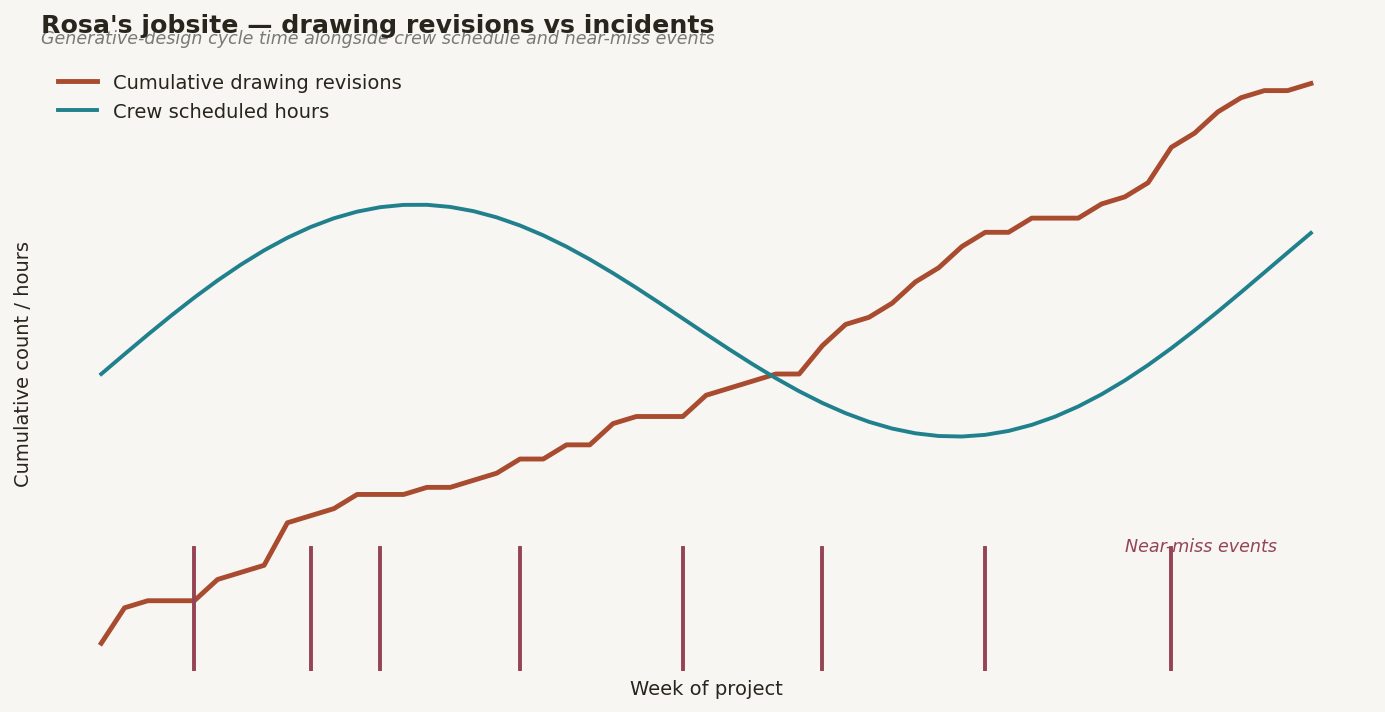
Figure 9. Timeline chart for Rosa's project showing architectural drawing revision dates against crew schedule milestones and safety incident/near-miss events, overlaid with generative design tool adoption date
Comments (0)
Join the conversation!