


|
Governments worldwide lose an estimated 3–8 percent of program expenditure to fraud, waste, and abuse every year — a figure that in the U.S. alone exceeds $300 billion annually. AI-driven detection systems are changing the economics of fraud recovery with returns on investment that outperform virtually any other government technology program. |
The Scale of the Problem Demands a Different Solution
Public sector fraud is not a niche problem — it is one of the largest financial drains on government budgets worldwide. The combination of high program expenditure volumes, complex eligibility rules, distributed benefit administration, and historically limited enforcement resources creates an environment that sophisticated fraudsters have learned to exploit systematically.
Traditional fraud detection in government programs relied on rule-based systems — flags triggered when a payment exceeds a threshold, when a claimant has an address match with a prior fraud case, or when a vendor appears on a debarment list. These systems catch the unsophisticated fraud. They miss the organised fraud that has adapted specifically to avoid rule-based detection — and organised fraud is where the largest dollar losses occur.
The detection rate data by method tells the story directly. Manual audits catch 12.4 percent of fraud in the populations they sample. Rule-based filter systems improve that to 28.6 percent. Machine learning anomaly detection reaches 67.3 percent. Generative AI review — combining ML pattern detection with reasoning-layer analysis of claim narratives and documentation — reaches 84.1 percent. The progression is not incremental. Each level of technology sophistication opens access to a materially different segment of the fraud population.
Recovery Ratios That Are Difficult to Beat
The return on investment from government fraud AI is among the clearest in the public technology sector. The recovery ratio data — dollars recovered per dollar invested — across five program types is uniformly compelling: 8.4x for tax compliance, 12.1x for benefits fraud, 6.8x for procurement fraud, 14.2x for customs and duty, and 7.9x for grants review.
The highest return is in customs and duty — where AI systems analysing import declarations, pricing benchmarks, and international shipping data can identify duty evasion schemes that manual review at customs volumes would never surface. A customs AI program that costs $50 million to deploy and operate annually, returning 14.2x, generates $710 million in recovered duty annually. For programs with documented performance at these ratios, the case for continued investment is not a technology question — it is a capacity and implementation speed question.
Benefits fraud recovery sits at 12.1x, driven primarily by AI systems that cross-reference benefit claims with employment records, property ownership, and income data from multiple government databases — identifying double-dipping, phantom beneficiary, and income misrepresentation schemes that manual case management cannot detect at scale. The deterrence effect — the reduction in fraud attempts when potential fraudsters know AI monitoring is in operation — adds an additional financial benefit that is difficult to quantify but real.
What Makes a Government AI Fraud Program Work
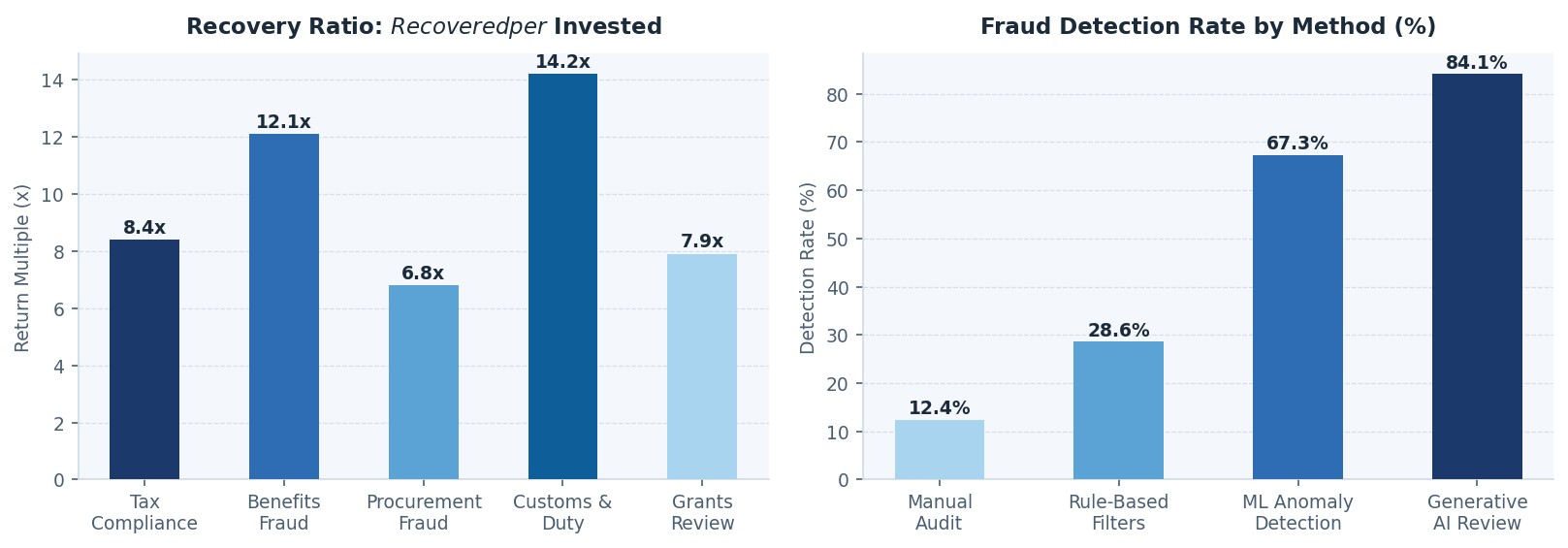
Figure 10 — Recovery Ratio ($ Recovered per $ Invested) by Program & Fraud Detection Rate by Method
The return ratios described above are achievable, but they are not automatic. Government AI fraud programs that have delivered these results share several characteristics that distinguish them from programs that underperform.
First, cross-agency data sharing. The highest-value fraud detection signals come from connecting data across agencies — tax, social services, employment, licensing — and that requires data sharing agreements, privacy frameworks, and technical integration that takes 12–18 months to establish. Programs that try to work within a single agency's data silo achieve a fraction of the detection performance of those with cross-agency data access.
Second, investigator capacity matched to detection volume. AI that detects 10x more suspicious cases but feeds them into an investigation workforce sized for the pre-AI detection rate will create backlogs that eliminate most of the financial benefit. Successful programs invested in investigator capacity alongside detection capability — typically adding 20–30 percent more investigators and providing AI-assisted case preparation tools that increase investigator productivity simultaneously.
The Deterrence Multiplier
The financial case for government fraud AI is typically presented on recovered funds and avoided future losses from detected cases. The deterrence multiplier — the reduction in fraud attempts that occurs when potential fraudsters know an AI system is in operation — is harder to measure but equally real.
Internal Revenue Service research on the impact of AI-enhanced examination selection found that the deterrence effect of improved detection — measured through voluntary compliance improvement in populations known to be subject to enhanced AI scrutiny — was equivalent to 40–60 percent of the direct recovery impact. If a program recovers $500 million in detected fraud, the additional deterrence-driven compliance improvement generates $200–300 million in additional tax compliance that never needed to be recovered because it was never lost.
This multiplier is not consistently incorporated into government AI program business cases — partly because it is inherently difficult to attribute, and partly because government procurement frameworks tend to be conservative about claiming non-documented benefits. The programs that have been running long enough to document the deterrence effect are starting to incorporate it into their renewal justifications, creating a more complete picture of the full return.
Comments (0)
Join the conversation!