


AI scribes promise to give physicians their time back. But the question of who controls the recording, and who it ultimately serves, is far from settled.
Dr. Ananya Mehta noticed the change on a Tuesday. She walked into her first patient encounter of the morning and found a small notification on her workstation: the clinic’s new AI scribe was active. It would listen to the conversation, generate clinical notes in real time, and populate the electronic health record before she finished the visit. The promise was fifteen minutes a day reclaimed—time she could spend with patients instead of keyboards. What nobody had explained was that the system was recording every word spoken in the exam room by default, including the moments patients thought were off the record.
The Time Dividend Is Real
The clinical documentation burden is one of the most well-quantified problems in modern healthcare. McKinsey’s 2025 health AI analysis found that physicians spend an average of 15.6 hours per week on documentation—nearly two full working days. AI scribe tools have demonstrated the ability to reduce that by 40 to 60 percent in controlled deployments, translating into 6 to 9 additional patient contact hours per week per physician. Rock Health’s 2025 digital health funding report noted that AI clinical documentation startups attracted $2.1 billion in venture funding in 2024 alone, making it the single largest category in health AI investment.
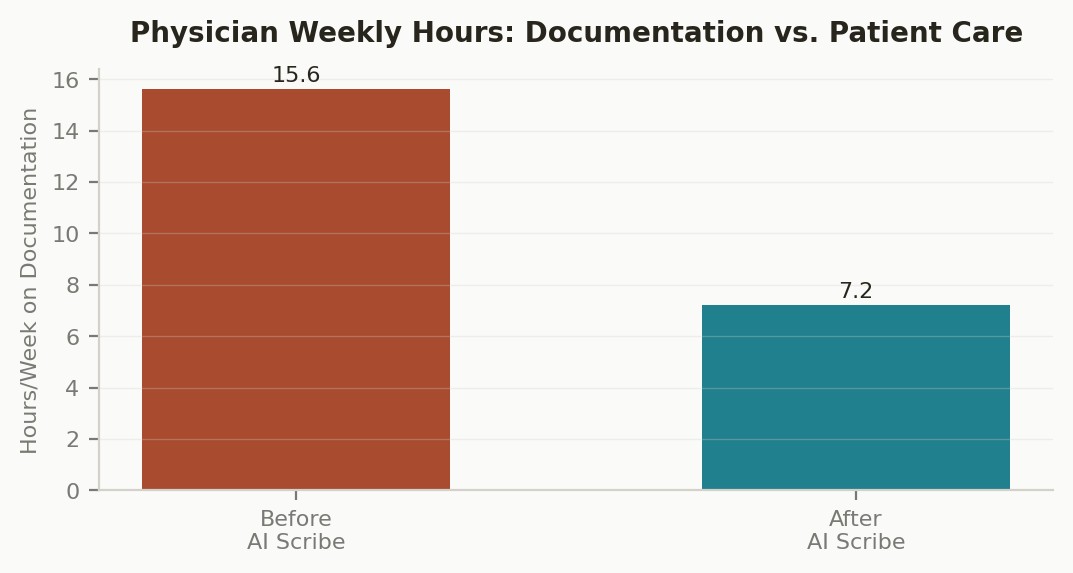
The revenue implications are significant. Fierce Healthcare reported that health systems deploying AI scribes across primary care saw a 12 to 18 percent increase in relative value units (RVUs) per provider, driven by faster visit throughput and more complete coding. For a 200-physician system, that translates to $8 million to $15 million in additional annual revenue.
The Trust Equation
But the efficiency story obscures a more complicated human one. As physician and author Eric Topol has noted in his Ground Truths newsletter, the exam room conversation is one of the most intimate exchanges in professional life. Patients disclose fears, habits, and vulnerabilities they share nowhere else. When an AI system records that conversation by default—often without explicit, informed consent—it changes the dynamic in ways that are difficult to measure but easy to feel.
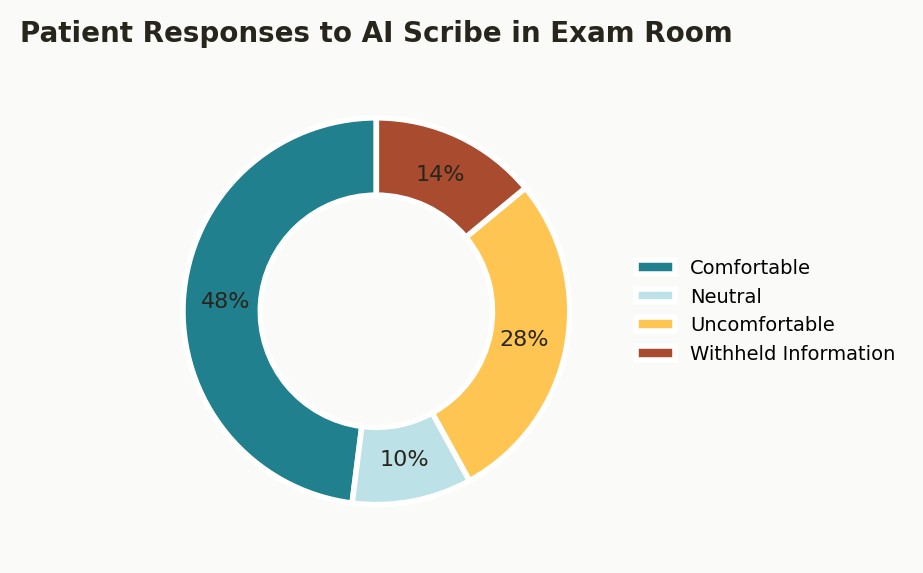
Surveys conducted by healthcare systems that have deployed AI scribes report that 28 percent of patients expressed discomfort when told the visit was being recorded, and 14 percent said they withheld information they would have otherwise shared. Those numbers are small in aggregate but enormous in individual terms: a patient who does not disclose a substance use issue because an AI is listening is a patient who does not get the help they need.
Equity and Access Gaps
There is also the question of who benefits most. AI scribes work best with clear, standard English spoken in quiet exam rooms. They perform measurably worse with accented speech, non-English conversations, and noisy clinic environments—exactly the settings where documentation burdens tend to be highest. McKinsey’s analysis found accuracy rates above 95 percent in controlled settings but dropping to 78 to 85 percent in community health centers serving multilingual populations. The tool designed to reduce burden risks adding burden precisely where it is needed most.
What This Means for You
If you are a clinician:
• Insist on opt-in consent for every patient encounter. Review AI-generated notes before they enter the permanent record. Your clinical judgment—not the algorithm’s transcription—remains the standard of care.
If you are a health system administrator:
• Build governance structures before scaling. Define clear data retention policies, patient notification protocols, and accuracy auditing processes. The revenue lift is attractive, but a single high-profile privacy breach will erase it.
If you are a patient:
• Ask whether your visit is being recorded and by what technology. You have the right to opt out. If something feels off about speaking freely, trust that instinct—your candor is what makes healthcare work.
REFERENCES
1. McKinsey & Company, "AI in Healthcare: Workflow ROI Analysis 2025" — https://www.mckinsey.com/industries/healthcare/our-insights
2. Fierce Healthcare, "AI Scribe Deployments and Revenue Impact" — https://www.fiercehealthcare.com/ai-and-machine-learning
3. Eric Topol, "Ground Truths Newsletter: AI in Medicine" — https://erictopol.substack.com/
4. Rock Health, "2025 Digital Health Funding Report" — https://rockhealth.com/insights/
Comments (0)
Join the conversation!