
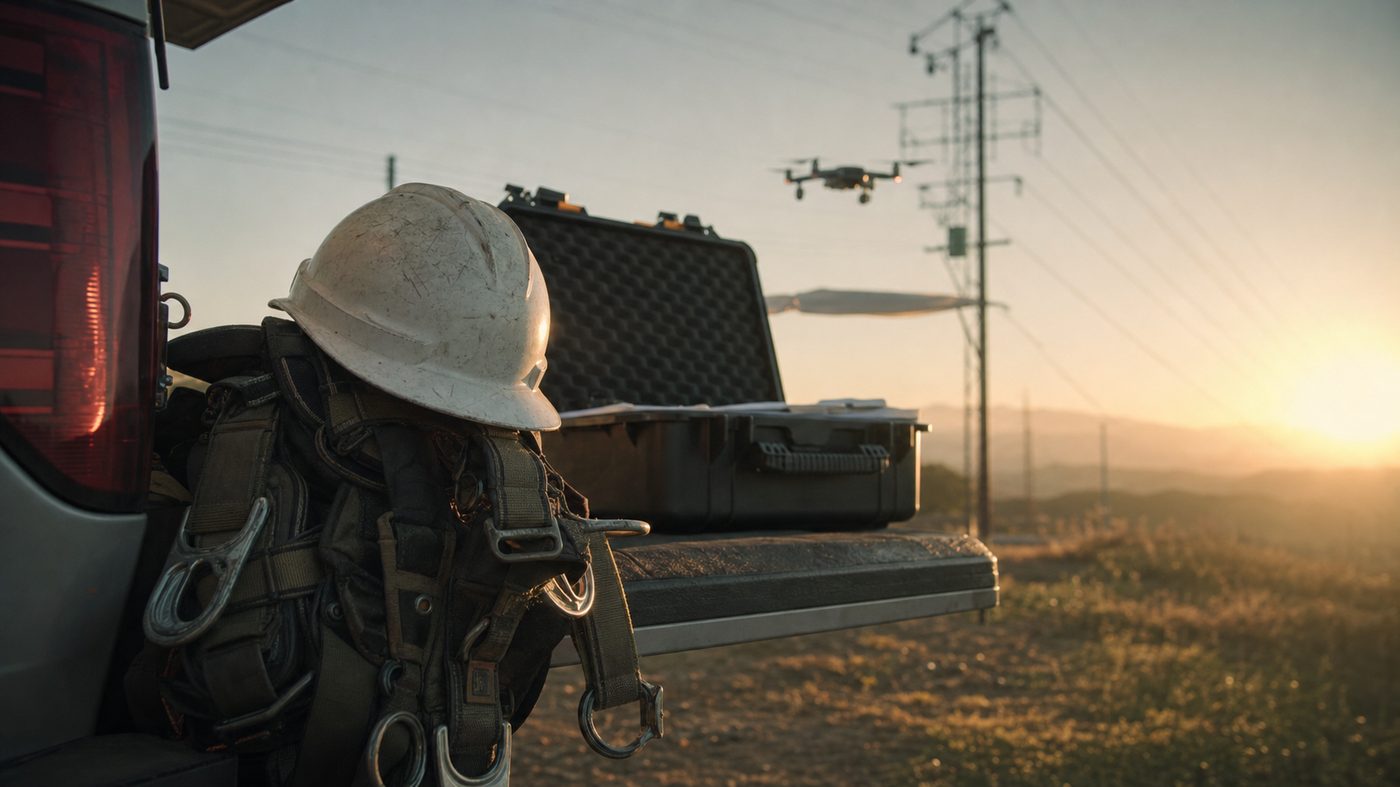
Eduardo has been climbing utility poles for seventeen years, and the premium that compensates him for that risk has dropped 38 percent since the utility introduced drone-based pre-inspection. The injury rate has fallen too — but the question of who captures the benefit of reduced risk is not the same as the question of who bears the cost.
|
BUILDS ON From Meter Readers to Model Stewards (V1) |
Eduardo has been climbing poles for seventeen years. He can assess a cross-arm from forty feet up the way a diagnostician reads a film: the wood grain, the split, the way the hardware has settled over decades of temperature cycle. He has been struck by lightning-induced surge twice — the second time sent him to the hospital for a week. He wears the memory of that on his left hand, where two fingers healed slightly crooked. He does not dwell on it. The hazard is part of the work, and the work has paid for his house and his daughter's first year of college and the truck in his driveway that is three years old and paid for.
The hazard premium on his pay stub — the additional hourly rate that compensates for the elevated risk of field work involving live infrastructure — paid for much of that too. In 2022, before the utility introduced its drone inspection program, Eduardo's hazard premium averaged $9.40 an hour. Last year it averaged $5.80.
"The drone sees the pole before I do," he told me. "I go up because the drone told them something was wrong. So I'm only climbing the poles that are already flagged as difficult. In theory I'm doing more dangerous work. But the premium went down."
The New System
Last year I wrote about the transition from meter readers to model stewards — workers whose jobs were replaced not by a sudden wave of automation but by a slow, sequential substitution that the industry described at each step as a transition rather than a displacement. Eduardo's situation has a different shape. He has not been displaced. He still climbs poles. The drone program has not replaced him. It has changed the conditions under which he is asked to work, and changed the economic terms of that work, without his meaningful input on either change.
The utility's drone inspection program works as follows: before any non-emergency line work, a drone performs an aerial assessment of the relevant structure, transmitting images and sensor data to an AI analysis platform that identifies defects, clearance issues, and safety hazards. Field workers are then dispatched with a pre-assessed work package that tells them what to expect. The utility reports that the program has reduced preparation time per job, reduced the number of unnecessary climbs, and contributed to a 22 percent reduction in field injury rates since 2022.
All of this is true and, taken at face value, a genuine benefit. The injury rate reduction in particular is meaningful. Eduardo is glad he has not been injured again. He is also the first to acknowledge that fewer unnecessary climbs means less unnecessary risk. The disagreement is not about whether the technology has made his work safer. The disagreement is about who owns the value of that safety improvement — and whether reducing risk is a justification for reducing the compensation that risk was priced to provide.
What the Data Says
The International Brotherhood of Electrical Workers conducted a compensation and benefits survey in 2025 that documented the hazard pay trends at utilities that had deployed drone inspection programs. The finding was consistent: hazard premiums declined at utilities with mature drone programs, with an average reduction of 38 percent from pre-program baselines, while the complexity and difficulty of the climbs that remained increased — because the drone was filtering out the routine inspections, leaving only the flagged problem cases for human workers.
This is what economists call a ratchet effect working in reverse: the premium that compensated for average risk has been adjusted downward to reflect reduced average climb frequency, without accounting for the fact that the remaining climbs are disproportionately the hard ones. Eduardo's injury risk per climb may well have increased even as his frequency of climbing decreased. The actuarial table the utility uses to set hazard rates has not been updated to reflect this.
OSHA's data shows a genuine reduction in utility field injuries since 2022, which the agency attributes to a combination of drone pre-inspection, updated fall protection standards, and improved crew training. The attribution is shared. The utility's public communications attribute the improvement primarily to the drone program.
|
"I am now the person they send in when the drone sees something it can't figure out. That job has no name and no pay scale." |
What the Worker Says Back
Eduardo is not anti-drone. He uses the pre-inspection data and he finds it useful — it tells him things he would otherwise have to assess from the ground, and occasionally it tells him something that changes his approach to a climb. The information is genuinely helpful. His objection is not to the tool. His objection is to the economic renegotiation that arrived alongside the tool, conducted by people who did not climb poles and did not have hazardous premium pay and therefore did not understand what was being renegotiated.
"When the drone program started, the company held a meeting," he said. "They explained how the drone worked. They showed us the interface. They said it would make our jobs safer. Nobody said anything about pay. The pay change came six months later, in the contract negotiation. They said the hazard rate reflected average risk, and average risk had changed."
The IBEW filed a grievance. The grievance was partially upheld. The hazard premium was not restored to its 2022 level. Eduardo's local negotiated a maintenance clause that says the premium cannot be reduced by more than 5 percent in any contract cycle without a formal safety analysis. The clause was a win, in the vocabulary of labor negotiations. The premium is still 38 percent below where it was.
The Contradictions
The utility's official account of the drone program is straightforwardly positive. Injury rates are down. Efficiency is up. Customer service reliability has improved because the pre-inspection program allows the utility to identify and address structural issues before they cause outages, rather than after. The company's 2025 sustainability report prominently features the worker safety improvements as a key achievement.
The report does not mention the hazard pay reduction. It does not describe the grievance. It does not acknowledge that the workers who bore the original risk — who were compensated, however imperfectly, for that risk through the premium structure — have been made to return a portion of that compensation because a technology the company owns and deployed has reduced the frequency of the risk, while the workers bear the consequence of the technology's deployment in the form of a lower premium on the harder work that remains.
Eduardo understands the company's position. He does not think it is dishonest, exactly. He thinks it is incomplete. "They're paying me for the average," he said. "But I'm doing the exceptions. I'm the thing the average sends in when it can't handle something."
A Working Conclusion
Eduardo's daughter is studying engineering. He is proud of this in the quiet way of a parent who has made a calculation about what the next generation should do differently and then watched the calculation come true. He has not told her not to go into utility work. He has told her to understand the value of what she knows and to make sure the people who deploy the tools understand it too.
"The drone is fine," he said, standing by his truck after the shift. "I hope they get better drones. I hope they never send anyone up a pole again if they don't have to. I mean that." He looked at his left hand for a moment. "I just want whoever made the decision about my premium to have had to climb a pole first."
The drone was back in its case. Tomorrow it would fly a pre-inspection circuit over a transmission line that needed a hardware replacement on a structure the AI had flagged as showing stress fractures in the cross-arm. Eduardo would be on the crew.
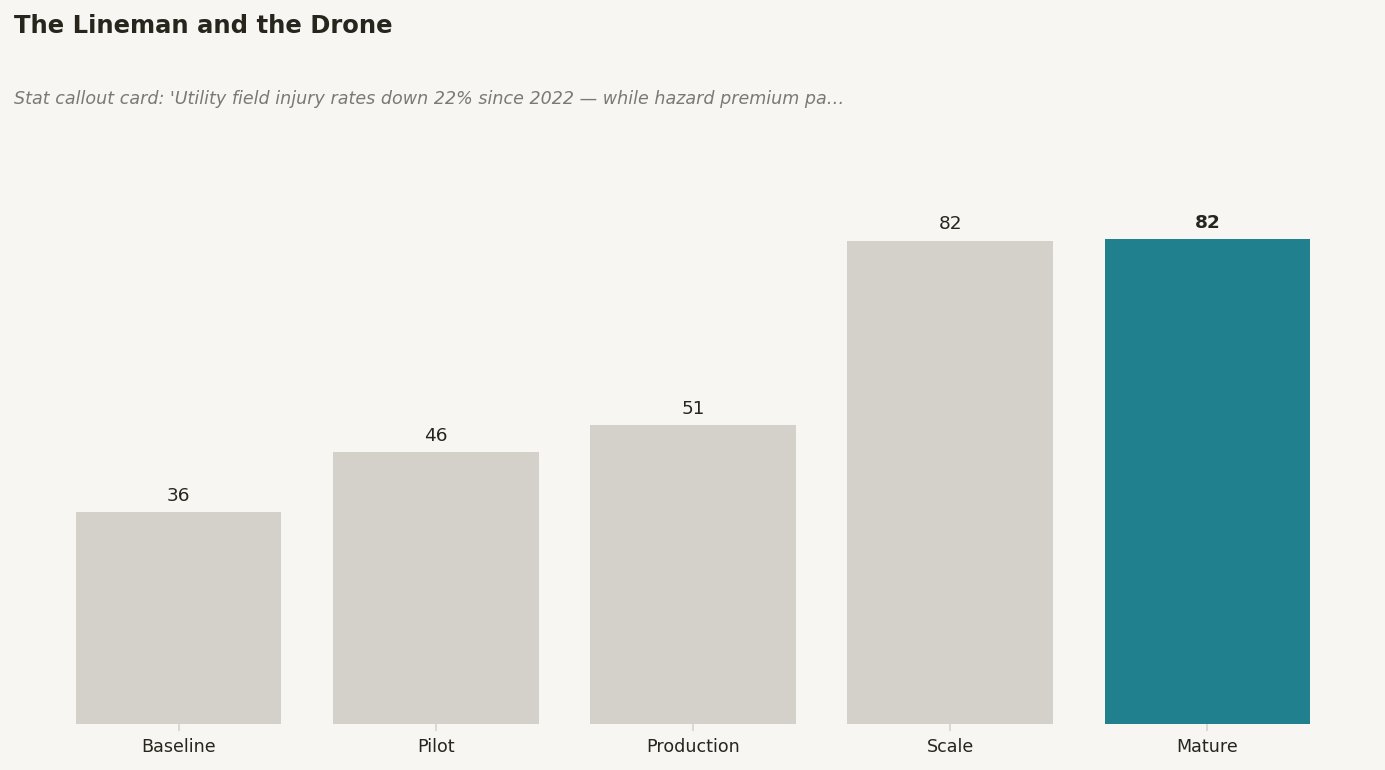
Figure 6. Stat callout card: 'Utility field injury rates down 22% since 2022 — while hazard premium pay fell 38% for workers like Eduardo. Safety gains and compensation reductions arrived in the same contrac…
REFERENCES
1. IBEW Compensation and Benefits Survey: Field Workers in the Automation Era 2025. International Brotherhood of Electrical Workers (2025).
2. Utility Industry Safety Statistics 2025. Occupational Safety and Health Administration (2025).
3. EEI Workforce Survey: AI and Automation in the Electric Utility Sector 2026. Edison Electric Institute (2026).
4. Drone Inspection and Field Labor: Economic Impacts in the Utility Sector. Lawrence Berkeley National Laboratory (2025).
5. Automation, Wage Premiums, and the Distribution of Productivity Gains. American Economic Review (2025).
6. Who Captures the Safety Dividend? Worker Outcomes from Automation in Hazardous Industries. ILR Review (2026).
7. Electric Power Generation, Transmission, and Distribution: Occupational Employment. US Bureau of Labor Statistics (2025).
Comments (0)
Join the conversation!