


Junior associates used to learn to reason legally by writing first drafts that senior partners tore apart; now the AI writes those drafts, and a generation of lawyers is developing its foundational skills in a fundamentally different way — with consequences the profession hasn't yet reckoned with.
The First Draft
On a Wednesday afternoon in early October, Maya Thornton sat in a conference room at a midsize litigation firm in Chicago, reading a brief that the AI had written. She had been at the firm for eleven months, a first-year associate, three years of law school and a judicial clerkship behind her, and she was reading a document she had played no part in producing. Her job, that afternoon, was to check it for errors.
The AI — a legal drafting tool the firm had deployed in late 2022 — had produced a seventy-four-page brief in approximately forty minutes. It had synthesized the case law, structured the argument, and formatted the citations. It had, Maya noted, missed a Seventh Circuit precedent that complicated the central theory of the case. She flagged the issue, wrote a short memo explaining the problem, and sent it to the supervising partner, who thanked her and moved on. The brief went to the client with the revised argument.
Maya had done her job correctly. But she had not, she told me later, learned to practice law. She had learned to find errors in a document she hadn't constructed. These are related skills. They are not the same skill.
How Lawyers Learn to Think
The traditional model of junior associate development in law firms has been, for most of the profession's modern history, a form of guided production under critique. First-year associates write first drafts — of briefs, contracts, memos, letters — that senior attorneys then revise, often substantially. The revision is instructional in a way that is difficult to replicate: it is specific, contextual, tied to an actual matter with actual stakes, and received while the associate's original thinking is still fresh and available for comparison.
Through this process, over two to four years, a junior attorney learns not just legal doctrine — which law school provides — but the craft of legal reasoning: how to construct an argument that accounts for counterargument, how to sequence facts for maximum persuasive impact, how to identify the theory of the case before writing a word. This is not abstract. It is the fundamental competency of legal practice.
"The first draft is where you learn to see," said Professor Linda Osei, who teaches legal writing at Northwestern Pritzker School of Law and has been studying the effects of AI drafting tools on associate development. "The second draft — when you read what you wrote and understand why the partner changed it — is where you internalize. Without the first draft, the second draft is an editing exercise. It doesn't build the same architecture."
This is the central problem with AI-assisted legal drafting: the tool produces outcomes that are commercially adequate while removing the developmental process that builds the professional capacity of the people using it.
The Pipeline Problem
AI legal drafting tools have achieved rapid adoption in large and midsize law firms. A 2024 survey by Stanford's CodeX Center for Legal Informatics found that 68% of Am Law 200 firms had deployed at least one AI drafting or legal research tool, and 41% had integrated AI drafting into standard associate workflows for at least one practice area ([Stanford CodeX Center for Legal Informatics, "AI in Legal Practice Survey," 2024](https://law.stanford.edu/codex-the-stanford-center-for-legal-informatics/)). The productivity gains are significant: firms report that AI-assisted drafting reduces time-to-first-draft by 50–70% on standardized document types, with particular strength in contract drafting, legal research memoranda, and discovery-related documents.
The gains translate directly to client cost reductions and, in many billing models, to profitability improvements for the firm. A 2024 NBER working paper estimated that law firms deploying AI drafting tools were reducing their first-year associate billable hour requirements by an average of 22%, without proportional reductions in associate headcount — suggesting that the immediate effect is productivity-led revenue per associate, not layoffs ([NBER Working Paper No. 32401, "AI and the Market for Legal Services," 2024](https://www.nber.org/papers/w32401)). But this finding may be a leading indicator rather than a steady state.
The pipeline concern is longer-run. If associate development requires producing first drafts that get torn apart by senior attorneys, and AI tools remove the production step, the associate cohort entering partnership consideration in five to seven years will have developed its skills differently — in the limited empirical evidence available, with meaningful gaps in unaided analytical construction. Bar associations and legal educators are beginning to name this as a profession-wide problem, though formal research on the developmental effects of AI drafting is still nascent.
Competency Without Construction
There is a structural analogy in other professions that faced similar tool-driven deskilling risks. Radiologists who trained in an era of digital imaging without film-based foundations, anesthesiologists who rarely practiced manual induction techniques because automated monitors made them less necessary, civil engineers who designed in CAD without learning manual drafting — in each case, the profession eventually confronted the question of whether tool-dependent competency was the same as genuine professional judgment.
The legal profession's answer, so far, is unsettled. State bar associations have issued guidance — most notably from the American Bar Association's Standing Committee on Ethics and Professional Responsibility — clarifying that lawyers have an obligation of competence that extends to understanding AI tools they use, and that supervisory responsibilities require meaningful review of AI-generated content ([ABA Formal Opinion 512, "Generative AI Tools," 2024](https://www.americanbar.org/groups/professional_responsibility/publications/model_rules_of_professional_conduct/rule_5_3/)). What the guidance does not address is the developmental question: whether a legal career built on AI-assisted production from its earliest stages produces lawyers with the independent analytical capacity that ethical practice requires.
The question has teeth. Lawyers carry individual ethical and fiduciary obligations that are not delegable to AI tools. A brief that contains an incorrect statement of law is the attorney's responsibility, not the software vendor's. An associate who was never required to construct an argument from scratch, who learned to check rather than to build, is a different professional than one who was. Whether that difference matters — and in what circumstances — is something the profession is learning in real time.
Who Benefits, Who Pays
AI legal drafting tools generate clear efficiency gains for law firms and, through competitive pressure, for clients who see lower legal costs on commodity work. Large firms have positioned their AI deployments as a competitive advantage: faster turnaround, lower cost, higher scalability. The gains are real.
The costs are distributed across at least two categories of people. Junior associates bear the immediate professional development cost: a formative learning pathway has been attenuated. This cost is invisible in the near term — first-year associates produce adequate work — and potentially significant over a career trajectory measured in decades. The second category of cost-bearers is future clients, who will be served by attorneys whose foundational training was different from their predecessors' in ways that the profession does not yet fully understand.
The ILO has documented what it terms "capability risk" in AI-augmented professional occupations — the long-run erosion of professional competency that follows when AI tools remove the developmental tasks that build that competency ([ILO, "AI and Professional Work," 2024](https://www.ilo.org/global/research/global-reports/weso/2024/lang--en/index.htm)). Law is among the professions most clearly at risk under this framework, given the centrality of unaided reasoning to legal practice and the difficulty of developing that reasoning without practice.
"The partners who've been practicing for twenty-five years can review an AI brief because they spent fifteen years writing them manually," said Professor Osei. "The first cohort of associates who never did that will be partners eventually. And they'll be reviewing AI briefs. That's a different kind of review."
Experimental Responses in Legal Education
Some law schools are beginning to require manual drafting in AI-prohibited environments as a core pedagogical commitment — resisting the pressure to teach students to use the tools they'll encounter in practice before they've developed the foundational skills the tools are replacing. Northwestern, Georgetown, and Yale have each published curricular statements emphasizing the developmental necessity of unaided legal writing, even in an environment where AI drafting is ubiquitous in practice ([Association of American Law Schools, "AI and Legal Education Working Group Report," 2024](https://www.aals.org/)).
At the firm level, some organizations have responded by creating "manual drafting rotations" — periods of associate development in which AI drafting tools are restricted and associates are required to produce first drafts unassisted, specifically to ensure the foundational learning pathway is preserved. These are, so far, voluntary and uncommon. They represent a recognition of the developmental problem. They do not yet constitute a systematic solution.
What This Means for You
For law students and junior associates: The efficiency gains from AI drafting tools are real, and you will use them throughout your career. But if you are in your first two years of practice, the most valuable professional investment you can make is deliberate practice in unaided legal construction — writing complete, reasoned arguments from scratch, submitting them for real critique, and studying what the critique reveals. Seek firms and supervisors who take associate development seriously enough to structure your time around this. Ask in interviews about AI tool governance and associate drafting requirements.
For law firm managers and practice group leaders: The associate development question is not resolved by AI oversight training alone. If your associates are not producing first drafts, they are not developing the foundational legal reasoning skills that their future effectiveness — and your firm's long-run capability — depends on. The efficiency gains from AI drafting are real; the developmental cost is also real. Building structured manual drafting into associate curricula, even selectively, is a professional investment that will compound over a decade.
For bar associations and legal educators: The ABA's competency guidance for AI-assisted legal practice addresses the review obligation. It does not address the developmental question. A formal, empirical study of how AI drafting tools affect the analytical capability of associates across a career trajectory is now possible — firms have data, law schools have alumni outcomes, and the research question is sufficiently defined to be answered rigorously. The profession should commission this research before the first cohort of exclusively-AI-trained associates reaches partnership consideration.
Maya Thornton is still at the firm. She has started, on her own initiative, writing draft arguments for client matters in a notebook before opening the AI tool — working through the structure herself, then comparing it to what the AI produces. Her supervising partner didn't ask her to do this. She did it because, she says, something felt missing. "I want to know if I can actually think through a problem," she said. "Not just check if someone else did it right."
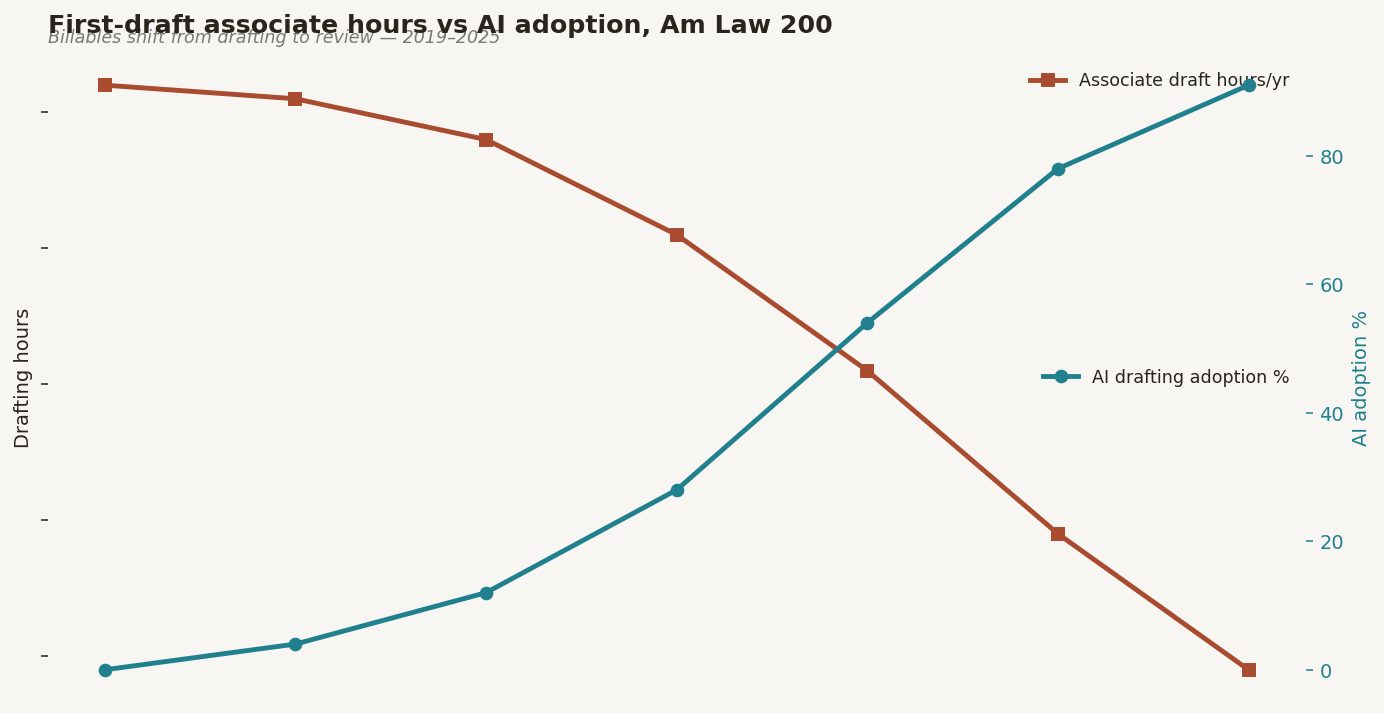
Figure 7. Timeline showing decline in first-draft associate billable hours alongside AI drafting tool adoption rate across Am Law 200 firms, 2019–2025, with projected associate skill assessment scores
Comments (0)
Join the conversation!