


Two premium streaming shows, two writers' rooms, two opposite decisions about AI tools — and the answer to which show survived is more complicated than either side in the ongoing debate about creative labor and artificial intelligence will comfortably admit.
Two Rooms, One Question
In the fall of 2023, two premium television dramas were in production simultaneously in Los Angeles. Both were mid-season renewals for streaming platforms. Both had writers' rooms of comparable size — eight to twelve writers — and comparable budgets. Both were under pressure to deliver faster than their previous seasons, a consequence of post-strike streaming economics that had tightened everywhere.
The first show's room, led by a showrunner with two prior awards-season nominations, adopted a workflow that incorporated AI language model tools into the outlining and pitch process. Writers used the tools to generate scene variants, test dialogue against character voice, and accelerate the cold-start problem of a blank-document breaking session. The second show's room, led by a showrunner who had been a visible voice in the WGA strike, prohibited AI tools in the room and insisted on entirely human-generated material from outline to script. The tools were available; the decision was principled.
One show is in its third season. The other was cancelled after thirteen episodes. The answer to which is which is, as it usually is, more complicated than it first appears.
The Writers' Room After the Strike
The 2023 Writers Guild of America strike was, in part, a labor action about artificial intelligence — specifically about the terms under which AI-generated material could be used in the production of written content, and about whether human writers could be replaced by, or required to "clean up," AI-generated scripts. The contracts that ended the strike included provisions requiring that AI-generated material not be treated as literary material for purposes of credit, and that writers not be required to rewrite AI-generated content unless they chose to. These were meaningful protections. They were also a beginning, not an endpoint ([WGA Minimum Basic Agreement, 2023](https://www.wga.org/contracts/contracts/mba)).
The landscape after the strike is, by all accounts, complex. The most sophisticated showrunners and writers use AI tools in ways that are genuinely auxiliary — for research, for generating options to react against, for accelerating the mechanical parts of the outlining process — while retaining full creative authorship of the material that reaches the screen. Others use AI tools more centrally, in ways that blur the line between AI generation and human writing. And some refuse entirely, on grounds that range from principled craft defense to practical concerns about output quality.
The labor economics of the writers' room have been transformed not just by AI tools but by the broader structural changes in streaming economics: smaller orders, shorter seasons, truncated development periods. A 2024 survey by the Writers Guild of America West found that the median income of working TV writers had declined 14% in inflation-adjusted terms since 2019, driven by smaller room sizes, shorter seasons, and the elimination of the "mini-room" development model that had provided significant employment for mid-career writers ([WGA West, "State of the Industry Survey," 2024](https://www.wgaw.org/)). AI tools arrived in this context — after the economics had already been compressed.
What the Research Says About Creative AI
The question of what AI tools contribute to, and what they take from, creative writing processes is empirically contested. Large-scale studies of AI-assisted writing have found that AI tools increase output volume reliably — writers produce more text, more variants, more options — and that quality assessments of AI-assisted versus unassisted writing, when blind-rated, are mixed ([Stanford HAI, "Generative AI and Creative Labor," 2024](https://hai.stanford.edu/research/ai-index-2024)). On some metrics — dialogue coherence, plot structure, genre convention adherence — AI-assisted scripts score similarly to unassisted ones. On others — character originality, tonal specificity, the density of embedded meaning that distinguishes great television writing — the human-only work scores higher, though the gap narrows as writers become more skilled at directing AI tools.
What the research cannot easily capture is the nature of the creative process itself: the way a writers' room generates material through conflict, revision, argument, and the specific chemistry of a group of people trying to surprise each other. This is not a sentimental claim. It is a description of how original material is produced in collaborative creative environments, and AI tools interact with this process in ways that are not simply additive.
"The room is where the show is born," said one showrunner, who asked not to be identified by name, speaking to me about the broader industry shift. "When you introduce AI into that process, you're not just adding a tool. You're changing the chemistry. Some of what gets lost is craft. Some of what gets lost is the room itself — the reason people want to be in it."
The Show That Succeeded and the Show That Didn't
The show that adopted AI tools in its writers' room — the one in its third season — did not succeed because of the tools. It succeeded because it had a strong showrunner, a coherent creative vision, and the structural advantage of a network that renewed it through a brief early-season ratings plateau. The AI tools reduced the mechanical time in breaking room sessions by an estimated 30%, according to the showrunner, who spoke on background. They did not write the show.
The show that refused AI tools — the one that was cancelled — had a more complicated situation. It was a critically praised debut season, renewed but with a reduced budget, and its second season struggled with the tension between a demanding creative vision and a compressed production timeline. Whether AI tools would have helped is unknowable. What the room's writers told me was that the cancellation had nothing to do with the AI decision — it had to do with streaming platform economics that had already decided the show's fate.
"Everybody wants to make this into a story about AI versus craft," said one writer from the cancelled show. "It's not that story. It's a story about whether a streaming platform was willing to invest in something difficult. They weren't. That's a business decision. AI wasn't in the room."
The Emerging Division of Labor
What is emerging in the television industry is a de facto division of labor in which AI tools are most fully integrated in higher-volume, genre-defined content — procedurals, reality formats, animated children's programming — and least integrated in the prestige, auteur-driven projects where originality is the product. This division is not yet clean; it is emerging unevenly across the industry. But it parallels a broader pattern in AI-augmented creative industries: AI tools perform best where genre conventions are established and adherence to convention is the goal, and perform worst where deviation from convention is the point.
The labor-market consequence of this division is a compression of the middle. The volume-production end of the market is increasingly AI-assisted, which reduces the headcount of writers needed to generate that volume. The prestige end remains human-driven but is a smaller portion of the market and supports fewer jobs. The mid-tier — the steady-work core that historically sustained mid-career television writers — is the segment most affected by both forces simultaneously.
A 2024 NBER analysis of creative sector employment found that occupational decline in screen writing was concentrated in the mid-tier employment range: writers earning $75,000 to $150,000 annually (adjusted for 2020 dollars) saw the steepest employment declines, while both the top tier (showrunners and lead writers) and entry-level positions showed smaller changes ([NBER Working Paper, "AI and Creative Sector Employment," 2024](https://www.nber.org/papers/w32718)). The hollowing-out pattern is familiar from other sectors where AI has affected middle-skill employment; it is arriving now in creative work.
Who Benefits, Who Pays
Streaming platforms that can reduce the cost of generating adequate content benefit from AI integration in writers' rooms — lower headcount requirements, faster production timelines, more content for the same budget. Audiences receive more content, of variable quality. Technology vendors receive subscription and licensing revenue.
Writers — particularly mid-career writers who have built sustainable incomes in the mid-tier television market — bear the primary costs: in declining room sizes, shorter seasons, reduced development opportunity, and the pressure to use tools that they may regard as artistically or ethically problematic. The WGA protections from the 2023 contract cover certain explicit scenarios; they do not cover the structural compression of employment that results from platform economics and AI-assisted production taken together.
The ILO has identified creative sector workers as among the groups most likely to experience what it terms "partial displacement" — not full job loss but significant erosion of the conditions (income, creative control, career trajectory) that make the work viable as a sustained occupation ([ILO, "AI and the Creative Industries," 2024](https://www.ilo.org/global/research/global-reports/weso/2024/lang--en/index.htm)). Partial displacement is, in many ways, harder to address in policy than full displacement — it shows up in income surveys rather than unemployment statistics and resists the standard remedies of retraining and job placement.
What This Means for You
For working writers and creative professionals: The WGA contract provides a baseline. Understand specifically what it covers and what it does not. If your room is using AI tools, understand whether your employer's use of those tools in your workflow triggers credit or residual implications that the contract addresses. Engage your guild's AI working group — it exists, it is active, and it needs specific reported cases to advocate effectively. Document the ways AI is being used in your workplace, including informal uses that sit outside the formal contract provisions.
For showrunners and creative executives: The decision about whether and how to integrate AI tools in a writers' room is genuinely consequential for the people in it — their creative development, their professional satisfaction, and their ability to do the work that distinguishes good television from adequate television. A thoughtful integration policy, developed in consultation with the writers themselves, is not just ethically preferable; it is more likely to produce the conditions in which original work gets made. The chemistry of the room is a resource. Protect it.
For streaming platforms and studio executives: The short-run cost savings from AI-assisted production are real. The long-run cost is the erosion of the mid-career writer ecosystem that has historically been the source of the original material driving prestige content. The prestige content that attracts subscribers, commands critical attention, and defines a platform's identity does not come from optimized content pipelines. It comes from writers who have developed over time in conditions that supported their development. That ecosystem does not regenerate quickly once it has been compressed.
Both writers' rooms I spent time with are still working. The showrunner of the cancelled show is developing a new project. She has not decided yet about AI tools. "I'll use whatever helps me tell the story I'm trying to tell," she said. "That's always been the job."
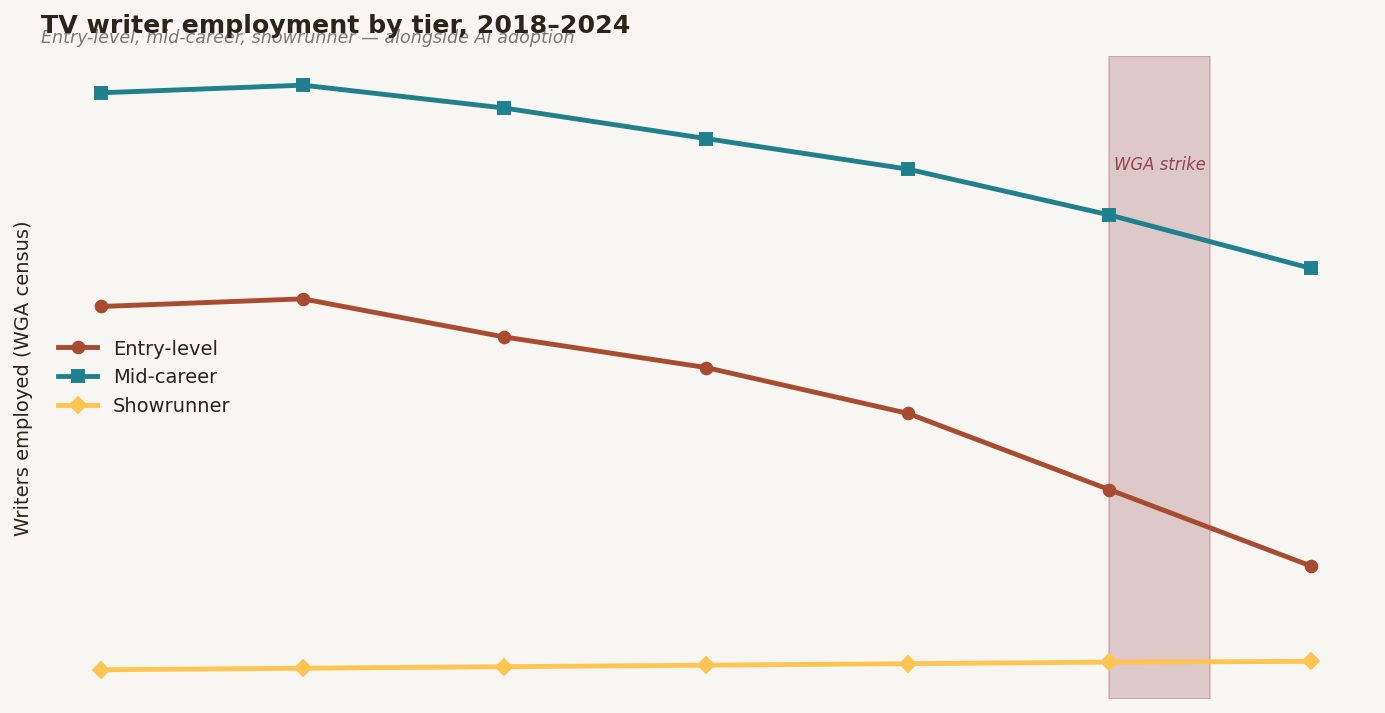
Figure 12. Employment and median income chart for TV writers by tier (entry-level, mid-career, showrunner) from 2018–2024, overlaid with AI tool adoption rate in television production and WGA strike timeline
Comments (0)
Join the conversation!