


Ambient clinical documentation is being positioned by vendors as a physician-retention and burnout-reduction tool — a compelling narrative that is, nonetheless, the wrong frame for finance leadership. The durable financial value of AI scribing systems lies in margin recovery through volume throughput and physician productivity monetization, and the payback period of 14 months is driven by operational improvements that the HR-oriented pitch obscures. A CFO who approves this investment for wellness reasons is leaving the primary financial thesis on the table.
|
TIME RECLAIMED/PHYSICIAN/DAY 2.3 hrs ↑ vs baseline documentation burden |
NET SAVINGS PER 100-PHYSICIAN SYSTEM $1.1M ↑ annual, net of implementation cost |
|
PAYBACK PERIOD 14 mo ↓ net of full implementation and training |
PATIENT THROUGHPUT LIFT 18% ↑ vs pre-deployment baseline |
The Pitch CFOs Are Hearing
The ambient AI clinical documentation market — led by companies like Nuance DAX, Suki, and Abridge — grew at more than 80% annually in 2024 and 2025 by selling health systems on a single thesis: physicians are drowning in documentation, burnout is driving turnover, and turnover is expensive. That framing is accurate. Physician turnover costs a health system between $500,000 and $1 million per departure when recruitment, onboarding, and locum coverage are fully loaded. A tool that meaningfully reduces burnout has a defensible ROI on those terms alone.
But that is not the primary financial case. It is the floor, not the ceiling. CFOs who evaluate ambient scribing exclusively through the retention lens are underpricing what they are actually buying, and that underpricing leads to underinvestment in the governance and integration work required to capture the full value.
Where the 2.3 Hours Goes
Gartner's Healthcare IT Hype Cycle 2025 placed ambient AI documentation at the Slope of Enlightenment — meaning measurable productivity data from early production deployments was available and being validated. The consistent finding across institutions that have published performance data is that physicians reclaim approximately 2.3 hours per clinical day when AI handles real-time note generation, coding suggestion, and after-visit summary production.
The distribution of those 2.3 hours is the critical question. In health systems that have not deliberately redesigned workflows around the reclaimed time, it tends to flow into administrative catch-up, email, and personal recovery — real value from a wellbeing standpoint, but not monetizable. In systems that have redesigned panel sizes, scheduling templates, and visit capacity models around the reclaimed time, it flows into incremental patient volume.
HBR's 2026 analysis of ambient AI in healthcare found that systems with active throughput redesign programs captured an 18% lift in patient throughput per physician — roughly 3-4 additional visits per day per clinician in primary care and internal medicine. At a conservative $150 net revenue per visit and 220 working days, that is approximately $99,000-$132,000 per physician per year in incremental contribution. On a 100-physician system, the range is $9.9-$13.2 million annually. The $1.1 million net savings figure cited in smaller-scale deployments reflects a more conservative capture rate, but the order of magnitude is consistent.
The Coding Accuracy Revenue Stream
Ambient documentation has a second financial channel that receives almost no attention in vendor pitches: coding accuracy improvement. When AI generates clinical notes in real time from physician-patient conversations, the documentation specificity required for accurate ICD-10 and CPT coding is substantially higher than what physicians produce under time pressure on manual systems.
MIT Sloan Management Review's healthcare operations research published in 2025 found that AI-assisted documentation reduced undercoding rates by an average of 12-15% at institutions with mature deployments. Undercoding — the practice of billing for a lower-complexity service than was actually delivered, typically because documentation does not support the higher code — is pervasive in high-volume clinical settings. Correcting it through documentation improvement is not upcoding; it is accurate billing for services rendered. At a 100-physician system seeing 150,000 visits annually, a 12% reduction in undercoding at an average revenue impact of $8 per corrected encounter represents $1.44 million in annual revenue recovery.
This revenue stream does not require any change in physician behavior, scheduling redesign, or workflow transformation. It is a direct consequence of better documentation specificity, and it accrues from the first month of deployment.
The 14-Month Payback: What It Assumes
Deloitte's Center for Financial Services healthcare practice modeled payback periods for ambient scribing deployments across a range of health system sizes. The 14-month figure for a 100-physician system reflects implementation costs of approximately $800,000 (licensing, EHR integration, training, and change management) netted against three value streams: physician time reallocation into incremental volume, coding accuracy improvement, and retention savings from reduced turnover.
The 14-month figure is achievable but not automatic. The primary variable is how aggressively the health system redesigns scheduling and panel management to capture the throughput benefit. Systems that deploy the technology without touching scheduling templates see payback periods in the 22-26 month range — still reasonable by capital investment standards, but materially worse than the headline figure. The operational redesign work is not optional if the CFO case is to close.
The Physician Relationship Dynamic
The political economy of this investment differs from most technology deployments. Physicians are not employees who can be directed to adopt new tools through policy; in many health systems they are employed partners with contractual autonomy over their clinical workflows. Ambient scribing implementations that succeed treat physician adoption as a design problem, not a mandate.
Gartner's research identifies the critical success factor as giving physicians control over note review and edit before signature — a feature that distinguishes mature ambient systems from first-generation voice recognition products. Physicians who experience the tool as an assistant they control rather than a system imposed on them show adoption rates above 85% at six months. Those who experience it as an automation layer that removes their documentation agency show adoption rates below 40%, with associated dissatisfaction that can accelerate the very turnover the system was meant to prevent.
What to Demand From Vendors
The ambient AI scribing vendor market in 2026 includes at least 14 platform-scale competitors and a long tail of point solutions. The financial due diligence items that matter most are: EHR integration depth (systems that write directly to the structured fields in Epic or Cerner carry 3-4x the coding accuracy benefit of those that write to unstructured notes), specialty coverage (primary care performance does not generalize to procedural specialties without additional model tuning), and data residency terms (regulatory exposure under HIPAA is the health system's liability, not the vendor's, regardless of BAA terms).
MIT SMR's 2025 health system CIO survey found that EHR integration quality was the single largest predictor of realized ROI — more predictive than model accuracy metrics or physician satisfaction scores. Integration quality is not visible in a demo; it requires reference checks with live production deployments in comparable EHR environments.
The Takeaway
CFOs evaluating ambient AI scribing should build the investment case on three revenue streams — throughput volume lift, coding accuracy recovery, and retention savings — and require that capital approval include funding for scheduling and panel management redesign as a mandatory companion workstream. The burnout narrative is true but insufficient; the financial case is substantially larger, and the 14-month payback is real for systems willing to do the operational work that surrounds the technology deployment.
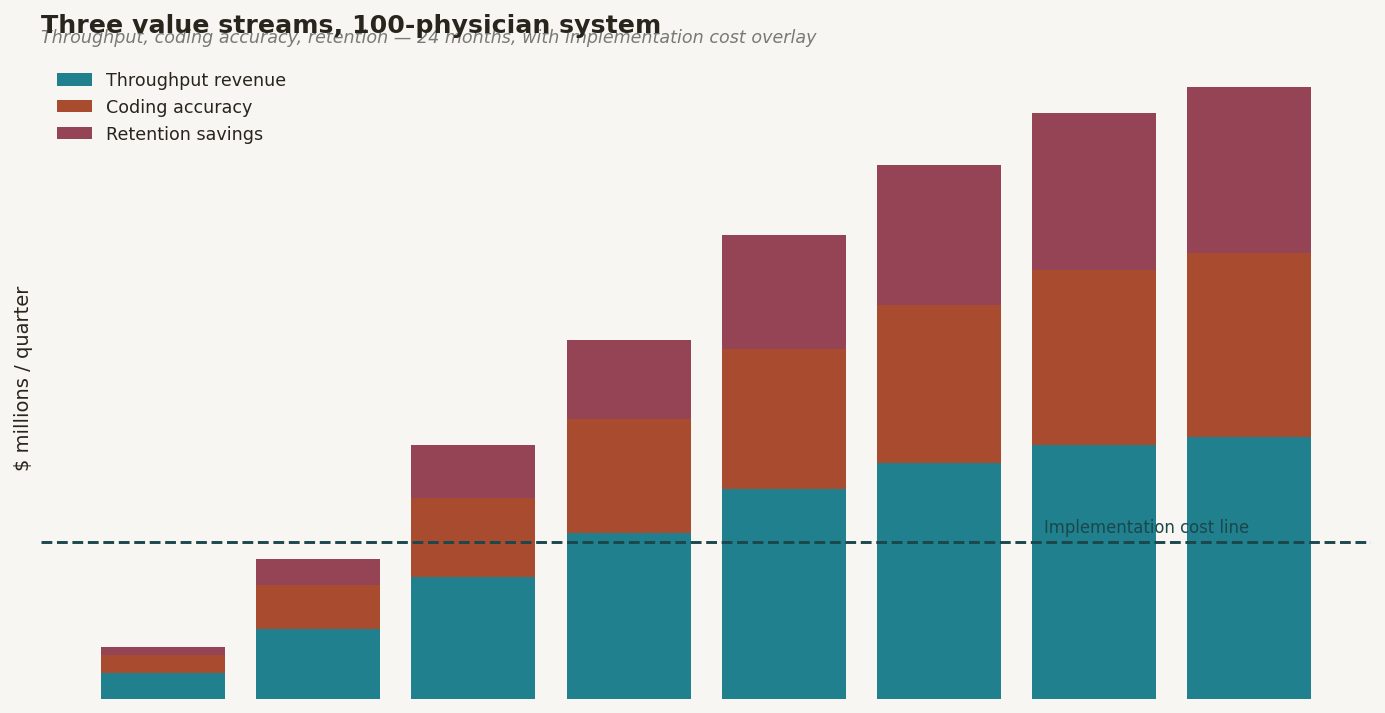
Figure 2. Stacked bar chart showing the three value streams (throughput revenue, coding accuracy recovery, retention savings) for a 100-physician system over 24 months, with implementation cost recovery curv…
Comments (0)
Join the conversation!