

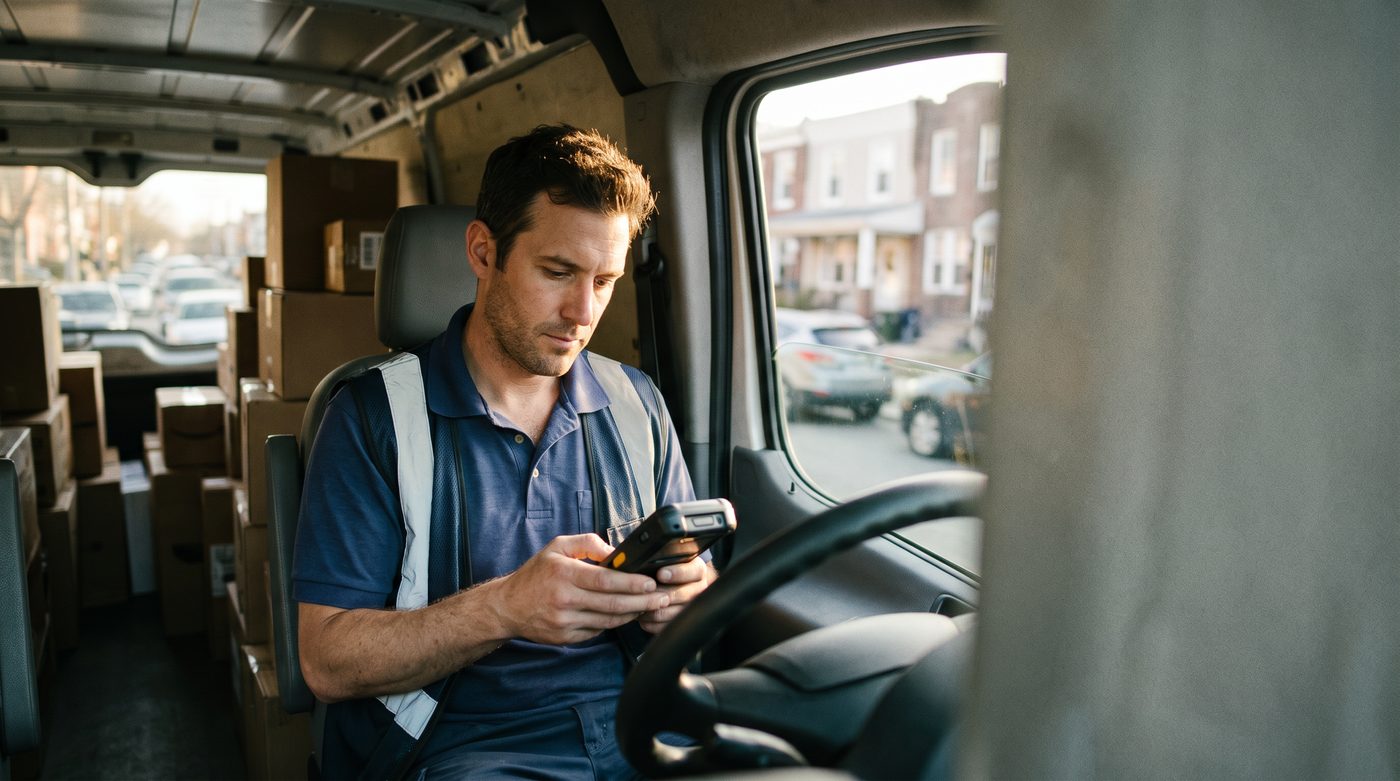
Gig delivery drivers used to choose their routes, but now the algorithm chooses for them — monitoring every stop, every second, every customer complaint — and what happens to workers when the algorithm becomes the supervisor is a story about control that the independent-contractor classification was never designed to address.
The Route That Never Ends
Darnell Washington starts at 7 a.m. and finishes when the deliveries are done. On most days, that means eleven to twelve hours in a vehicle across Chicago's South Side, with a forty-five-minute window for lunch that the algorithm tracks and a performance metric that measures, in real time, how many stops he completes per hour, how long he idles at each address, how many customer complaints are associated with his routes, and whether his acceptance rate — the proportion of delivery assignments he takes on — stays above the threshold that keeps him from being deactivated.
He is not an employee. He is a "delivery partner," a classification that means he owns his vehicle, pays his own fuel and insurance, has no employer-provided health benefits, and can, in principle, set his own schedule. In practice, the algorithm sets his schedule. The algorithm decides which routes are available, which rates are offered for which zones, and which drivers are offered the best routes based on the performance metrics it tracks continuously. Darnell's sense of autonomy over his workday is, he says, "about as wide as a tightrope."
He has been doing this for three years. He is, by the algorithm's metrics, an excellent driver. He has never lost a package. He has almost never been deactivated. He understands the system well enough to work within it. He just doesn't pretend that he chose it.
"The algorithm runs my life," he said. "I just report to work."
The Gig Economy's AI Layer
Algorithmic management in gig-economy logistics has grown from a dispatch optimization tool to a total management system in less than a decade. The platforms that coordinate last-mile delivery — including Amazon Flex, DoorDash, Instacart, and several regional logistics operators — have deployed AI systems that simultaneously optimize route assignment, monitor driver behavior, assess customer satisfaction, and manage workforce composition through deactivation, incentive structures, and access to high-value assignments.
The result is a form of labor control that resembles employment in its intensity and comprehensiveness but is structured to avoid the legal designation of employment. A 2024 NBER working paper examining algorithmic management in gig delivery found that the behavioral monitoring and control exercised by platform AI systems exceeded, by most measurable dimensions, the control exercised by traditional employers over employees in comparable occupations — while the platforms retained the legal protections of the independent-contractor classification ([NBER Working Paper No. 32610, "Algorithmic Control in Platform Labor Markets," 2024](https://www.nber.org/papers/w32610)). The paper's authors described this as "the control paradox": platforms that claim insufficient control to be employment relationships exercise more granular behavioral control than most employers.
The BLS does not separately track gig delivery workers in its standard occupational classifications, making precise employment and wage data difficult to obtain. Survey-based estimates suggest that approximately 1.5 million workers performed gig delivery work as a primary or significant secondary income source in 2023 ([Pew Research Center, "The State of Gig Work in 2023," 2023](https://www.pewresearch.org/internet/2023/12/19/the-state-of-gig-work-in-2023/)). Median earnings for workers who treat gig delivery as a primary income source, after vehicle costs, are difficult to calculate but consistently estimated below $20 per hour in most markets — a figure that often falls below minimum wage when vehicle depreciation, fuel, and insurance are properly accounted.
The Surveillance Architecture
Darnell's workday is monitored comprehensively and continuously. The platform's app tracks his location in real-time. It records how long he spends at each stop and flags pauses above a threshold as potential idle time. It uses customer rating data to assess service quality. It monitors driving behavior — hard braking, sharp turns, speed exceedances — using device sensors. Some platforms have added computer-vision monitoring that uses phone camera images to detect distracted driving.
Kate Crawford has argued that algorithmic surveillance in gig work represents a form of labor discipline that is uniquely intensive precisely because it is continuous, automated, and invisible in its decision-making logic — workers know they are watched but often cannot determine what specific behaviors are being penalized or rewarded ([Kate Crawford, Atlas of AI, 2021](https://yalebooks.yale.edu/book/9780300209570/atlas-of-ai/)). This opacity is not accidental. Platform algorithms are proprietary, and the specific factors that affect driver scoring and route assignment are not disclosed to drivers.
The Markup has conducted extensive investigation of algorithmic management in gig platforms, finding that deactivation — the functional equivalent of termination for gig workers — occurs through automated processes with limited human review and often without clear explanation to the affected worker ([The Markup, "Deactivated: How Gig Workers Lose Jobs Without Explanation," 2022](https://themarkup.org/gig-economy/2022/01/27/deactivated-how-gig-workers-lose-jobs-without-explanation)). The appeals process for deactivation is, in most platforms, opaque and rarely successful. Workers who are deactivated lose their income with the equivalent of no notice, no severance, and no clear explanation.
"My livelihood is one bad customer rating away from being gone," Darnell told me. "A customer lies about a delivery not showing up, I get a complaint, my score takes a hit, and if it happens a few times in a week I'm looking at losing my routes. There's nobody to call. There's nobody to explain it to. You just watch your score and wait."
Worker Classification and the Legal Contest
The question of whether gig delivery workers are employees or independent contractors is being actively litigated in multiple jurisdictions, with significant consequences for workers' access to minimum wage protections, workers' compensation, unemployment insurance, and collective bargaining rights.
California's Proposition 22 — passed in 2020 after a multimillion-dollar campaign by platform companies — created a hybrid status for app-based drivers that preserved the independent-contractor classification while providing limited benefits. A California appeals court upheld the initiative in 2024 following a challenge by labor groups. Similar legislative battles are underway in Illinois, Massachusetts, and New York ([NBER, "Worker Classification and Platform Labor Policy," 2024](https://www.nber.org/papers/w32611)).
The ILO has called for international policy frameworks that address the gap between the employment-like control exercised by algorithmic platforms and the legal protections available to their workers, recommending that countries develop "platform work directives" that extend minimum labor protections regardless of classification ([ILO, "World Employment and Social Outlook: The Role of Digital Labour Platforms," 2024](https://www.ilo.org/global/research/global-reports/weso/2024/lang--en/index.htm)). The EU Platform Work Directive, adopted in 2024, establishes a rebuttable presumption of employment for platform workers — shifting the burden of proof to platforms to demonstrate that their workers are genuinely independent. U.S. policy has not moved in this direction at the federal level.
Who Benefits, Who Pays
Gig delivery platforms generate genuine value for consumers in the form of convenience, speed, and competitive pricing. They have also created income opportunities for workers who value flexible scheduling — a genuinely important consideration for caregivers, students, and workers managing multiple jobs. These benefits are real.
The costs fall on workers who bear the full risk of income volatility, vehicle depreciation, and health events while subject to the level of behavioral control that, in any other labor context, would carry employer obligations. They fall on communities where gig workers are concentrated — often workers of color in urban areas — who absorb the consequences of income precarity and lack of benefits access. And they fall on traditional employment-based delivery operations, which compete on price against platforms that do not carry employment costs, creating pressure that has compressed wages and conditions in the broader logistics sector.
A 2024 Brookings report estimated that gig workers in logistics earn, after expenses, an effective hourly wage that falls below the federal poverty line for a family of four in approximately 30% of metropolitan labor markets — and that this figure worsens as vehicle depreciation accumulates over time ([Brookings, "The Real Earnings of Gig Delivery Workers," 2024](https://www.brookings.edu/research/)).
What This Means for You
For gig delivery workers: You have more legal rights than you may know, even within the independent-contractor framework. In most states, platforms are required to disclose, upon request, the factors used in deactivation decisions. Workers' compensation for gig-specific injuries is available in California and several other states under gig-specific legislation. If you believe your deactivation was incorrect, document the specific delivery records and customer interactions involved before the platform's records are inaccessible. Connect with worker centers and advocacy organizations in your area that specialize in platform labor issues — many offer free guidance on appeals and legal rights.
For logistics companies and retailers that use platform delivery: The cost advantages of gig delivery are real in the short term. They also carry reputational and regulatory risk as worker classification law evolves, and they reflect quality risks associated with high driver turnover and algorithmic deactivation of experienced workers. Companies that have invested in direct employment of delivery workers have, in several documented cases, achieved lower turnover costs that partially offset the higher per-delivery labor cost. The calculation deserves honest accounting.
For policy-makers: The legal gap between the control exercised by algorithmic platforms and the protections available to the workers subject to that control is one of the most significant labor policy failures of the current era. Federal legislation extending minimum wage guarantees, portable benefits, and meaningful due process for deactivation decisions to platform workers would not eliminate gig work — it would constrain its most exploitative dimensions. The question is whether the political will exists to require it.
Darnell Washington will be on his route tomorrow at 7 a.m. He knows the South Side streets as well as anyone. The algorithm, he notes, sometimes routes him in ways that make no geographic sense. "It doesn't know the streets," he said. "It knows the data. Those are different things." He paused. "But I follow it anyway. That's the deal."
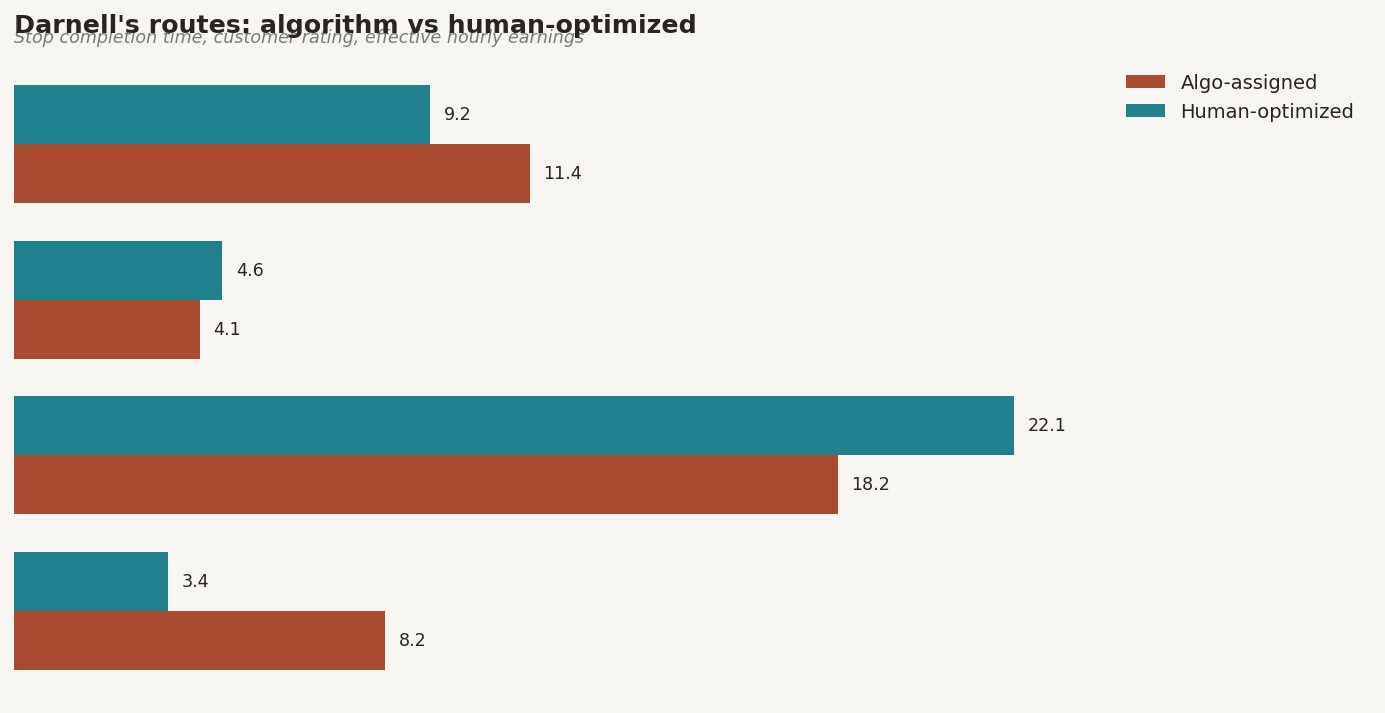
Figure 11. Map overlay of Darnell's algorithm-assigned routes vs. human-optimized routes across Chicago's South Side, with stop completion time and customer rating data, alongside effective hourly wage calcul…
Comments (0)
Join the conversation!