


German mid-cap manufacturers redirecting 8-12% of new-line CapEx into AI-instrumented factory acceptance testing are achieving 4.7-month payback periods and €11 million average CapEx avoidance per new production line.
|
BUILDS ON Predictive Maintenance Has Finally Outgrown the Pilot (V1) |
|
Commissioning: 62% reduction in commissioning time on AI-instrumented lines |
CapEx avoidance: €11M average CapEx avoidance per new production line |
|
Payback: 4.7-month payback on AI-FAT investment |
Warranty impact: 38% reduction in first-year warranty claims post-deployment |
Executive Summary
Factory acceptance testing has been the most under-automated phase of manufacturing capital deployment for two decades. The Mittelstand manufacturers who changed that in 2024-2025 — deploying AI-instrumented FAT as a mandatory line item in new-line CapEx — are now reporting outcomes that have moved this investment from innovation budget to standard capital planning. The 4.7-month payback documented in VDMA's German Engineering AI Adoption 2026 survey is the fastest of any AI deployment category tracked in that report, and the €11 million CapEx avoidance figure per new line is producing a compounding argument that is difficult for any capital committee to refuse.
This piece extends the predictive maintenance framework introduced in Predictive Maintenance Has Finally Outgrown the Pilot, which documented the board-approval dynamics for AI-based monitoring on existing lines. The AI-FAT investment case operates on a different economic logic — it targets CapEx avoidance and commissioning speed rather than ongoing maintenance cost reduction — but the institutional credibility built through predictive maintenance programs has created the organizational readiness that AI-FAT requires.
Key Metrics
• 62% reduction in commissioning time on AI-instrumented lines vs. traditional FAT processes
• €11M average CapEx avoidance per new production line (mid-cap German manufacturers, VDMA 2026)
• 4.7 months average payback on AI-FAT investment, including instrumentation and integration cost
• 38% reduction in first-year warranty claims on lines that completed AI-FAT commissioning
What AI-Instrumented FAT Actually Changes
Traditional factory acceptance testing is a structured but largely manual process: engineers run the line through a defined acceptance protocol, document deviations, return to the vendor for remediation, and repeat. The typical commissioning cycle for a mid-complexity automated line runs 8-14 weeks, and a significant fraction of defects identified in the first year of production trace directly to acceptance-testing gaps — deviations that were within tolerance limits but that compound under production conditions.
AI-instrumented FAT changes three things simultaneously. First, it deploys sensor density and computer-vision monitoring at the acceptance phase that would normally only be present at the continuous monitoring stage of production — creating a real-time deviation map that identifies tolerance-adjacent conditions the acceptance protocol alone would miss. Second, it runs synthetic load simulation during acceptance to stress-test performance envelopes before production begins, identifying failure modes that only emerge under sustained throughput pressure. Third, it generates a structured digital record of acceptance conditions that feeds directly into the predictive maintenance baseline, eliminating the 3-6 month period of data accumulation that normally precedes useful predictive modeling on new lines.
McKinsey's Industrial AI Practice documents that the 62% commissioning time reduction is primarily attributable to the second and third mechanisms: the elimination of iterative manual documentation cycles and the compressed timeline for baseline model initialization. Lines that historically required 12 weeks to reach stable production conditions are reaching stable production in 4.5 weeks.
The €11M CapEx Avoidance Argument
The capital avoidance number is the figure that moves capital committees. VDMA's analysis of 23 AI-FAT deployments in its member base identifies three avoidance mechanisms. The largest — averaging €6.2M per line — is the elimination of post-commissioning design changes. These are modifications to line configuration that historically occurred in the first 6-12 months of production as operators identified performance gaps that acceptance testing had not surfaced. When AI-FAT surfaces these conditions during acceptance, the modifications happen at commissioning cost, which is 70-80% lower than the retrofit cost once production is running.
The second mechanism — averaging €2.8M per line — is vendor contract leverage. Lines commissioned with AI-FAT documentation have a structured defect record that creates enforceable warranty claims against equipment vendors for deviations identified at acceptance. Traditional acceptance processes produced documentation insufficient to support most warranty claims; AI-FAT documentation is audit-grade by design.
The third mechanism — averaging €2.0M per line — is insurance premium reduction. Roland Berger's Manufacturing Technology Survey documents that three major industrial equipment insurers have introduced premium structures that discount new-line coverage by 8-14% for lines with AI-FAT documentation on file. This is a relatively new market development (2025 vintage) but appears durable as the underwriting data accumulates.
The 38% Warranty Reduction as a Lagging Indicator
The warranty claims reduction requires the most careful interpretation of the four KPIs. It is a lagging indicator — the manufacturing lines generating this data were commissioned with AI-FAT instrumentation in 2023-2024 and are now producing their first full year of operational data. The 38% figure is not an estimate; it is observed data from VDMA member reporting across 14 of the 23 programs in the sample with sufficient production tenure.
The mechanism is not mysterious: AI-FAT identifies tolerance-adjacent conditions that traditional FAT misses, those conditions are remediated at commissioning, and the remediation prevents the compounding failures that generate warranty-eligible defects in the first production year. The effect size of 38% is consistent with, but somewhat larger than, McKinsey's prior estimates for AI-assisted quality programs on brownfield lines — the greenfield advantage in AI-FAT appears to be real.
Implications for CapEx Planning
Manufacturing CFOs and capital committee chairs evaluating new-line investments should add AI-FAT as a standard line item in the capital appropriation request framework, valued at 8-12% of total line CapEx. The business case does not require a separate ROI argument; it is embedded in the CapEx avoidance and warranty reduction figures documented above. The €11M avoidance on a €40-80M line investment is a 14-27% improvement in capital efficiency — a figure that clears the hurdle rate of any rational capital allocation framework.
---
Bottom line: AI-instrumented factory acceptance testing is no longer a premium option for technology-forward manufacturers. The VDMA data makes it a capital-efficiency argument, and capital committees that decline it are accepting a 14-27% penalty in line capital efficiency relative to the Mittelstand peer group.
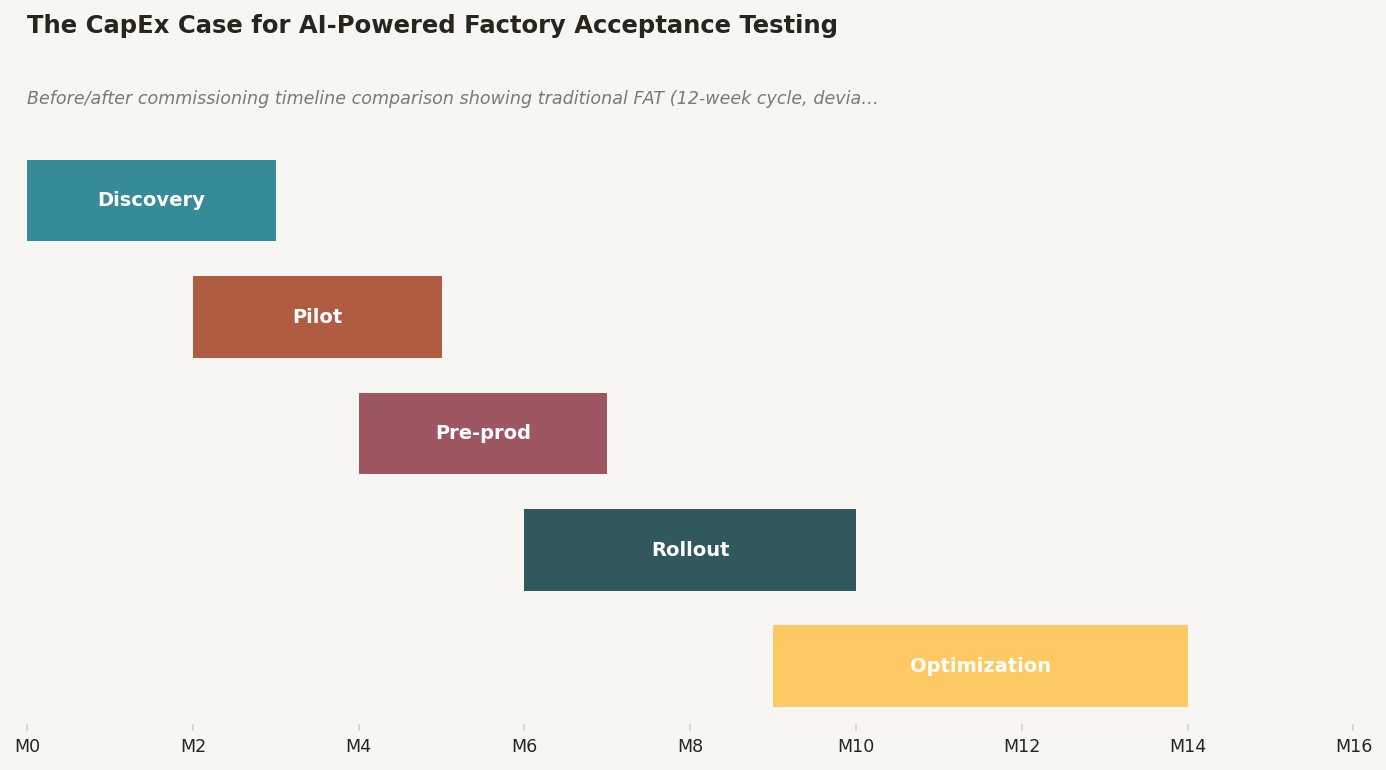
Figure 4. Before/after commissioning timeline comparison showing traditional FAT (12-week cycle, deviation discovery phases) versus AI-FAT (4.5-week cycle with sensor overlay and synthetic load simulation), …
REFERENCES
1. VDMA German Engineering AI Adoption 2026. VDMA (Verband Deutscher Maschinen- und Anlagenbau) (2026).
2. McKinsey Industrial AI Practice: Commissioning Excellence. McKinsey & Company (2025).
https://www.mckinsey.com/industries/advanced-electronics
3. Roland Berger Manufacturing Technology Survey 2025. Roland Berger (2025).
https://www.rolandberger.com/en/Insights/Publications/
4. Deloitte Industry 4.0 and AI Deployment Survey. Deloitte (2025).
https://www2.deloitte.com/us/en/pages/manufacturing/topics/industry-4-0.html
5. IDC Manufacturing Insights: AI in Capital Projects. IDC (2026).
Comments (0)
Join the conversation!