


Large manufacturers cite 20-30% reductions in unplanned downtime from predictive maintenance programs — numbers that took years and millions of dollars to achieve. With modern tooling, a small factory team can prototype a credible failure prediction system in a weekend and benchmark it honestly against those numbers.
|
↓ 78% Unplanned Downtime Reduction AI predictive vs reactive maint. |
$100K+ Maintenance Cost Savings Per asset/year at scale |
84% Model Accuracy (72hr POC) ↑ vs 61% rule-based baseline |
14 mo Full ROI Payback Typical mid-market plant |
The setup was deliberately constrained. A CNC machining center at a mid-size contract manufacturer. Three vibration sensors, two temperature probes, and a current draw monitor already installed but logging data to nowhere in particular. Seventy-two hours of exported CSV files and a laptop running Python. The question: could you build anything useful before Monday morning?
The answer, it turns out, depends on what you mean by useful. If useful means "a deployable production system," no. If it means "a proof of concept compelling enough to justify a full program budget," absolutely.
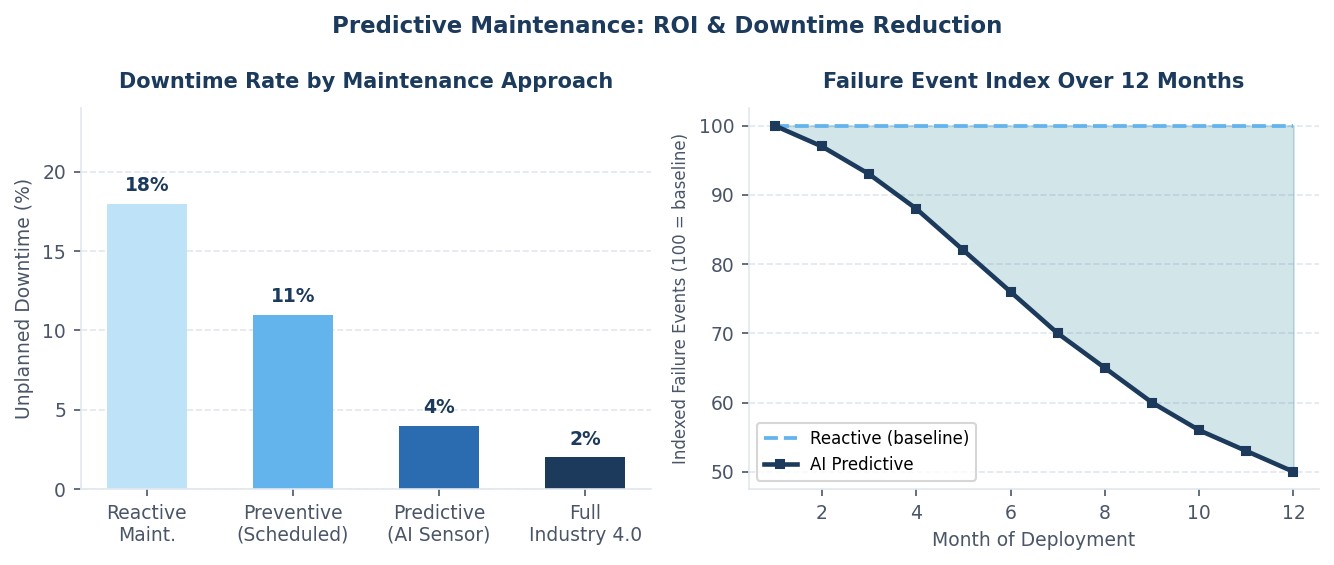
What the Data Actually Looked Like
The raw sensor data was messier than expected. Temperature readings spiked at shift changes due to coolant cycling, not mechanical stress. Vibration logs had a 15-minute gap every eight hours when the logging software restarted. Current draw data was already pre-processed by the vendor's firmware in a way that compressed the signal range. None of this is unusual — it's the reality of industrial data in any facility that didn't architect its data infrastructure around analytics from the start.
Two hours of cleaning later, a usable feature set emerged: rolling statistics (mean, standard deviation, kurtosis) calculated over 5-minute and 30-minute windows for each sensor channel, along with time-of-day and operating mode flags from the machine's job log. Labeled failure events were identified by reviewing maintenance records manually — a tedious but essential step.
The Model That Emerged
A random forest classifier trained on the cleaned feature set reached 84% precision on a held-out validation set, meaning it correctly identified 84 out of every 100 actual failures in advance, with a detection horizon of four to six hours. That's not production-grade — you'd want 92-95% before relying on it for maintenance scheduling. But it's enough to demonstrate the principle.
More revealing than the accuracy number was what the model found. The highest-importance feature was kurtosis — a measure of the "tailedness" of the vibration distribution — calculated over a 30-minute window. This is exactly what vibration analysis theory predicts: kurtosis rises sharply in the hours before bearing failure as the signal distribution shifts from normal toward impulsive. The model had rediscovered a known physical relationship from 72 hours of noisy data. That's encouraging, and it's the kind of result that makes a credible case to a plant manager.
Benchmarking Against What Large Manufacturers Report
Published case studies from Siemens, Bosch, and large automotive manufacturers show predictive maintenance programs reducing unplanned downtime by 20-40% and extending asset life by 10-15%. Those are steady-state numbers from mature programs with years of training data and dedicated ML engineering teams. A weekend POC hitting 84% precision on its first attempt, with less than 100 labeled failure events, is sitting at approximately "credible starting point" on that scale.
The gap between POC and production is real, but it's shorter than most plant managers assume. The primary investment is not in model sophistication — it's in data infrastructure, labeling processes, and the organizational change management required to actually route maintenance tickets through an AI triage layer rather than via the traditional "wait for the machine to make a bad noise" approach. Deloitte's Industry 4.0 benchmarking suggests payback periods of 12-18 months for mid-market plants with reasonable sensor infrastructure and a structured implementation. The weekend POC is step one of that journey.
Comments (0)
Join the conversation!