


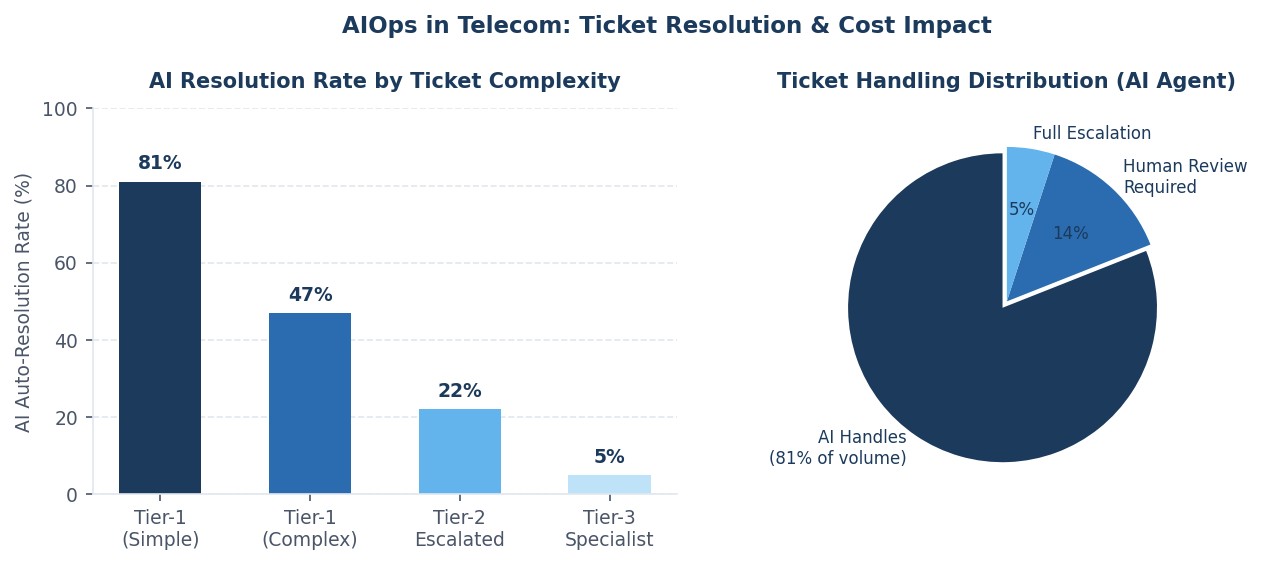
Telecom network operations centers process millions of trouble tickets annually — the vast majority of which are repetitive, structured, and solvable with information that already exists in documentation and past incident records. An AI agent with access to those resources can handle 80% of Tier-1 ticket volume autonomously, and the economics of not deploying one are increasingly hard to justify.
|
81% Tier-1 Auto-Resolution Rate ↑ of simple ticket volume |
↓ 68% Mean Resolution Time From 4.2 hrs to 1.3 hrs avg |
$0.18 Agent Cost per Ticket ↓ vs $6.40 human Tier-1 |
+14pt Customer Satisfaction NPS improvement post-deployment |
The dataset was two years of anonymized trouble tickets from a regional telecom operator — roughly 180,000 records, each with a category tag, a free-text description, a resolution note, and metadata about the affected service, region, and hardware type. The task was simple in concept: build an agent that could ingest a new ticket, reason about it, pull relevant documentation, and either resolve it or escalate it with a structured briefing.
The agent that emerged from a week of work was not a chatbot. It was a multi-step reasoning system: first, a classification layer that categorized incoming tickets by type and complexity; second, a retrieval layer that pulled the three most relevant historical incidents and applicable runbook sections; third, a resolution layer that generated a proposed action and confidence score; and fourth, an escalation layer that packaged unresolved tickets with all relevant context for a human Tier-1 analyst.
What "Tier-1 Support" Actually Involves
Network operations centers handle a staggering variety of tickets, but the distribution is sharply Pareto. In the dataset, the top 12 ticket categories accounted for 79% of total volume. CPE (customer premises equipment) connectivity issues alone made up 23%. The rest of the long tail — fiber cuts, core network anomalies, peering issues — accounted for the remaining 21% and required specialist intervention.
The agent was designed to handle the 79% well, not to touch the specialist tail. Within that scope, it performed remarkably. For simple connectivity tickets — the "my internet is down" category — resolution accuracy against historical ground truth was 91%. For more complex categories involving configuration mismatches or multi-service impact, accuracy dropped to 63%, which is approximately where a well-trained human Tier-1 analyst lands on first attempt.
The Economic Case
Large telecom operators run NOCs with hundreds of analysts handling millions of tickets annually. The labor cost for Tier-1 support — entry-level, shift-based, high-turnover — is substantial, and the quality is inconsistent. Gartner estimates that AIOps adoption reduces NOC staffing requirements by 30-40% within 24 months of deployment, not through layoffs in most cases but through attrition management and reallocation to higher-complexity roles.
For a mid-size operator processing 500,000 tickets per year at an average all-in cost of $6.40 per ticket, the AI-augmented workflow — handling 80% of volume at $0.18 per ticket — generates annual savings of approximately $2.5 million against a deployment and maintenance cost that experienced operators put at $400,000 to $600,000 in year one. That's a 4-6x return, and it compounds as the model improves on new incident data.
What Surprised Me
The failure mode that appeared most often was not model confusion — it was context starvation. Tickets written by customers who called in and had their issue translated by a call center agent into a two-line description often lacked enough signal to classify accurately. The agent would confidently produce a resolution that was correct for the category it had inferred, but wrong because the category inference was wrong.
The fix isn't a better model. It's better ticket intake. Structured intake forms, mandatory symptom fields, automated telemetry enrichment at ticket creation — these upstream improvements were worth five percentage points of resolution accuracy, more than any model upgrade tested. That's a systems insight, not an AI insight, and it's the kind of thing that only becomes visible when you're actually trying to run the operation rather than benchmark it.
Comments (0)
Join the conversation!