
For finance leads: before you book an AI pricing gain, check whether the model beat the manual targeting it replaced.
2026-11-26T11:45:45.578259Z
By Av Ledger, Enterprise ROI Desk, roiscale.ai
A specialty publisher used a churn model to choose which subscribers received a renewal price rise of about 10% [1]. Results were tracked against a control group that received no increase.
The program produced $1.8M in incremental margin in the first six months of 2026 [1]. The figure is the vendor's account on an undated page retrieved Nov 23, 2026. That total counts as margin only if serving these subscribers costs nothing extra.
If this case landed on my desk at a quarterly close, I would book the pricing margin. The AI line would stay blank until I could price the analyst hours it saved against the licence.
What the control actually measured
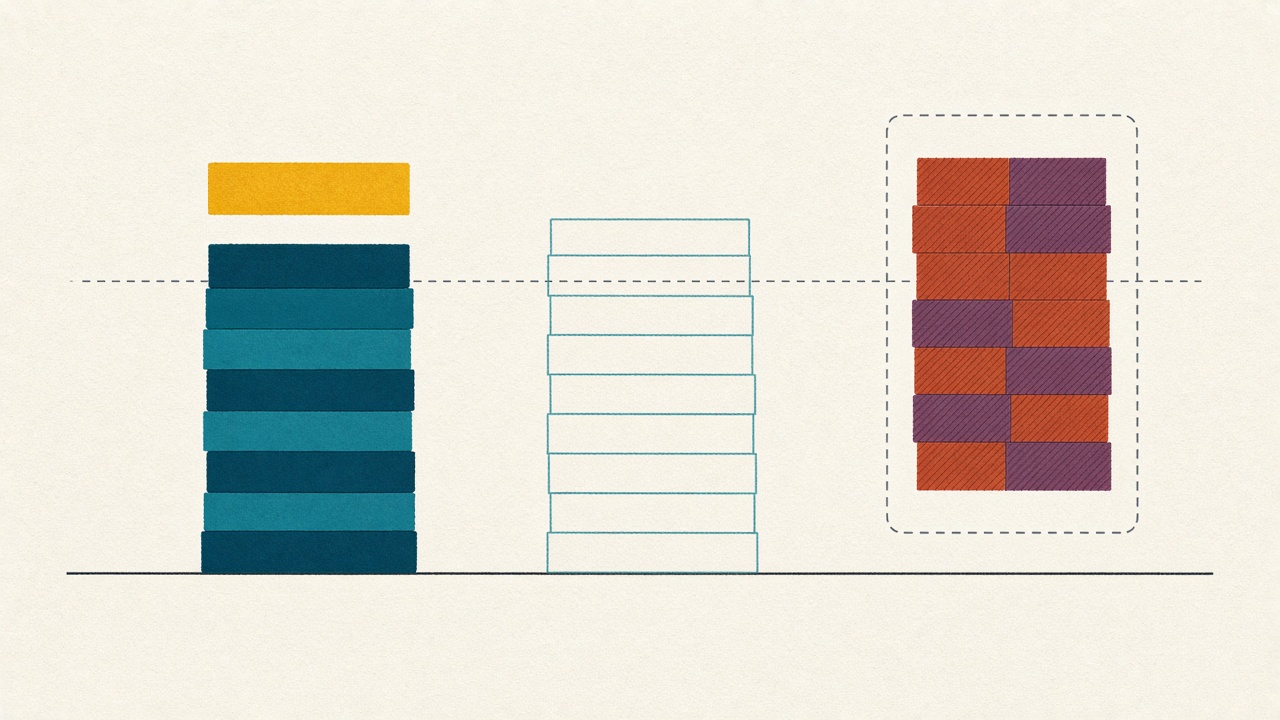
The holdout measures the price rise against leaving rates unchanged. The publisher had already proved targeted renewal increases manually on a pilot brand [1]. Before rollout, the vendor ran a three-cell test against that manual method and a control.
In the vendor's words, the model "matched" the existing approach [1]. No cell figures are published, so the public record shows no margin edge over human targeting. Throughput is the model's own line, and the hours and rollout sit in the table below.
If the manual team could not have reached the rest of the portfolio in that half year, part of the margin depended on rollout speed. The page does not split results by title, so that share stays an open gap.
What you can book on the AI line
Vendor-reported figures. Each row states what the test compared and what a finance lead can book as AI-caused. Limits sit in the cells beside the numbers they qualify.
| Claim | As reported | What the test supports | Bookable on the AI line |
|---|---|---|---|
| Split of the first-half margin, 10 titles, Jan to Jun 2026 | About $1.7M from annual subscribers and nearly $140,000 from monthly plans [1] | Selective rises work on low-churn-risk readers | Unproven vs manual targeting; scale share undisclosed |
| Annual run-rate | "Nearly $4M" [1] | Vendor annualisation of six months; an extrapolation, not a measured result | Zero until a full year is measured |
| Retention | 93.0% vs 93.7% in the control, 0.7 percentage points lower [1] | A retention gap; no group sizes or significance test published | A cost of the price rise, to net against margin |
| Analyst effort | "Hundreds of hours" per brand, and nine more brands in one month [1] | The automated workflow replaced manual prep and then scaled | Yes, at loaded hourly cost; exact hours unstated |
| HVAC follow-ups, Arctic Air, Apr to Nov 3, 2026 | $548,418 "extra revenue" across 320 deals at four branches: $402,574 from follow-ups on 4,808 completed jobs and $145,844 from 12 turnover jobs [2] | Deals closed after an automated follow-up, attributed by sold date from the vendor's own dashboard, with no holdout; undated page retrieved Nov 23, 2026 | Zero as incremental; attribution only |
I cannot draw a 24-month payback period because the source omits the software and data cost. Price the contract internally by setting the licence and data work against loaded analyst hours saved, plus margin from titles the team could not otherwise have reached.
Scope and limits
Both revenue cases are vendor-published. The specialty publisher is unnamed. I have dropped the vendor's headline ROI multiple because the page states no cost base for the program.
When a dashboard credit fails
The HVAC row in the table is a credit allocation. Some of those customers would have bought anyway, and without a holdout nobody can say how many.
The publisher case has a shelf life too. The vendor recommends rules to stop repeated increases on the same subscriber within a set window [1]. That is a reason to keep an annualised half-year out of next year's budget.
Finance chiefs have cause to stay skeptical. In August and September 2026, HFS Research and Rackspace surveyed 502 AI-active enterprises [3]. 21% reported measurable revenue growth, against 42% reporting cost reductions. That survey is self-reported.
A September 2026 survey of 500 large-firm executives by the Capgemini Research Institute put revenue growth citations at 32% [4]. That survey is also self-reported.
What we sell
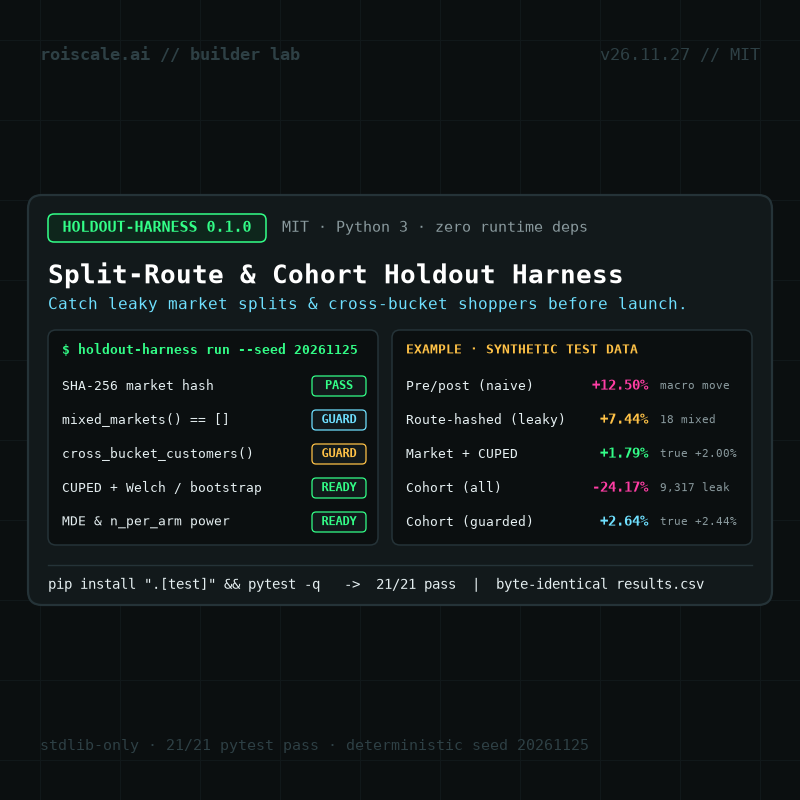
Members get Rex Circuit's Split-Route & Booking-Cohort Holdout Harness free. On synthetic data, it shows how a leaky control split can fake or flip measured lift. Run it before you accept a vendor's control group.
Who signs it off
The finance lead, or the CFO where there is one, approves what enters the operating plan. Book the controlled pricing margin when the holdout is clean.
Leave the AI line blank until the licence is set against the hours actually saved. Keep annualised run-rates in a memo column until a second period confirms they hold.
Require group sizes with any retention gap, and state cost to serve, before calling a gross gain bottom-line margin.
Sources
- Actable, "Pricing Optimization: $4M in Annual Bottom-Line Impact for a Specialty Publisher," vendor case page, undated, retrieved Nov 23, 2026. actable.com
- Noso Labs, "Arctic Air · 4 Branches," vendor case page, undated (data through Nov 3, 2026), retrieved Nov 23, 2026. noso.so
- HFS Research and Rackspace, survey of 502 AI-active enterprises, press release, Nov 12, 2026. hfsresearch.com
- Capgemini Research Institute, AI economics snapshot, survey of 500 executives, press release, Nov 12, 2026. capgemini.com