


Derek Mobley is an African American man over 40, with a finance degree from Morehouse College, who lives with anxiety and depression. That is how a federal court in California summarised his complaint.1 He alleges that since 2017 he has applied to more than 100 jobs at employers using Workday's screening tools and was turned down every time, often after a Workday-branded assessment or personality test, and once less than an hour after applying at 12:55 a.m. All of this is alleged; nothing has been decided on the merits, and Workday denies that its technology discriminates.1,6
Who Is Responsible When Software Says No
In July 2024 the court held that Workday could be sued as an agent of the employers that use it. “Employers cannot escape liability for discrimination by delegating their traditional functions, like hiring, to a third party,” the order reads. Nothing in the statutes, it added, distinguishes between delegating to an automated agent and to a live human one.1 In June 2026 the court let disability and most California state-law claims go forward while dismissing some others.2
Mobley is not alone, and not every case succeeds. Arshon Harper alleged that Sirius XM's screening tools scored applicants on proxies for race such as schools and zip codes, and that about 150 applications produced one interview and no offer. On 30 September 2026 a federal judge in Michigan ruled for Sirius XM on the pleadings.3 Erin Kistler and Sruti Bhaumik allege that Eightfold AI's applicant scores are consumer reports under the Fair Credit Reporting Act, requiring notice and a chance to dispute. Kistler says she applied for two PayPal roles through a link containing “eightfold.ai” and was never asked to interview. Eightfold has moved to dismiss.4
Who Benefits, Who Pays
Automated screening saves employers hours and speeds hiring. That is an efficiency gain, not a welfare gain. A wrong rejection's cost falls on the applicant, who rarely learns why. Responsibility sits with the employer that delegated the decision and, plausibly, the vendor that accepted it, yet often no one stands at the exit.
What the Evidence Says
In a preregistered experiment, Chuyao Wang, Patrick Sturgis and Daniel de Kadt had 1,919 U.S. job seekers choose between screening systems. Relative to AI deciding alone, a human decision raised the probability a system was chosen by 0.257 to 0.287, an appeal by 0.156, an opt-out by 0.129 and an independent bias audit by 0.068. Human involvement moved choices about as much as cutting wrongful rejections from 30% to 10%.5 These are stated preferences in an unreviewed preprint, but the ordering is instructive: the audit ranked last.
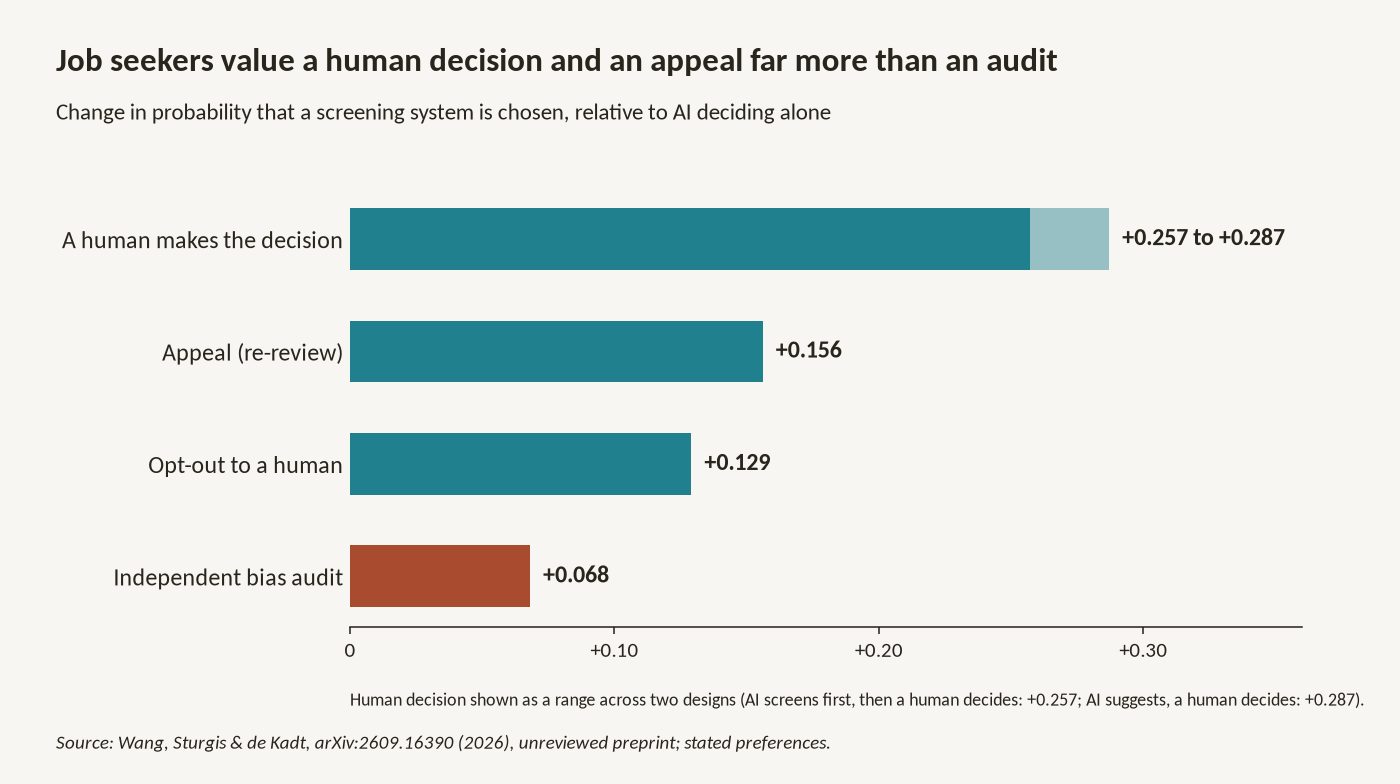
Job seekers rank a human decision and an appeal above an audit.
The Fix: A Reject-Path Review
Three checks cover one hiring workflow. First, map every point where a candidate can leave without a person seeing the file: knockout questions, score cutoffs, the automatic rejection email. Second, put a named reviewer on each automatic rejection, or on a defined sample when volume makes full review impractical. Third, add an appeal link to every rejection, with a real person's name and a date by which they will reply. The readout should report, for each exit, how many candidates left unseen, how many appealed and how many decisions were reversed. A score can route a file to a person; it must never send the rejection.
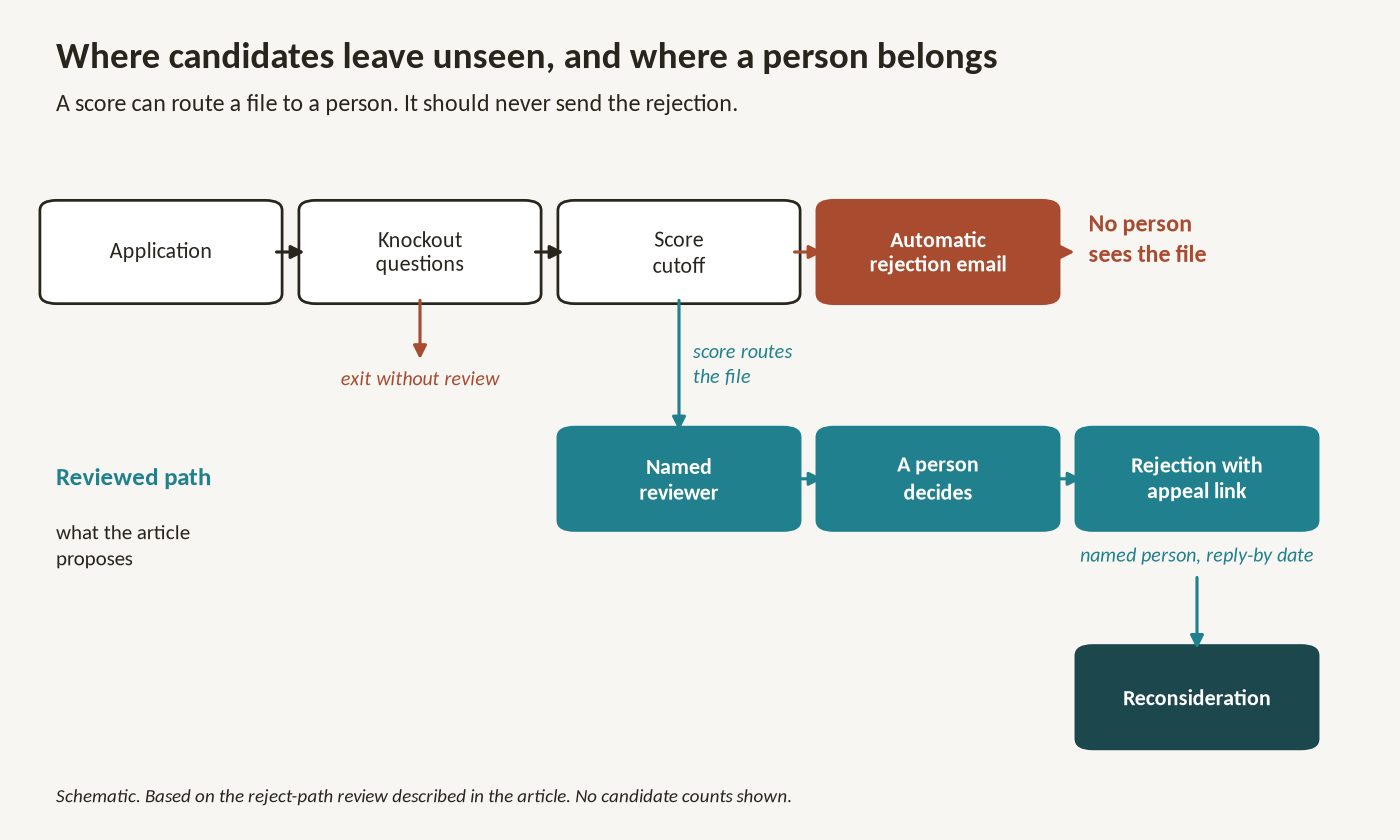
Scores route files to people; they never send the rejection.
What This Means for You
Workers: If a rejection arrives fast or at an odd hour, ask in writing whether a person reviewed your application and how to request reconsideration; keep copies. Our step-by-step guide and letter templates for the US, Canada and the EU: [LINK TO WORKER GUIDE — placeholder].
HR, talent and counsel: List every automated exit, including vendor auto-disposition defaults, and confirm no score sends a rejection without a named reviewer. After the Workday rulings, assume responsibility includes you.
Policymakers: A right to human review at the point of rejection is easier to verify than disclosure alone. Requiring employers to record unseen exits and reversals would give enforcers something to measure.
Technology is only progress if it moves people forward.
References
1. Mobley v. Workday, No. 3:23-cv-00770 (N.D. Cal.), order, 12 Jul 2024. https://storage.courtlistener.com/recap/gov.uscourts.cand.408645/gov.uscourts.cand.408645.80.0.pdf
2. Mobley v. Workday, order, 22 Jun 2026. https://www.govinfo.gov/content/pkg/USCOURTS-cand-3_23-cv-00770/pdf/USCOURTS-cand-3_23-cv-00770-17.pdf
3. Harper v. Sirius XM, No. 2:25-cv-12403 (E.D. Mich.), docket incl. complaint and 30 Sep 2026 order. https://www.courtlistener.com/docket/71038991/harper-v-sirius-xm-radio-llc/
4. Kistler v. Eightfold AI, complaint, 20 Jan 2026; motion to dismiss, N.D. Cal. No. 3:26-cv-01768. https://www.classaction.org/media/kistler-et-al-v-eightfold-ai-inc-complaint.pdf
5. Wang, Sturgis & de Kadt, arXiv:2609.16390 (2026), preprint. https://arxiv.org/abs/2609.16390
6. Lawyer Monthly, 21 Sep 2026 (Workday's denial). https://www.lawyer-monthly.com/2026/09/workday-faces-class-bid-over-ai-hiring-bias-claims/