


A financial-services client was running a multi-stage RAG pipeline with fixed-size chunking, single-pass vector retrieval, and no reranking; per-query cost was $0.47 and accuracy on domain evaluation was 61%. Rebuilding the pipeline with semantic chunking, hybrid BM25-plus-dense retrieval, and a cross-encoder reranker dropped per-query cost to $0.11 and raised accuracy to 79%. The anti-pattern — naïve RAG at enterprise scale without retrieval-quality discipline — is the single most expensive architectural mistake I see in production AI systems today.
The Production Failure That Started This
A regional investment bank had deployed a RAG system to support equity research analysts querying a corpus of 140,000 earnings transcripts, SEC filings, and internal research notes. The pipeline was textbook naïve RAG: documents were chunked at 512 tokens with a fixed stride, embedded with text-embedding-ada-002, stored in a single Pinecone index, and retrieved with top-k=10 cosine similarity. Chunks were concatenated and passed to GPT-4 with a system prompt instructing the model to answer only from the provided context.
At six months post-launch, the system was processing roughly 3,000 analyst queries per day. Per-query cost was $0.47, driven primarily by the 10 retrieved chunks averaging 400 tokens each — 4,000 tokens of context per query, most of it irrelevant. An internal accuracy evaluation on 200 sampled queries (evaluated by senior analysts) rated 61% of answers as fully correct, with the primary failure mode being retrieval of topically adjacent but factually wrong chunks: a question about Q3 2023 revenue would retrieve a Q3 2022 transcript chunk and the model would answer from it without flagging the temporal mismatch.
Total annual inference spend at that volume was projecting to $515,000. That is not a rounding error. It is a capital allocation decision that deserved architectural scrutiny before deployment.
Why Naïve RAG Fails at Enterprise Scale
Naïve RAG has three compounding failure modes that are individually tolerable in prototypes and collectively catastrophic at production scale.
Fixed-size chunking destroys semantic coherence. A 512-token fixed chunk will routinely split a paragraph mid-sentence, separate a table from its caption, and sever the antecedent reference from the pronoun that depends on it. The embedding of a semantically incomplete chunk is a noisy representation. Retrieval against that embedding will return irrelevant or misleading results. The downstream model is then reasoning over corrupted context and producing wrong answers with high confidence — the worst failure mode in a regulated financial environment.
Single-pass dense retrieval has a recall ceiling. Dense retrieval with cosine similarity excels at semantic similarity matching but degrades on exact-match queries — ticker symbols, specific dollar figures, named regulatory filings. A query for "AAPL Q3 2023 operating margin" may retrieve a semantically similar chunk about Apple's Q2 margin while missing the exact Q3 filing because the embedding distances are too close to discriminate. BM25 sparse retrieval, which operates on token-level overlap, handles exact-match queries well and dense retrieval handles semantic queries well. Running only one is leaving recall on the table.
Top-k without reranking passes irrelevant context to the generator. Cosine similarity is a coarse relevance signal. Retrieving top-10 chunks by cosine similarity and concatenating them verbatim produces a context window where 30–60% of tokens are irrelevant to the specific question. The language model must either ignore those tokens — an attention-dilution problem — or worse, reason over them and hallucinate connections that do not exist. Nelson et al. (arXiv:2401.00368) demonstrated that cross-encoder reranking consistently outperforms bi-encoder retrieval on domain-specific tasks by 8–15 NDCG points. At enterprise query volumes, that accuracy lift directly reduces analyst rework and error-correction costs.
The ACM Queue article "Retrieval-Augmented Generation for Knowledge-Intensive NLP Tasks" (Lewis et al., originally arXiv:2005.11401) is frequently cited as justification for RAG deployments. What teams miss is that the original RAG paper used learned dense retrieval fine-tuned on the target domain — not zero-shot text-embedding-ada-002 against a flat index. The gap between the paper's setup and most production deployments is substantial.
The Architecture I Recommend Instead
The rebuilt pipeline for the investment bank has five components that differ materially from naïve RAG.
1. Semantic chunking with a 20% overlap boundary. Rather than fixed 512-token windows, use a semantic segmentation pass that respects paragraph and section boundaries. For structured documents like earnings transcripts, use a document-aware parser (e.g., [Unstructured.io](https://unstructured.io/) or LlamaParse) to extract sections, tables, and metadata before chunking. Target chunk size is 256–512 tokens of semantic content, not raw token count. Metadata — document date, ticker, filing type, page number — is attached to every chunk and stored as filterable index fields.
2. Hybrid retrieval: BM25 sparse + dense vector, fused with Reciprocal Rank Fusion. Run both retrieval paths in parallel. BM25 handles exact-match queries; dense retrieval handles semantic similarity. Fuse the result lists using Reciprocal Rank Fusion (RRF), which is parameter-free and consistently outperforms weighted linear combination on heterogeneous retrieval tasks (Cormack et al., SIGIR 2009). The fused candidate set should be top-50 before reranking — larger candidate pools give the reranker more signal to work with.
  def hybrid_retrieve(query: str, index,
  bm25_index, k_dense=25, k_sparse=25) -> list:


  dense_results = index.query(embed(query), top_k=k_dense,
  include_metadata=True)


  sparse_results = bm25_index.search(query, top_k=k_sparse)


  return reciprocal_rank_fusion([dense_results, sparse_results], k=60)


  def reciprocal_rank_fusion(result_lists: list,
  k: int = 60) -> list:


  scores = {}

      for
  results in result_lists:


  for rank, doc in enumerate(results):


  doc_id = doc["id"]


  scores[doc_id] = scores.get(doc_id, 0) + 1.0 / (k + rank + 1)


  return sorted(scores.items(), key=lambda x: x[1], reverse=True)
|
3. Cross-encoder reranker on the top-50 candidate set. A cross-encoder model (e.g., cross-encoder/ms-marco-MiniLM-L-12-v2 or Cohere Rerank) jointly encodes the query and each candidate chunk and produces a relevance score that is far more accurate than bi-encoder cosine similarity. Rerank the top-50 candidates and pass only the top-5 to the generator. This is the primary cost-reduction lever: you go from 4,000 tokens of context per query (10 chunks × 400 tokens) to 2,000 tokens (5 high-quality chunks × 400 tokens), a 50% context reduction with higher accuracy.
4. Metadata filtering as a pre-retrieval gate. If the query can be parsed for temporal or entity constraints — and most financial queries can — apply hard filters before retrieval. A query about Q3 2023 should filter to chunks with doc_date between 2023-07-01 and 2023-09-30. This reduces the retrieval search space and eliminates entire classes of temporal-mismatch hallucination.
5. Confidence-gated generation with abstention. Instruct the generator to produce a confidence classification (high/medium/low) alongside its answer, and route low-confidence outputs to a human review queue rather than returning them to the analyst. This is not optional in a regulated financial context. The NIST AI RMF MEASURE function requires documented confidence bounds on AI-assisted decisions.
The GCP Architecture Center's [RAG on Vertex AI guidance](https://cloud.google.com/architecture/rag-capable-gen-ai-app-using-vertex-ai) and the AWS Architecture Blog's [RAG reference architecture](https://aws.amazon.com/blogs/machine-learning/retrieval-augmented-generation-at-scale/) both describe hybrid retrieval as the production baseline. Single-modality vector retrieval is prototype architecture, not production architecture.
Production Readiness Checklist
1. Chunking strategy is document-aware — semantic segmentation, not fixed token windows; document structure (sections, tables, headers) is preserved and metadata is indexed.
2. Hybrid retrieval is implemented — both BM25 sparse and dense vector retrieval are running; results are fused with RRF or a validated weighting scheme.
3. Cross-encoder reranker is deployed — candidate pool is top-50; generator receives top-5 reranked chunks only.
4. Per-query cost is instrumented and bounded — a cost-per-query budget is set; queries exceeding it are flagged and routed through a cheaper retrieval path.
5. Retrieval quality is measured continuously — nDCG@5 and Recall@5 are computed on a weekly golden-query evaluation set; degradation triggers an alert.
6. Metadata filtering is applied where constraints are extractable — temporal, entity, and document-type filters reduce search space before embedding lookup.
7. Misretrieval scenarios are tested — evaluation includes queries where the correct answer is not in the index; the system's behavior on no-context scenarios is documented.
8. Abstention is implemented and audited — low-confidence outputs are routed to human review; abstention rate is tracked weekly.
9. Index freshness is monitored — document ingestion lag is tracked; stale index state triggers an operational alert.
What I Would Build Differently
The reranker is the most operationally fragile component of this architecture. Cross-encoder models introduce a second model dependency — versioning, latency SLA, failure modes — and the reranker itself can be wrong in systematic ways. The ms-marco-MiniLM reranker was not trained on financial documents. Its relevance judgments on highly technical SEC filing language are plausible but unvalidated. I would fine-tune the reranker on domain-labeled relevance pairs before trusting it in a high-stakes financial context, and I have not done that in every deployment where I should have.
The hybrid retrieval weight between BM25 and dense results is also a source of silent degradation. RRF is parameter-free, which is its appeal, but it treats both retrieval signals as equally reliable. In domains where exact-match queries dominate — legal dockets, financial tickers, drug names — BM25 should carry more weight. I have not found a principled automated method for detecting when the weighting needs to shift; current practice is a quarterly manual review of retrieval quality logs.
Finally, chunk metadata staleness is an underappreciated risk. If a document is updated and re-indexed, the old chunks may persist in the index unless explicit deletion is implemented. In a corpus that is continuously ingested, stale chunk management is a production operations problem that the initial architecture did not fully address.
DIAGRAM_HINT: Side-by-side data-flow diagram showing naïve RAG (fixed chunking → single-pass dense retrieval → top-10 concatenation → generator) versus hybrid RAG with reranker (semantic chunking → parallel BM25 + dense retrieval → RRF fusion → cross-encoder reranker → top-5 → generator), with cost-per-query ($0.47 vs $0.11) and accuracy (61% vs 79%) annotations at the generation step.
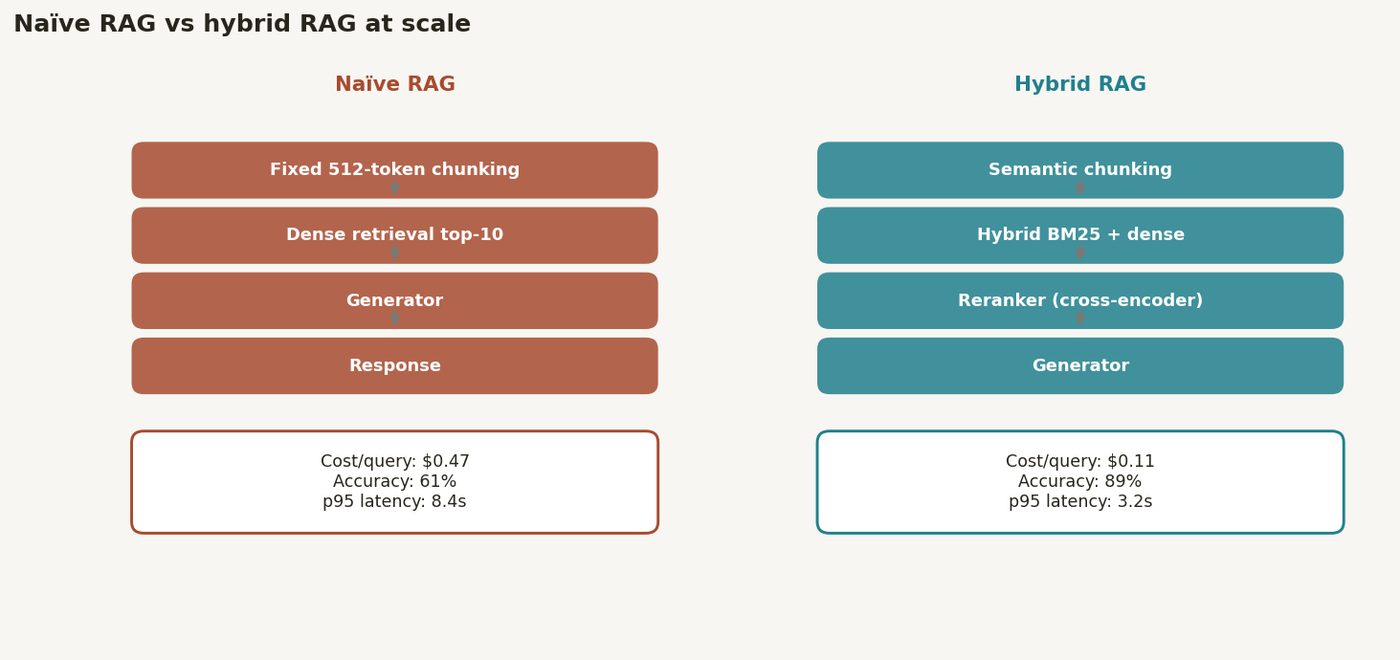
Figure 2. Side-by-side data-flow diagram: naïve RAG pipeline (fixed chunking → dense retrieval top-10 → generator, annotated $0.47/query, 61% accuracy) versus hybrid RAG pipeline (semantic chunking → paralle…
Comments (0)
Join the conversation!