


She wrote the call scripts that became the training data for her employer's voice AI, and six months later her team was cut — a pattern that reveals what the 'AI augmentation' narrative consistently leaves out of customer-service operations.
The Labor of Language
Amara Osei spent the better part of 2021 talking into a headset, solving problems she wasn't supposed to be solving and writing down the ones she was. She was a Tier-1 customer service agent at a regional telecommunications company in Atlanta — the kind of work that is often described, from the outside, as repetitive and unskilled, and is, from the inside, an intricate negotiation between a frustrated customer, an inadequate database, and a company's contractual liability limits.
When customers called with billing disputes, Amara listened. When they called with outage complaints, she sympathized. When they called furious about a promise a sales representative had made that the system had no record of, she found the language to de-escalate, document, and route. She was good at her job. Her supervisor knew it. Her quality scores showed it. Her training materials — the call scripts, the de-escalation frameworks, the decision trees she had personally helped revise over four years — reflected it.
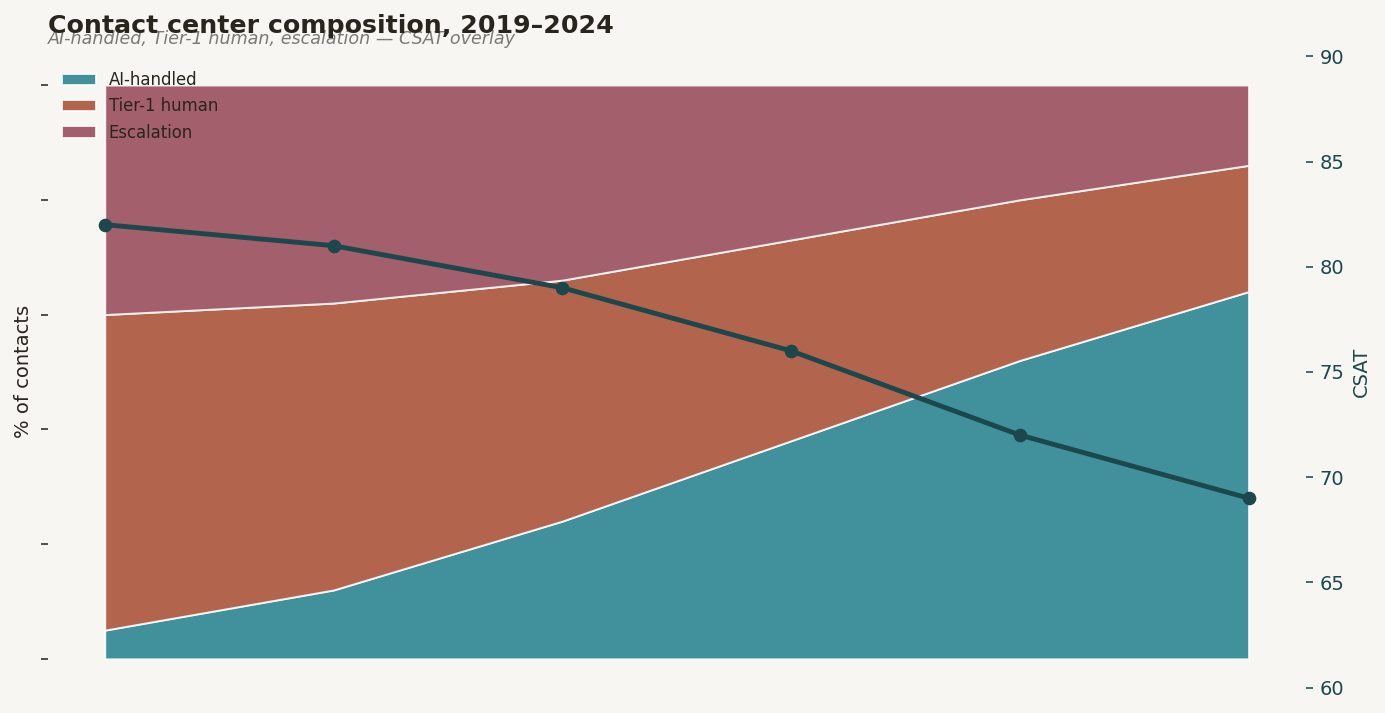
In 2022, the company launched a pilot of a voice AI customer service system. Amara's team was told they would be "augmented." The AI would handle Tier-1 volume; they would handle escalations. Seven months after the pilot went enterprise-wide, her team of forty-three was reduced to eleven. The voice AI, trained in part on call transcripts and the scripts Amara had helped write, was handling 64% of incoming contacts without escalation. Amara was among the thirty-two who received a transition package. She spent six months trying to figure out what came next.
Augmentation as Prelude
The "augmentation" framing — AI tools that help workers rather than replace them — has become the dominant rhetorical mode for AI deployment in customer service and contact center operations. It is not always dishonest. There are deployments where AI genuinely functions as decision support, providing agents with real-time information, suggesting responses, and reducing the cognitive load of navigating complex knowledge bases. But the augmentation framing is also frequently applied to deployments where the actual trajectory is toward workforce reduction, and workers are given no reliable way to know which situation they are in.
The distinction matters enormously for how workers should think about their participation in training and calibration activities. A worker who believes she is being augmented has different rational interests than a worker who is, in fact, being replaced. She might help more freely, share more knowledge, participate in more optimization sessions. The information asymmetry is structural.
BLS data shows that customer service representative employment declined 5% between 2020 and 2024 — a period during which overall employment grew — and projects a further 5% decline through 2033 as AI-mediated customer interaction becomes standard across financial services, telecommunications, retail, and utilities ([BLS Occupational Outlook Handbook, 2024](https://www.bls.gov/ooh/office-and-administrative-support/customer-service-representatives.htm)). The jobs that remain are, in many cases, substantively different from the ones that existed before: they involve supervising AI interactions, handling the escalations and edge cases the AI cannot manage, and — critically — continuing to generate the training data and interaction logs that improve the AI that handles the rest.
Shadow Training
The term "shadow training" was coined by labor researchers to describe the phenomenon Amara experienced: the process by which customer-facing workers generate, through their daily labor, training data for the AI systems that ultimately replace them — without compensation, explicit awareness, or consent.
Every call a skilled agent handles produces a transcript. That transcript is a record of effective customer communication — the specific language, the emotional tone, the problem-framing that resolved a situation. In aggregate, these transcripts are among the most valuable training assets in customer service AI development. Companies that have deployed voice AI extensively — including in telecommunications, banking, and insurance — acknowledge that human agent call records were central to their training datasets, though the specific contribution of individual workers is rarely disclosed.
Kate Crawford's work examines how this kind of invisible labor — the ongoing human effort that maintains and improves AI systems — is systematically excluded from the accounting of AI's economic value ([Kate Crawford, Atlas of AI, 2021](https://yalebooks.yale.edu/book/9780300209570/atlas-of-ai/)). Content moderation workers, data labelers, and customer service agents all contribute to AI systems that generate substantial commercial value; none of them hold any rights in the systems they help to improve, and few receive compensation beyond their base wages for the AI-training dimensions of their work.
The NBER has documented that in customer service occupations, women and workers of color are disproportionately represented — reflecting decades of labor market stratification — and therefore disproportionately bear the costs of AI-driven displacement in these roles ([NBER Working Paper No. 32208, "Demographic Patterns in AI-Displaced Occupations," 2024](https://www.nber.org/papers/w32208)). The gains flow predominantly to institutions and shareholders; the costs, once again, are most heavily borne by those who were already least well-positioned in the labor market.
The Career Ladder Problem
Customer service work has historically functioned as a career entry point — a way into corporate employment that required interpersonal skill and allowed workers to demonstrate capability, get access to benefits and employer networks, and advance toward supervisory, training, or operational roles. This ladder existed at scale. Contact centers employed hundreds of thousands of workers who were, in the best circumstances, moving through and up.
The AI transition is not simply removing rungs from this ladder; it is removing the ladder itself for the people who most depended on it. An AI system that handles 64% of Tier-1 contacts doesn't create 64% fewer career entry points at the Tier-1 level — it reduces Tier-1 headcount by a greater proportion, because the cases remaining for human agents are the most complex and require the most experience. Employers who reduce Tier-1 staff substantially find themselves needing agents who are already skilled, not workers who are developing skills.
"They kept saying the work was going to be more interesting," said one agent at a financial services call center in Phoenix, who has been in the role for eight years and asked not to be named. "And it is, kind of. Every call is a problem the AI couldn't solve. But there are eleven of us now instead of sixty. Nobody is getting trained. Nobody is moving up. The ladder is gone."
Stanford HAI's 2024 survey of AI deployment in service industries found that 71% of companies that had deployed customer-service AI reported a net reduction in frontline service staff, with supervisory and quality assurance roles declining alongside agent headcount ([Stanford HAI, "AI Deployment in Service Industries," 2024](https://hai.stanford.edu/research/ai-index-2024)). The "human-in-the-loop" supervision model — the idea that humans would oversee and improve AI customer interactions — has materialized in some organizations, but at far lower headcounts than the original agent pool.
Who Benefits, Who Pays
Contact center AI generates genuine efficiency gains. Per-contact costs in AI-handled interactions are typically 60-80% lower than in human-handled interactions. Customer satisfaction scores in AI-mediated contacts, for routine queries, have approached parity with human handling in several published case studies. The technology has improved substantially, and its improvement trajectory shows no sign of plateauing.
The efficiency gains accrue to companies and, to some degree, to customers who get faster responses for simple issues. The costs fall on workers who lose employment or whose career trajectories are truncated, on communities where contact centers have been significant employers (often in regions with limited alternatives), and on the broader labor market, as a historically accessible employment pathway closes.
Brookings has documented the geographic concentration of contact center employment — predominantly in mid-sized cities in the South and Midwest — and noted that AI-driven displacement in this sector will have concentrated local economic effects in places that lack the economic diversification to absorb them ([Brookings, "AI and Geographic Labor Market Disparities," 2023](https://www.brookings.edu/research/)). Amara's Atlanta is a large, diversified metro. The workers in smaller cities with fewer options are less visible in this analysis and more vulnerable to its consequences.
What This Means for You
For customer service and contact center workers: If your employer has introduced AI tools into your workflow, ask directly and in writing what the company's headcount planning horizon is for your team. Request to see the governance documentation for any AI system that uses your call recordings or interaction logs as training data. Know that in most U.S. jurisdictions you have the right to see what data your employer holds about your work performance. Union representation in contact centers, while historically low, has been growing as workers recognize that AI deployment decisions are collective bargaining issues.
For managers and workforce planners: The transition from human-majority to AI-majority customer service operations creates genuine organizational risk. The complex, escalated cases that human agents handle after AI deployment represent your most difficult customer interactions — and they arrive in a context where experienced agents are fewer and institutional knowledge is thinner. Building deliberate knowledge-management and mentorship systems during the transition period is not just ethically advisable; it is operationally prudent.
For policy-makers: The "augmentation" framing in public discourse about AI and customer service jobs obscures a real displacement trend with documented demographic dimensions. Policy responses should include: extending Trade Adjustment Assistance or equivalent programs to workers displaced by domestic AI automation (currently not eligible); funding retraining programs specifically designed for experienced customer service workers transitioning to adjacent roles; and requiring companies above a certain scale to conduct and disclose AI workforce impact assessments before deploying AI systems in customer-facing operations.
Amara Osei is working now as a patient services coordinator at a medical practice in Decatur. The work uses many of the same skills she developed in the contact center. It pays somewhat less. She doesn't regret what she built at her former employer. "I was good at that job," she said. "I just wish they'd been honest about what they were doing with it."
Comments (0)
Join the conversation!