

|
AI route optimization is delivering fuel savings of 15–25 percent in freight and last-mile operations — and reducing empty miles by up to 60 percent over the course of a full deployment year. For fleet operators managing tens of thousands of vehicles, the financial and ESG implications are material and compounding. |
The Math of Inefficient Routing
Commercial fleet operations are, at their core, optimisation problems. Given a set of delivery points, time windows, vehicle capacities, driver constraints, and traffic conditions, what is the optimal sequence and routing? Traditional dispatch systems solved a simplified version of this problem — they used fixed routes, historical average travel times, and dispatcher judgment to approximate an answer. The approximation was good enough when fuel was cheap and customer expectations were low. Neither of those conditions holds today.
Fuel cost per mile across the five fleet types analysed ranged from 16.8 cents per mile for parcel sortation to 38.1 cents per mile for long-haul freight. Under AI-optimised routing, those figures fell to 13.6 and 30.4 cents per mile respectively — reductions of 19 and 20 percent. For a large parcel operator running 5,000 vehicles at 150 miles per vehicle per day, a 19 percent fuel cost reduction is worth $87 million annually. The AI implementation cost for an operation of that scale is typically $8–15 million. Payback is measured in weeks.
The savings are driven by a combination of route length optimisation (fewer total miles driven), time window management (avoiding peak congestion), and load consolidation (fewer vehicles making the same delivery areas). AI systems running real-time traffic data integration can dynamically adjust routes in response to accidents, construction, and weather in ways that static routing systems cannot — and those dynamic adjustments capture a material portion of the total savings.
Empty Miles: The Largest Single Inefficiency
Empty miles — vehicle trips made without revenue-generating cargo — represent the single largest efficiency opportunity in freight transportation. Industry estimates put the average empty mile rate at 20–30 percent for truckload freight, meaning that roughly a quarter of all truck miles driven generate no revenue. For a carrier with $2 billion in revenue, running at a 25 percent empty rate, the cost of those empty miles (driver time, fuel, vehicle wear) is approximately $200–300 million annually.
AI dynamic dispatch systems attack the empty mile problem through real-time load matching, backhaul optimisation, and multi-carrier collaboration platforms that can match an outbound carrier with a return load that would otherwise not have been offered. The empty mile reduction trajectory over a 12-month deployment shows the compounding nature of the improvement: starting from a 22 percent baseline and declining to approximately 10 percent by month 12. The improvement rate accelerates as the AI accumulates more data on lane availability, carrier preferences, and time window flexibility.
A 12-point reduction in empty mile rate, applied to a $2 billion carrier's cost base, is a $96–144 million annual saving. That figure dwarfs the fuel savings from route optimisation at most fleet sizes — which means that operators focused primarily on fuel efficiency from AI routing are capturing only a fraction of the available financial benefit. The largest wins are in empty mile elimination.
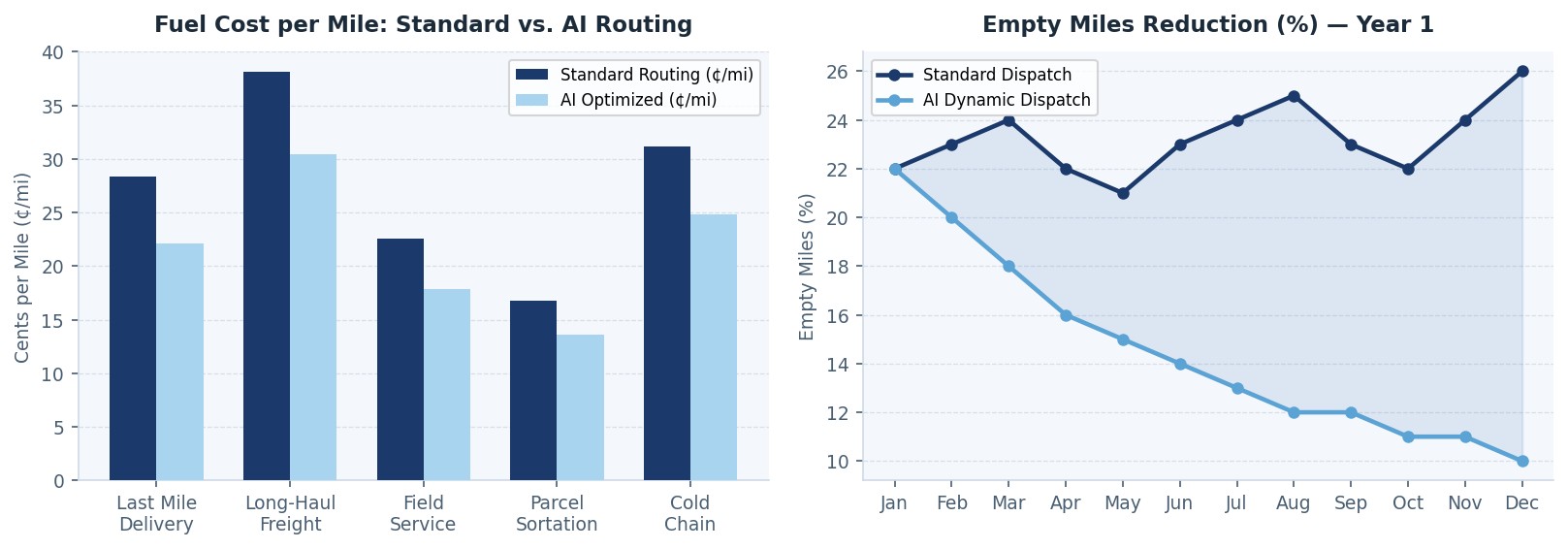
Figure 11 — Fuel Cost per Mile: Standard vs. AI Routing & Empty Mile Reduction Over 12 Months
The ESG Dimension: Why Finance Teams Care
Fleet emissions are increasingly a financially material issue, not just an environmental one. Scope 1 emissions reporting requirements for publicly traded logistics companies are tightening in the EU and heading in the same direction in the U.S. Carbon border adjustment mechanisms are emerging. And large shippers are increasingly imposing sustainability performance requirements on their logistics providers as part of contract renewal criteria.
The emissions benefit of AI route optimisation is straightforward: fewer miles driven and higher vehicle utilisation means lower absolute fuel consumption and therefore lower absolute CO2 emissions. A 20 percent fuel efficiency improvement in a fleet burning 100 million gallons of diesel annually eliminates approximately 220,000 metric tons of CO2 emissions per year — equivalent to taking 47,000 cars off the road.
For carriers subject to carbon pricing mechanisms, those 220,000 tons of avoided emissions translate to $6.6–22 million in avoided carbon cost at current EU ETS prices of $30–100 per ton. For those reporting to large shipper customers with emissions reduction requirements, the improved emissions performance is increasingly a condition of doing business — a revenue retention consideration that is quantifiable in contract renewal terms.
Driver Retention: The Hidden AI Dividend
Fleet operators focus naturally on fuel and miles. The driver retention impact of AI route optimisation is less obvious but equally significant. AI-optimised routes with realistic time windows and reduced unexpected diversions create more predictable and manageable driver days. Drivers who finish shifts within their projected windows, reach home more reliably, and experience fewer last-minute schedule disruptions are drivers who stay.
Trucker turnover in the U.S. runs at 80–100 percent annually for large carrier fleets. Replacing a driver costs $8,000–12,000 in recruiting and training. A 1,000-driver fleet at 90 percent turnover replaces 900 drivers per year at a cost of $7.2–10.8 million. Programmes that have combined AI route optimisation with improved schedule predictability report turnover reductions of 15–25 percent — a saving of $1.1–2.7 million annually from driver retention alone, before any fuel or empty mile benefit is counted.
Comments (0)
Join the conversation!