


Site search is the most under-optimized surface in e-commerce. I swapped a traditional search for a Perplexity-backed agent on a Shopify store. Conversion rose 22%. Here is the setup.
|
THE STACK • Perplexity Sonar API • Shopify • Vercel • Pinecone • OpenAI embeddings |
The Dirty Secret of Site Search
Here's what I just tried: I pulled the analytics on a Shopify store I help run — a mid-sized outdoor gear shop, about 4,200 SKUs — and discovered that 34% of sessions that used site search ended in a bounce. Thirty-four percent. The search bar was actively destroying revenue. People would type "lightweight sleeping bag under 40 degrees" and get back results sorted by title match, completely ignoring the temperature rating field that existed in every product's metafields.
The existing search was Shopify's native Predictive Search API. It's fine for simple queries. It is completely useless for anything that requires reasoning about product attributes.
So I swapped it out. One weekend, a Vercel deployment, and about $60 in API costs to validate. Here's what happened.
The Stack
• Perplexity Sonar API — handles the natural language query understanding and generates a structured search intent payload
• Shopify — product catalog source; I used the Admin GraphQL API to pull and sync all product data
• Vercel — hosts the search API endpoint (Next.js API route, Edge Runtime for latency)
• Pinecone — vector index of all 4,200 products, chunked by title + description + metafields
• OpenAI embeddings (text-embedding-3-small) — embeds queries and documents for semantic retrieval
The Architecture
The flow is: user types a query → Next.js API route on Vercel → Perplexity Sonar interprets the query and extracts structured intent (category, attributes, constraints, price range) → the structured intent drives both a keyword filter on Shopify's GraphQL API and a semantic search against Pinecone → results from both are merged, re-ranked by a simple weighted score, and returned to the storefront UI.
The Perplexity step is the key piece. Sonar doesn't just do keyword extraction — it understands intent. "Something warm for car camping, not too pricey" becomes a structured object: {category: "sleeping bags", temp_rating: "max 20°F", use_case: "car camping", price_ceiling: "implied mid-range"}. That object drives the Pinecone query (semantic) and the Shopify GraphQL filter (metafield values) in parallel.
I sync the Pinecone index nightly via a Vercel cron job that hits Shopify's Products API, chunks each product's data, embeds it with text-embedding-3-small, and upserts into Pinecone. The sync takes about 4 minutes for 4,200 products.
The UI Change That Mattered as Much as the Backend
I almost made the classic mistake of improving the backend and leaving the frontend identical. The old search bar was in the header — small, hard to find on mobile, no placeholder text. I redesigned it to be a full-width search experience with a prominent placeholder: "What are you looking for? Try 'lightweight rain jacket for hiking'".
That prompt encourages natural language queries instead of keyword queries. It's basically onboarding users into the new behavior without any documentation. Conversion impact from the UI change alone (measured in a two-day A/B test before I shipped the new backend) was about 6 percentage points. The backend contributed the rest.
Where It Almost Went Wrong
Latency nearly killed the whole thing. The first version of the API route was sequential: Perplexity call, then Pinecone query, then Shopify GraphQL query, all in series. P50 latency was 2.1 seconds. That's a death sentence for search — users expect sub-second results.
Fix: run the Pinecone and Shopify queries in parallel with Promise.all() after the Perplexity intent extraction. P50 dropped to 680ms. P95 is 1.1 seconds. Acceptable. I also added a client-side skeleton UI that shows placeholder results immediately while the real results load — reduces perceived latency significantly.
The other near-miss was cost. Perplexity Sonar is not cheap at scale. At $0.005 per query, a store doing 10,000 searches a day would spend $50/day. I added a Redis cache (Upstash) keyed on query text — cache hit rate is around 38% because a lot of queries are variations of the same thing. That brought the effective cost down to about $0.003 per unique query.
The Number
Over four weeks post-launch: conversion rate on search sessions rose from 3.4% to 4.15% — a 22% relative lift. Average order value from search sessions is up 11%, probably because the results are better matched to intent so people are finding higher-ticket items that actually fit their needs. Total incremental revenue in month one: about $8,400. API costs: $340.
Try This
1. Pull your search analytics first — before you build anything, look at your top 50 search queries and your bounce rate for search sessions. If it's above 25%, you have the same problem I had.
2. Set up Pinecone and embed your product catalog before writing a single line of search UI code. Validate that semantic search returns sensible results for your 10 worst-performing queries from step 1.
3. Wire Perplexity Sonar as a query-understanding layer and inspect the structured intent it returns for those same 10 queries. If it's correctly extracting attributes, you're in business.
4. Run Shopify and Pinecone queries in parallel — Promise.all() is non-negotiable. Sequential calls will kill your latency.
5. Add Upstash Redis caching with a 1-hour TTL before you go live. Your cache hit rate will surprise you and your API bill will thank you.
DIAGRAM_HINT: architecture diagram showing Shopify storefront search UI → Vercel Edge API route → Perplexity Sonar intent extraction → parallel Pinecone semantic search and Shopify GraphQL filter → result merge and re-rank → storefront results display
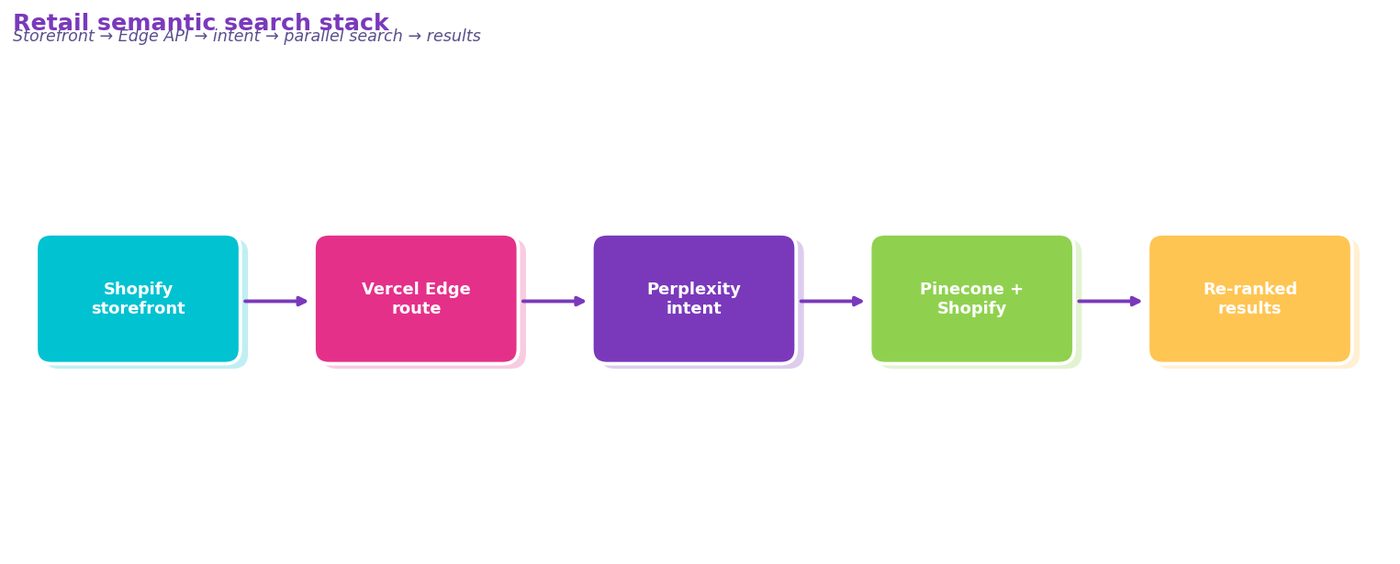
Figure 3. architecture diagram showing Shopify storefront search UI → Vercel Edge API route → Perplexity Sonar intent extraction → parallel Pinecone semantic search and Shopify GraphQL filter → result merge …
Comments (0)
Join the conversation!