


She spent two years training a credit-adjudication AI — then the bank cut her role — and the story of who benefits when human judgment is codified is also the story of who is expected to do the training without being paid for it.
The Hidden Cost of Institutional Memory
Diane Castellano spent the last eighteen months of her career at Midwest Regional Bank doing something her employment contract did not describe and her pay stub did not reflect: she was teaching a machine to do her job.
Every morning she arrived at the underwriting floor in Columbus, Ohio — a room of fluorescent light, laminate desks, and stacks of commercial loan files — and sat down next to a product manager who had flown in from the fintech vendor's San Francisco office. The product manager had a laptop and a list of questions. Diane had twenty-two years of commercial credit judgment. Together they worked through cases: why she had approved the Sandusky hardware store with a 1.18 debt-service-coverage ratio and three deferred tax years; why she had flagged the Cleveland restaurant group despite its impeccable payment history. She explained. He typed. The model learned.
She did this for ninety weeks. She was not compensated extra for the collaboration. When the vendor's AI credit-adjudication system went live in November 2023, Diane's position was among the first thirty-seven eliminated in the bank's workforce reduction announcement. The press release called the transition a "streamlining of back-office operations consistent with industry modernization efforts."
Knowledge as Capital, Labor as Depletable
What happened to Diane is not an isolated case. It is, labor economists argue, a structural feature of how AI systems enter professional workplaces — one that transfers intellectual capital from workers to institutions without compensation, and then uses that capital as justification for eliminating the workers who provided it.
The Bureau of Labor Statistics projects that loan officer employment will decline 4% between 2023 and 2033, with credit analysts facing even steeper losses in segments where AI-assisted underwriting has achieved regulatory acceptance ([BLS Occupational Outlook Handbook, 2024](https://www.bls.gov/ooh/business-and-financial/loan-officers.htm)). But the BLS projection obscures a more troubling sub-dynamic: the workers most likely to lose their jobs are often the most experienced ones, precisely because their judgment is most valuable to extract.
A 2024 working paper from the National Bureau of Economic Research found that in industries undergoing AI-assisted automation, workers in "judgment-intensive" occupations — roles requiring experiential heuristics that are difficult to codify — were disproportionately involved in system-training activities in the 12 to 24 months before layoffs ([NBER Working Paper No. 32114, 2024](https://www.nber.org/papers/w32114)). The study's authors described this as a form of "involuntary knowledge transfer," noting that workers typically had no contractual protection over the intellectual property they generated in these interactions.
"We think of AI training as a technical process," says Dr. Arjun Mehta, a labor economist at MIT's Work of the Future initiative. "But a huge portion of what makes these models useful in professional settings is the human judgment that gets baked into them during deployment. That judgment belongs to someone. Right now, that someone is rarely compensated for it." ([MIT Work of the Future, 2023](https://workofthefuture.mit.edu/))
What Underwriters Actually Know
The knowledge that Diane spent two decades accumulating is not easily reducible to variables in a credit model. Commercial underwriting involves what psychologists call "recognition-primed decision-making" — the rapid, pattern-based judgment that distinguishes an experienced professional from a novice and from an algorithm. She could look at a borrower's balance sheet and notice a receivables pattern that suggested seasonal concentration risk. She could read between the lines of a tax return to identify a family business in generational transition. She understood when a tight debt-service-coverage ratio reflected the inherent volatility of a particular industry rather than borrower weakness.
These capacities are real, they are trained, and they take years to develop. They are also, in the current AI deployment paradigm, transferable — but the transfer is asymmetric. The bank captures the judgment; the worker receives a severance package.
MIT's Work of the Future has documented what it terms "the codification gap" — the difference between what experienced workers know and what can be effectively captured in training data ([MIT Work of the Future Task Force Report, 2023](https://workofthefuture.mit.edu/)). The gap is smaller than most workers assume. Structured interviews, decision-logging systems, and behavioral elicitation techniques have made it possible to capture substantial portions of expert judgment — enough to make AI systems commercially viable, even if not perfect.
The commercial credit AI that replaced Diane's team approves routine applications at roughly 94% concordance with historical human decisions, according to the bank's public filings. It is slower on edge cases. It occasionally misses industry-specific context. But it is available twenty-four hours a day, does not require benefits, and costs a fraction of the human team's salary. For the bank's CFO, the math is not complicated.
Who Benefits, Who Pays
The efficiency gains from AI-assisted commercial underwriting are real and documented. A 2024 McKinsey survey of mid-market banks found that AI-augmented underwriting reduced time-to-decision by an average of 68% and cut per-file processing costs from roughly $19.80 to $3.40. Loan approval throughput increased 11% at institutions that fully deployed the technology ([McKinsey Global Institute Banking Report, 2024](https://www.mckinsey.com/industries/financial-services/our-insights)).
Those gains accrue almost entirely to institutions and their shareholders. Borrowers may see faster decisions; they have not, in any documented case, seen lower rates as a result of AI cost savings. Workers bear the primary costs — in job losses, in wage compression among those who remain, and in the unpaid intellectual labor of training the systems that replace them.
The Pew Research Center's 2023 study on AI and employment found that financial services workers had among the highest exposure to automation displacement of any sector, with loan officers and credit analysts facing the steepest projected declines ([Pew Research Center, "AI and the Future of Work," 2023](https://www.pewresearch.org/internet/2023/07/26/which-u-s-workers-are-more-exposed-to-ai-on-their-jobs/)). Pew's analysis also found that these workers were disproportionately mid-career, with median ages in the late thirties to mid-forties — old enough to have developed substantial expertise, young enough to have significant working years ahead, and poorly served by existing retraining programs.
The policy framework for managing this transfer does not currently exist in any meaningful form. The Worker Adjustment and Retraining Notification Act requires sixty days' notice before mass layoffs. It says nothing about knowledge extraction, intellectual property rights in training data generated by employees, or compensation for expertise that becomes encoded in commercial AI systems.
The Dignity Problem in Wind-Down
There is a particular cruelty in being asked to train your replacement and then thanked for your service. It is a dynamic that labor historians have documented in previous waves of automation — deskilling studies from the 1970s and 1980s found similar patterns in manufacturing, where experienced machinists were systematically consulted during the introduction of numerical-control equipment and then laid off when the new systems reached proficiency ([Harry Braverman, Labor and Monopoly Capital, 1974](https://monthlyreview.org/product/labor_and_monopoly_capital/)).
What is different in the AI case is the intimacy and duration of the extraction process. Diane was not providing factory-floor expertise to an engineer redesigning a process; she was being interviewed, observed, and prompted over eighteen months in a process designed to transfer her specific judgment into a machine learning system. The experience, she says, was "disorienting in a way I still don't have words for."
"I knew what was happening," she told me. "I'm not naive. But every time I explained my reasoning to that product manager, I kept thinking: this is the work. This is what I've spent my career building. And it's going somewhere I'll never see."
Ruha Benjamin, the Princeton scholar whose work examines the social dimensions of automated systems, has argued that the AI economy systematically extracts value from workers while framing the extraction as opportunity — professional development, upskilling, the chance to work with cutting-edge technology ([Ruha Benjamin, Race After Technology, 2019](https://www.ruhabenjamin.com/race-after-technology)). The framing is rarely challenged, because challenging it requires acknowledging that the benefit asymmetry is a choice, not a technical inevitability.
A Nascent Policy Conversation
Some jurisdictions are beginning to grapple with these questions. The European Union's AI Act includes provisions requiring disclosure of training data sources, though its application to internally generated human-expertise data remains contested. Several U.S. labor unions — including the Communication Workers of America and, more recently, units of the International Brotherhood of Electrical Workers — have begun negotiating technology impact agreements that require employer disclosure of planned AI deployments and worker consultation before implementation ([CWA Technology Impact Agreement Framework, 2024](https://cwa-union.org)).
The Brookings Institution has proposed a broader framework for what it calls "data dignity" — the principle that workers whose labor generates training data should have defined rights in that data, including rights to compensation and to restrict its use ([Brookings Institution, "Data Dignity and the AI Economy," 2023](https://www.brookings.edu/research/data-dignity-and-the-ai-economy/)). The proposal has not been enacted anywhere. But it names a real problem: the current legal framework treats employee-generated AI training data as a category of work product owned entirely by the employer, with no residual rights attaching to the worker.
What This Means for You
For workers in judgment-intensive roles: If you are being asked to participate in AI system training — whether framed as "knowledge capture sessions," "model calibration interviews," or informal collaboration with AI product teams — you are providing something valuable. Ask, directly, what intellectual property agreements govern your participation. Ask whether your employment agreement addresses AI-generated work product. If you are a union member, bring this to your shop steward before participating. The value of what you know is real; the question is who captures it.
For managers and HR leaders: The workforce wind-down process that accompanied Diane's bank's AI deployment is increasingly common — and increasingly scrutinized. Meaningful transition support goes beyond sixty days' notice and a severance calculation. Organizations that have handled these transitions with greater integrity have offered extended tenure during the transition period, active job placement assistance, and, in some cases, bonuses tied to system performance that reflect workers' contributions to training. These are not legally required. They are human obligations.
For policy-makers: The gap between what the current legal framework requires and what ethical AI deployment demands is wide. Minimum viable policy interventions include: requiring disclosure of AI deployment timelines to affected workers at least 180 days in advance; extending Worker Adjustment and Retraining Notification Act protections to cover AI-related reductions in force; and establishing a federal study of whether employee-generated training data constitutes a form of intellectual property deserving compensation. None of these require stopping AI deployment. They require taking the workers who enable it seriously.
Diane Castellano found a new position — a smaller bank, a step down in title, a significant pay cut. She has mixed feelings about the credit AI she helped train. "I hope it approves the right loans," she said. "I honestly do. I just wish someone had told me what I was actually doing."
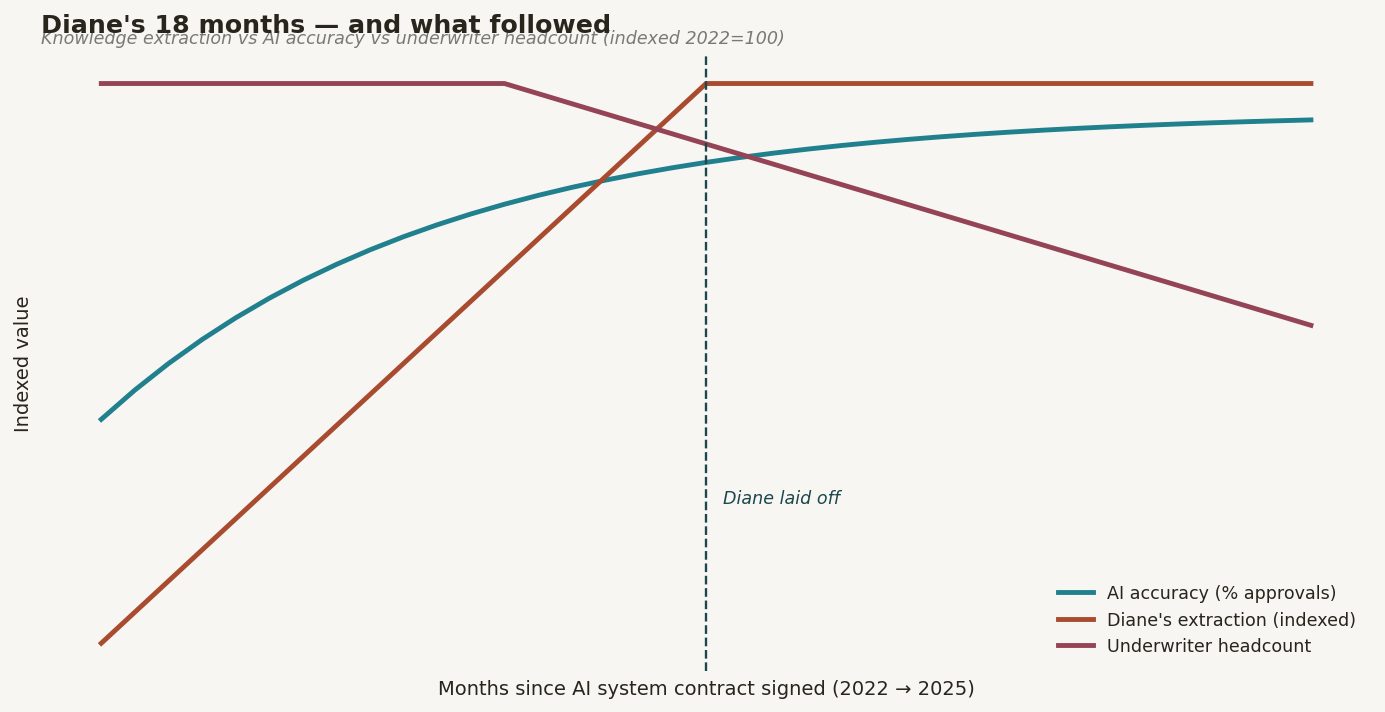
Figure 1. Timeline showing Diane's knowledge-extraction period (18 months) alongside the AI system's accuracy curve, overlaid with the bank's commercial lending headcount reduction, 2022–2024
Comments (0)
Join the conversation!