


Grid management AI was classified as an innovation experiment in most utility capital plans through 2024. The reclassification is underway in 2026: leading operators are moving AI-based grid optimization into the regulated asset base, regulators under updated FERC guidance are signaling willingness to allow returns on those investments, and the avoided capital expenditure from AI-informed planning is large enough — $42 million at the regional utility scale — to change the transmission expansion calculus materially. The payback period under regulatory rate base treatment is 30 months, a figure that survives commission scrutiny.
|
GRID BALANCING COST REDUCTION 22% ↓ on AI-optimized dispatch vs manual balancing |
AVOIDED CAPEX $42M ↑ regional utility scale, 5-year avoided transmission build |
|
PAYBACK (FERC TREATMENT) 30 mo ↓ under rate base inclusion, vs 48 mo unregulated |
DER INTEGRATION COST 1.8% ↓ per unit of distributed capacity added |
The Regulatory Shift That Changed the Economics
For grid AI investments to earn a regulated return, two things needed to happen: regulators needed to accept that AI-based grid management tools constitute capital improvements rather than operating expenses, and the performance data needed to be sufficient to support rate case filings. Both conditions came into alignment in 2025.
FERC's 2025 Order on AI-Assisted Grid Planning established a framework that allows transmission owners and independent system operators to classify AI-based forecasting, dispatch optimization, and congestion management tools as capital investments eligible for rate base inclusion under existing transmission formula rates. This was not a new subsidy — it was a classification clarification — but the financial implications are significant. A $42 million AI investment earning a 9.5% regulated return generates $4 million annually in allowed revenue, transforming the financial profile of the investment from a cost center to a rate base asset.
IDC's Energy Insights 2026 report identifies this regulatory shift as the primary driver of utility AI investment acceleration in the current planning cycle, ahead of technology maturity or operational urgency. Utilities respond to regulatory incentives; the incentive structure changed, and investment followed.
The $42 Million Avoided Capex Case
Deloitte's Power & Utilities practice has published a framework for quantifying the transmission capex avoidance attributable to AI-based grid optimization. The $42 million figure represents the 5-year avoided transmission and substation investment at a regional utility serving 2-3 million customers in a geography with high distributed energy resource (DER) penetration — broadly, a utility in the Southeast, Southwest, or Mid-Atlantic where solar addition rates are above the national median.
The mechanism is congestion management. Grid congestion — the condition where transmission constraints require curtailment of low-cost generation and dispatch of more expensive local generation to maintain reliability — costs U.S. ratepayers approximately $10-15 billion annually. Traditional congestion management involves building more transmission capacity to eliminate the constraint. AI-based grid optimization addresses congestion through real-time dispatch optimization: identifying the combination of generation dispatch, demand response activation, and battery storage discharge that resolves the constraint within existing infrastructure bounds.
IDC's analysis found that AI grid optimization delays the need for new transmission builds by an average of 4.2 years on constrained corridors where the technology has been deployed. At an average transmission build cost of $1.5 million per mile and an average constrained corridor length of 28 miles, the deferred investment per avoided build is $42 million — before financing costs. The NPV of deferring that expenditure by 4 years at a 7% WACC is approximately $10.5 million per deferred corridor.
Grid Balancing Cost Reduction
The 22% reduction in grid balancing costs reflects a different value stream from the capex avoidance case: the operating cost of maintaining real-time supply-demand balance. Balancing costs include real-time energy purchases at spot prices to cover forecast errors, ancillary service procurement (frequency regulation, spinning reserves), and the cost of dispatch instructions that deviate from the lowest-cost generation stack.
Deloitte's utility benchmarking shows that AI-based load forecasting models, when integrated with weather prediction systems and real-time DER telemetry, reduce the forecast error that drives unplanned real-time market purchases. The 22% balancing cost reduction translates to $8-15 million annually for a mid-sized regional utility, depending on the local market structure and the baseline accuracy of the legacy forecasting system being replaced.
FERC's Order explicitly acknowledges balancing cost reduction as a customer benefit in rate cases, allowing utilities to share the operational savings with ratepayers while retaining a portion to fund the investment. The specific sharing formula varies by commission, but the precedent that AI-driven operational savings constitute a ratepayer benefit — and therefore a regulatory consideration — is established in multiple pending rate cases as of 2026.
DER Integration and the 1.8% Cost Reduction
The distributed energy resource integration challenge is the fastest-growing source of grid management complexity. The addition of rooftop solar, battery storage, and EV charging infrastructure to distribution networks creates a bidirectional flow environment that legacy grid management systems were not designed to handle. Distribution utilities are reporting that DER integration processes — the engineering review, modeling, and approval required before each distributed resource can be connected — are consuming 40-60% of distribution engineering department capacity at utilities in high-penetration states.
IDC's 2026 energy report documents that AI-based interconnection screening tools are reducing the per-unit cost of DER integration by 1.8%, primarily through automated impact studies that replace manual network modeling for the majority of small-scale projects. At the volume of interconnection requests facing high-penetration utilities — some exceeding 10,000 applications annually — the aggregate cost reduction from automated screening is $3-6 million annually, and the reduction in interconnection queue backlog has secondary value in accelerating renewable capacity addition.
The Implementation Risk: Data Integration Challenges
IDC's survey of utility AI deployments identifies SCADA data integration as the primary technical barrier to achieving the documented performance levels. The AI models that produce the 22% balancing cost reduction require real-time, high-fidelity data from the supervisory control and data acquisition systems that manage physical grid operations. Many utilities operate legacy SCADA systems from multiple vendors with incompatible data formats, update rates, and latency profiles.
The utilities that have achieved production-grade AI grid optimization have uniformly invested in a data integration layer — an operational technology data historian that normalizes SCADA data into a consistent format accessible to the AI platform — before or concurrent with AI deployment. This integration work is not trivial: Deloitte's project data shows that OT data integration accounts for 35-45% of total project cost in grid AI deployments. Utilities that budget for AI tooling without budgeting for data integration are the ones generating the disappointing pilot results that create board-level skepticism about the technology.
The Rate Case Positioning Question
The 30-month payback under FERC rate base treatment assumes that the utility files for rate base inclusion in its next general rate case and receives a commission order within 18 months of filing — a reasonable assumption given the existing FERC framework and the rate case timelines at state-level commissions in most jurisdictions. Utilities with more adversarial commission relationships or more complex rate case environments should model 36-42 month paybacks to be conservative.
IDC's recommendation — echoed by Deloitte's regulatory affairs practice — is that utilities planning grid AI investments engage commission staff informally before deployment on the rate base classification question. Several utilities that received commission acknowledgment of the capital classification in pre-filing conversations avoided rate case litigation over the classification issue, saving 6-12 months of regulatory delay.
The Takeaway
Utility CFOs building the 2027-2031 capital plan should move grid AI from the innovation budget into the capital program, structure the investment to support a rate base filing under the FERC 2025 Order framework, and build the OT data integration layer as a co-budgeted line item rather than an afterthought. The $42 million in avoided transmission capex and the 22% balancing cost reduction are both achievable at scale — but only if the data in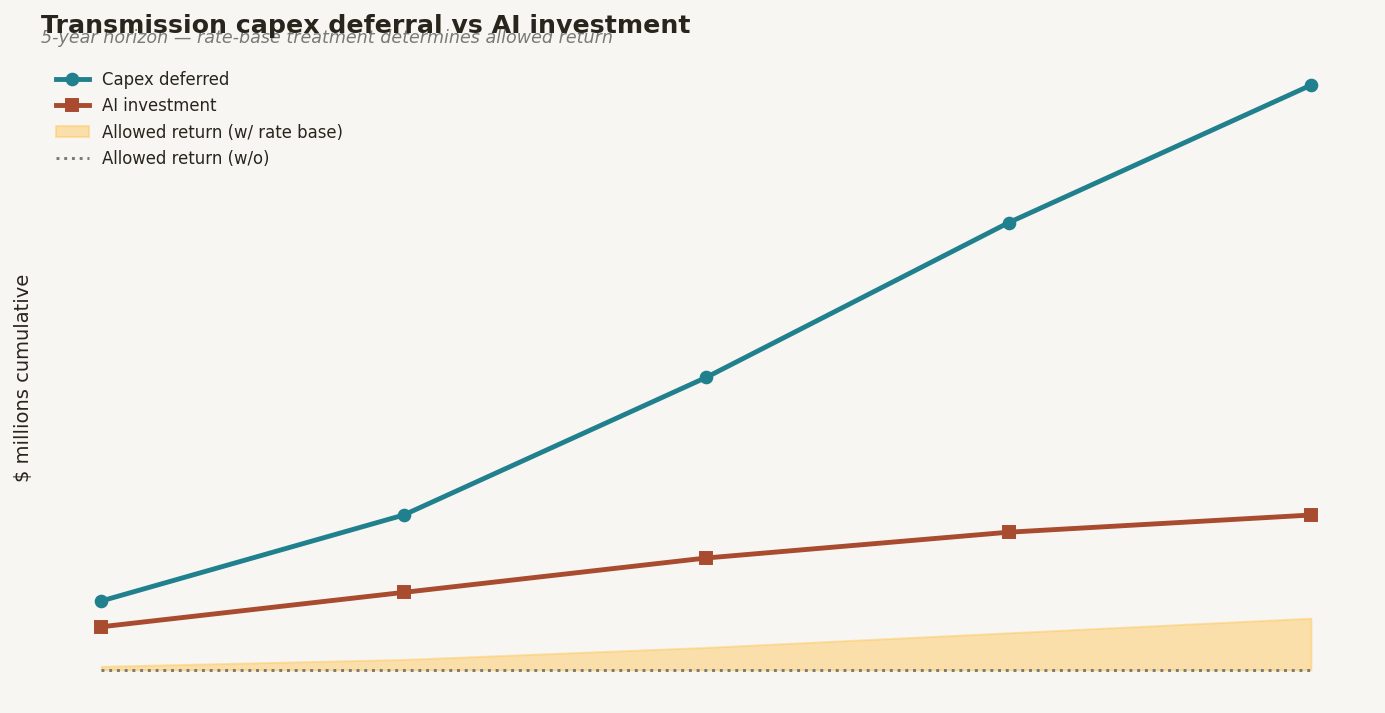
Figure 6. Timeline diagram showing transmission capex deferral value over 5 years alongside cumulative AI investment and rate base allowed return, with and without regulatory rate base treatment — illustrati…
Comments (0)
Join the conversation!