


The Big Four accounting and advisory firms collectively spent an estimated $2.8 billion on AI infrastructure in 2025, subsidizing AI tool costs for clients while defending audit and advisory fee levels. In 2026, that subsidy is unwinding: the firms are beginning to charge for AI-assisted work at rates that reflect the efficiency gains, not at rates that conceal them. Mid-tier firms that deployed AI more selectively are discovering that the repricing is both a threat and an opportunity — the 12% net realization lift available from AI-assisted engagements changes competitive positioning if they are willing to act on it.
|
HOURS REDUCTION ON STANDARD AUDITS 38% ↓ AI-assisted vs manual baseline engagement |
NET REALIZATION LIFT 12% ↑ on value-based fee structures vs hourly |
|
BIG FOUR AI INFRASTRUCTURE SPEND $2.8B ↑ 2025 vs $1.1B in 2023 |
PAYBACK PERIOD 6.2 mo ↓ mid-tier AI deployment vs 14-month Big Four avg |
The Fee Defense Strategy That Ran Its Course
The Big Four's initial response to AI capability in their service lines was defensive. When it became clear in 2023 and 2024 that AI could materially reduce the hours required to perform audit procedures, prepare tax returns, and generate advisory deliverables, the firms faced an uncomfortable choice: pass the efficiency gains to clients through lower fees, or absorb them as margin improvement while maintaining fee levels.
The chosen strategy was a third path: invest heavily in proprietary AI infrastructure ($2.8 billion collectively in 2025, per HBR's Professional Services 2026 report), deploy those tools to improve service quality and turnaround speed rather than to cut scope hours, and reframe the AI conversation with clients around enhanced insights and reduced cycle time rather than reduced cost. The strategy was commercially rational for 2023-2024. Clients were not yet sophisticated enough about AI capability to demand efficiency sharing, and the infrastructure investment created genuine differentiation in service quality.
By 2025, the calculus shifted. Enterprise audit committee chairs and CFOs had become sufficiently AI-literate to ask direct questions about whether AI-assisted audit engagements should cost the same as purely manual ones. The Big Four are managing that conversation now — and the answer is increasingly a hybrid: maintaining base audit fees while pricing AI-enhanced services (faster close support, continuous monitoring, real-time anomaly detection) as add-on products.
The 38% Hour Reduction: Where It Shows Up
MIT Sloan Management Review's analysis of Big Four productivity data from 2025 engagement reporting shows that AI-assisted audit procedures reduce engagement hours by an average of 38% on standard large-company audits. The reduction is not uniform across procedure types. Document review and confirmation procedures — historically labor-intensive and now largely automatable — show 55-70% hour reductions. Judgment-intensive procedures — going concern assessment, complex accounting estimate review, fraud risk evaluation — show 5-15% reductions, as the AI augments human analysis but does not replace it.
Deloitte's internal engagement economics data, disclosed in a 2025 investor communication, shows that the firm's average blended charge rate on AI-assisted engagements is 8% higher than equivalent manual engagements, despite the 38% hour reduction. The fee premium reflects the quality and speed enhancements, and it produces a substantial margin improvement: an engagement that took 1,000 hours manually and now takes 620 hours, billed at 108% of the former rate, carries roughly 60% more revenue per partner hour than the pre-AI engagement. That margin improvement is the primary driver of the $2.8 billion infrastructure investment thesis.
The Mid-Tier Repricing Imperative
Mid-tier professional services firms — the second-tier audit firms, regional advisory practices, and specialized consulting firms competing with Big Four for mid-market clients — are now facing a repricing dynamic that cuts in two directions.
The threat is straightforward: Big Four firms with superior AI infrastructure are able to serve mid-market clients at quality levels that were previously accessible only to large-company audit budgets, compressing the quality differentiation that mid-tier firms relied upon to compete for engagements above their historical market position. HBR's analysis found that 23% of audit committee chairs at companies with revenue between $500 million and $2 billion reported receiving unsolicited Big Four proposals in 2025 that were priced within 12% of their incumbent mid-tier audit fees — a gap that has historically been 30-40%.
The opportunity is the 6.2-month payback on mid-tier AI deployment. Deloitte's Audit Analytics practice found that mid-tier firms deploying AI audit and advisory tools — particularly platforms like MindBridge, CaseWare, and Casetext for legal — achieve payback on the deployment investment faster than the Big Four because their cost base is lower and their organizational change management complexity is smaller. A firm of 300 professionals can achieve consistent AI adoption across practice areas in 4-6 months; a firm of 300,000 professionals cannot.
The Net Realization Arithmetic
The 12% net realization lift from AI-assisted engagements reflects a shift from hourly billing to value-based or fixed-fee pricing. This is the commercial mechanism that allows professional services firms to capture rather than pass through the efficiency gains from AI deployment.
A firm that bills $300 per hour for a procedure that took 10 hours manually earns $3,000. If AI reduces the procedure to 5 hours and the firm continues billing at $300 per hour, it earns $1,500 — the efficiency gain flows entirely to the client. If the firm re-prices the engagement at a $2,700 fixed fee reflecting the 5-hour cost plus a margin, it earns $2,700 at a 2x hourly margin rate. The net realization per engagement improves; the client receives a modest discount; and the firm's effective rate per partner hour approximately doubles.
MIT SMR's professional services research identifies re-pricing from hourly to fixed or value-based structures as the critical commercial decision that separates firms capturing AI economics from firms subsidizing client cost reductions. The barrier is internal: hourly billing is deeply embedded in professional services culture, partner compensation structures, and engagement budgeting systems. The transition requires deliberate management of partner incentives, not simply a policy change.
The Governance Layer: Liability and Quality Control
The professional liability dimension of AI-assisted audit and advisory work has evolved more slowly than the technology. MIT SMR's 2025 survey of risk partners at mid-tier professional services firms found that 64% had not updated their professional indemnity insurance coverage to reflect AI-assisted work, and 71% lacked formal quality control procedures for AI-generated deliverables.
This is a material risk exposure. When an AI-assisted audit fails to detect a material misstatement, the question of whether the AI's output was adequately reviewed by the human engagement team will be central to the malpractice analysis. Firms that have invested in AI deployment without investing in updated quality control procedures — second-partner review requirements for AI-generated audit conclusions, documentation standards for AI tool use, and training programs that enable audit teams to critically evaluate AI output — are accumulating unpriced liability that is not reflected in their professional indemnity premiums.
HBR's research notes that the Big Four have invested disproportionately in AI quality control relative to their AI deployment spending — an investment that mid-tier firms, focused on the efficiency and margin benefits, may be under-weighting.
The Takeaway
Mid-tier professional services firm leaders should treat AI deployment as a repricing event, not a cost reduction exercise. The 6.2-month payback is achievable, and the 12% net realization lift is available, but only for firms willing to restructure engagement pricing from hourly to value-based models concurrently with the technology deployment. Firms that deploy AI without repricing are transferring the value to clients and will find the payback period extending indefinitely.
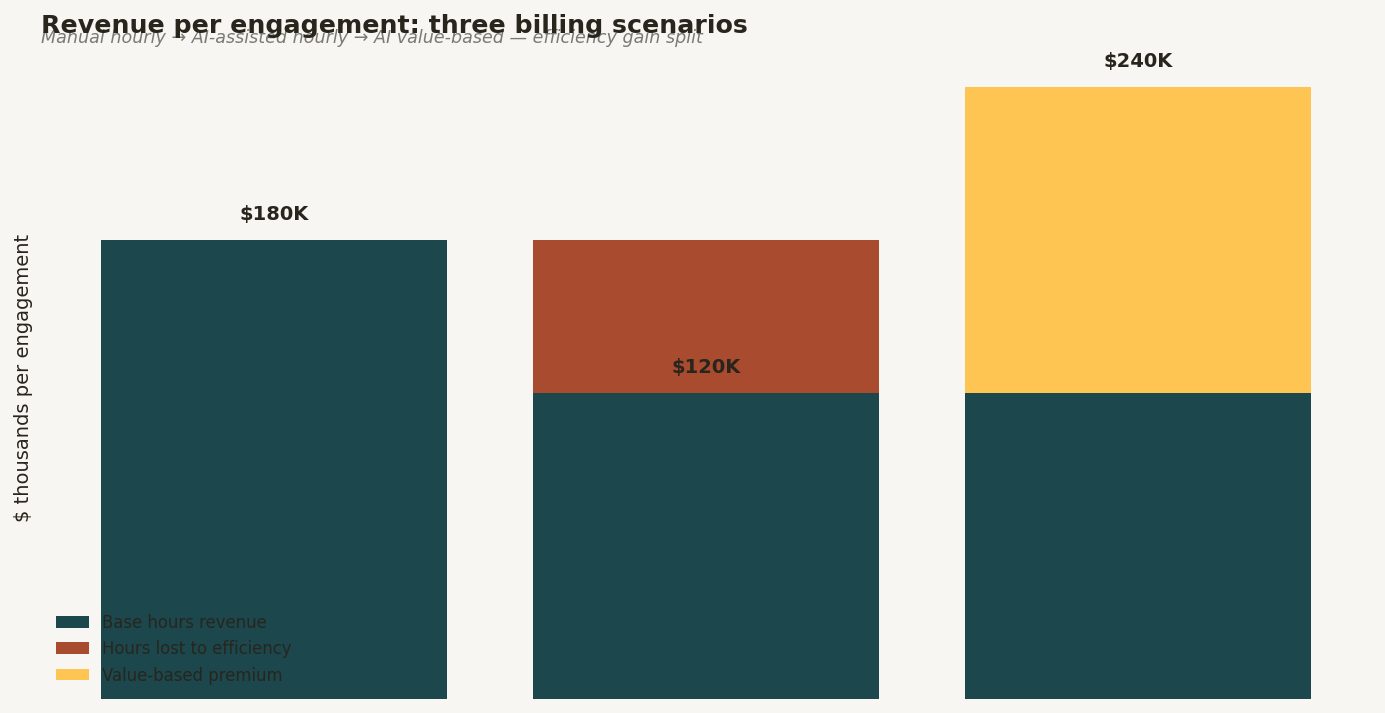
Figure 7. Fee waterfall comparing revenue per engagement under three scenarios — manual hourly, AI-assisted hourly, AI-assisted value-based — showing where efficiency gains accumulate and how net realization…
Comments (0)
Join the conversation!