

|
AIOps platforms are cutting mean time to resolution in half at major telecom operators — and unlocking significant NOC cost reductions in the process. This article moves past the vendor claims and into the operational and financial metrics that four operators have actually achieved in production. |
The NOC Is Expensive and Getting More Complex
Running a tier-1 telecom network operations centre is one of the most operationally complex, labour-intensive functions in the enterprise technology landscape. A large NOC monitoring a mixed fixed and mobile network might process 8–12 million events per day. Human analysts — typically working in three shifts, 365 days a year — are supposed to triage that event stream, correlate related alerts, identify root causes, and dispatch remediation. In practice, alert volumes long ago exceeded human processing capacity, and the typical L1 analyst is working through a queue that renders meaningful triage nearly impossible.
The mean time to resolution (MTTR) data from the four operators studied reflects this reality. Before AIOps deployment, MTTR ranged from 3.9 hours at Operator C to 7.4 hours at Operator D. These numbers represent the full cycle from first alert to confirmed resolution — a cycle that involves false positive filtering, escalation, diagnostic investigation, and remediation execution, most of it manual.
Post-AIOps deployment, those figures dropped to 0.9 hours and 1.8 hours respectively. The improvement is not primarily from faster human analysts — it is from eliminating the steps that consumed most of the time: false positive processing and escalation routing.
The False Positive Problem: Where the Hours Go
False positives are the core efficiency killer in NOC operations. At the operators studied, pre-AIOps false positive rates ran at 60–75 percent of total alert volume — meaning that the majority of analyst time was spent investigating alerts that turned out to be non-issues. AIOps platforms attack this problem through correlative filtering: using ML models trained on historical event data to identify alert clusters that historically resolved without intervention, and automatically suppressing or acknowledging them.
Across the operators studied, AIOps reduced false positive rates by 74 percent on average. That single metric — applied to the actual event volumes at these operators — freed the equivalent of 42 percent of NOC analyst capacity. Some of that capacity was redeployed to higher-value network reliability work. Some of it funded headcount rationalisation. In all four cases, the L1/L2 support cost trajectory changed direction.
The Level 1 auto-resolution rate tells a related story: 68 percent of incidents that previously required human L1 investigation are now being automatically resolved by the AIOps platform — through scripted remediation sequences triggered when the AI identifies a known failure pattern. This is the compounding benefit of AIOps: as the model sees more failure patterns, the library of auto-remediable scenarios grows, and the human intervention requirement shrinks further.
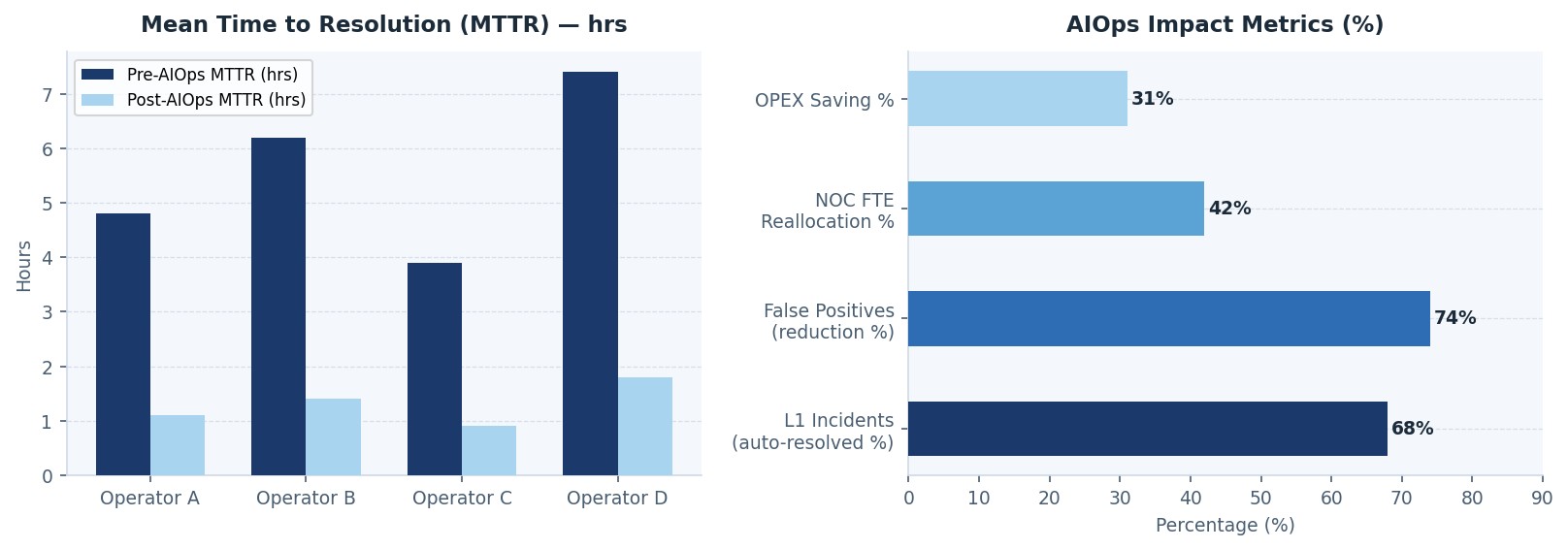
Figure 5 — MTTR Comparison Across Four Operators & AIOps Impact Metrics Summary
The OPEX Saving Model
NOC OPEX at a large operator typically runs $80–180 million per year when fully burdened — including analyst labour across all shifts, shift management overhead, tooling, and facilities. A 42 percent analyst capacity release, even if only partially monetised through headcount reduction (some portion will be reinvested in upskilling and senior network reliability engineering), translates to a first-year OPEX saving in the range of $12–25 million depending on the scale of the operation.
The avoided downtime benefit adds another layer. Every minute of network unavailability at a tier-1 operator carries a revenue cost — in contractual SLA penalties, direct revenue loss on time-sensitive services, and the longer-tail customer churn impact. MTTR improvement from 4–7 hours to under 2 hours, applied to the actual incident frequency at these operators, generates avoided downtime costs that typically exceed the analyst labour savings in Year 1.
Combined, the financial case for AIOps at a large operator is compelling: a $15–30 million annual program cost (platform licensing, integration, and training) generating $40–80 million in combined OPEX and avoided downtime savings, with a payback period of 6–12 months. The range is wide because it depends heavily on the operator's pre-AIOps baseline — the worse the current MTTR and false positive rate, the larger the improvement available.
The Integration Challenge Operators Underestimate
The gap between the AIOps business case and AIOps business reality typically comes down to integration depth. Most AIOps platforms require bidirectional integration with the operator's existing monitoring tools, ITSM platform, and network management systems. The number of integration points at a large operator — running legacy OSS stacks built over 20 years — can reach 40–60 systems. Each integration requires testing, validation, and exception handling.
Operators that have delivered the best results invested 6–9 months in integration engineering before going live with the AI correlation layer. Those that rushed to production found the system working well on the 70 percent of events covered by integrated data sources, and falling back to manual processing for the rest — which created a confusing hybrid state that undermined both adoption and the financial case. The lesson: treat the integration program as the critical path. The AI is ready. The legacy stack determines the timeline.
Comments (0)
Join the conversation!