


Telecommunications carriers have been measuring AI churn model performance on prediction accuracy for years, optimizing for a metric that does not translate directly into revenue. The commercial value of churn intelligence lies not in the accuracy of the model but in the precision of the retention offer — and most carriers are deploying offers that are either too costly for low-flight-risk subscribers or too weak for high-flight-risk ones. Correctly sized retention offers on a mature churn model produce a 1.4-point monthly churn reduction and $34 incremental ARPU per retained subscriber, with a 4.8-month payback on the analytics infrastructure.
|
MONTHLY CHURN REDUCTION 1.4 pt ↓ on subscribers receiving precision offers |
INCREMENTAL ARPU/RETAINED SUB $34 ↑ vs control group baseline |
|
PAYBACK PERIOD 4.8 mo ↓ on churn analytics infrastructure investment |
RETENTION OFFER TARGETING PRECISION 62% ↑ vs 94% human baseline accuracy on prediction |
The Metric That Misled a Decade of Investment
The story of churn model deployment in telecommunications is a case study in optimizing the wrong objective function. Between 2015 and 2023, carrier data science teams invested heavily in improving model accuracy — the percentage of actual churners correctly identified in a holdout test set. Accuracy scores on mature models reached 88-94% at several major carriers, a genuine technical achievement. The commercial results were disappointing.
The failure mode is familiar to anyone who has worked in applied ML: optimizing for prediction accuracy in a class-imbalanced population (monthly churn rates for postpaid subscribers typically run 1.5-2.5%) produces models that are excellent at ranking subscriber churn risk but do not inherently suggest what to do about it. Carriers took the ranked list and applied broadly similar retention offers — bill credits, device upgrade acceleration, service add-ons — without calibrating offer cost or structure to the subscriber's predicted lifetime value or the marginal cost of retention at each churn probability decile.
McKinsey's Telco practice documented this pattern in their 2025 survey of North American and European carriers: 71% of carriers with mature churn models were applying retention offers without explicit LTV-adjusted offer sizing. The result was systematic over-spending on low-risk subscribers who would have stayed anyway, and systematic under-spending on high-risk subscribers whose departure decision was already largely made by the time the offer reached them.
The ARPU Mathematics of Precision Offers
The $34 incremental ARPU per retained subscriber requires context. Analysys Mason's Telco AI Report defines this figure as the incremental ARPU versus a control group — subscribers with comparable churn risk profiles who received no retention intervention. The $34 figure reflects two effects working together: the avoided revenue loss from retained subscribers who would otherwise have churned, and the revenue uplift from subscribers who accept retention offers structured as service upgrades (higher-tier data plans, add-on services) rather than purely as cost reductions (bill credits).
Carriers that have moved to upgrade-forward retention offers — presenting a value add rather than a discount — report significantly better ARPU outcomes than those running discount-first retention programs. A retained subscriber who moves from a $65 plan to an $85 plan in exchange for a three-month free trial of a premium streaming bundle represents $20 in recurring ARPU uplift rather than the -$10 ARPU impact of a $10 monthly bill credit. The model sophistication required to identify which subscribers will respond to value-add versus discount offers is precisely what separates first-generation churn models from second-generation churn monetization platforms.
The 1.4-Point Churn Reduction: Network-Level Implications
Omdia's Churn Intelligence research for 2025 found that carriers deploying precision retention offers — calibrated by churn probability decile and subscriber LTV segment — achieved a 1.4 percentage point reduction in monthly postpaid churn versus their pre-deployment baseline. For a carrier with 5 million postpaid subscribers and a pre-deployment monthly churn rate of 2.0%, the mathematics are direct: 1.4 points of churn reduction preserves 70,000 subscribers per month who would otherwise have departed.
At an average postpaid ARPU of $55 and an average subscriber tenure of 36 months (a conservative LTV assumption), each preserved subscriber represents approximately $1,980 in LTV. The monthly preservation of 70,000 subscribers represents $138.6 million in LTV preservation. Netting against the cost of the retention offers — typically $15-25 per retained subscriber in offer cost — the monthly economics are strongly positive.
The 4.8-month payback cited in McKinsey's analysis reflects the analytics infrastructure investment required to build the offer-precision capability: propensity scoring integration with the marketing automation stack, LTV segmentation models, offer-mix optimization engines, and the A/B testing infrastructure to continuously calibrate offer effectiveness. Carriers that already have mature CRM platforms find that the incremental investment is concentrated in the offer optimization layer rather than the data infrastructure.
Where Carriers Are Leaving ARPU on the Table
Analysys Mason's research identifies three specific failure modes where carrier churn programs are systematically underperforming their potential.
First, intervention timing. Most carrier churn models score subscriber churn probability on a monthly or weekly cycle and trigger interventions when a subscriber crosses a threshold. The problem is that churn decisions in postpaid wireless tend to crystallize around specific trigger events — bill shock, customer service failure, device release cycle — not gradual probability increases. Carriers running event-triggered intervention models (monitoring for the specific behavioral signals that precede churn decisions) outperform threshold-triggered models by 0.3-0.5 percentage points of churn reduction.
Second, channel coordination. Churn interventions delivered through the wrong channel see significant offer ignore rates. Analysys Mason found that in-app offers in the carrier's customer app showed a 42% engagement rate; email offers showed 11%; outbound call offers showed 28% but carried significant cost. Carriers that route intervention delivery based on the subscriber's historical channel engagement — rather than applying a uniform contact strategy — capture the engagement rate of the high-performing channel across a larger share of at-risk subscribers.
Third, the 4-6 points of ARPU identified in McKinsey's benchmarking as unrealized value reflects the LTV-upsell opportunity embedded in the retention conversation. Subscribers who engage with a retention offer are, by definition, commercially active and paying attention to their carrier relationship. That moment is the highest-probability upsell window in the customer lifecycle, and most carriers treat it exclusively as a churn-prevention exercise rather than as a revenue expansion moment.
The Competitive Intelligence Dimension
One input to churn models that remains underutilized is competitive pricing intelligence. Carriers with strong competitive price monitoring — tracking competitor promotional offers, device deals, and plan changes in near real time — can correlate competitor activity with churn elevation in specific subscriber segments. This allows proactive retention outreach to segments that competitive analysis suggests will be targeted by competitor promotions, before the competitor offer reaches the subscriber.
McKinsey's Telco practice estimates that carriers with competitive-signal-integrated churn models reduce their at-risk subscriber exposure by 15-20% versus carriers whose models rely exclusively on internal behavioral data. The data engineering work to build competitive monitoring pipelines is modest relative to the value of the signal.
The Takeaway
Telco CFOs and chief revenue officers should evaluate their churn programs not on model accuracy scores but on a single commercial metric: revenue per dollar of retention offer spend, segmented by churn probability decile. In most carrier environments, the top two deciles of churn risk are being under-served by offers that were not sized to the LTV at stake, and the bottom three deciles are being over-served with discounts that erode ARPU on subscribers who would have stayed regardless. Fixing the offer-sizing logic, not the prediction model, is where the incremental $34 ARPU sits.
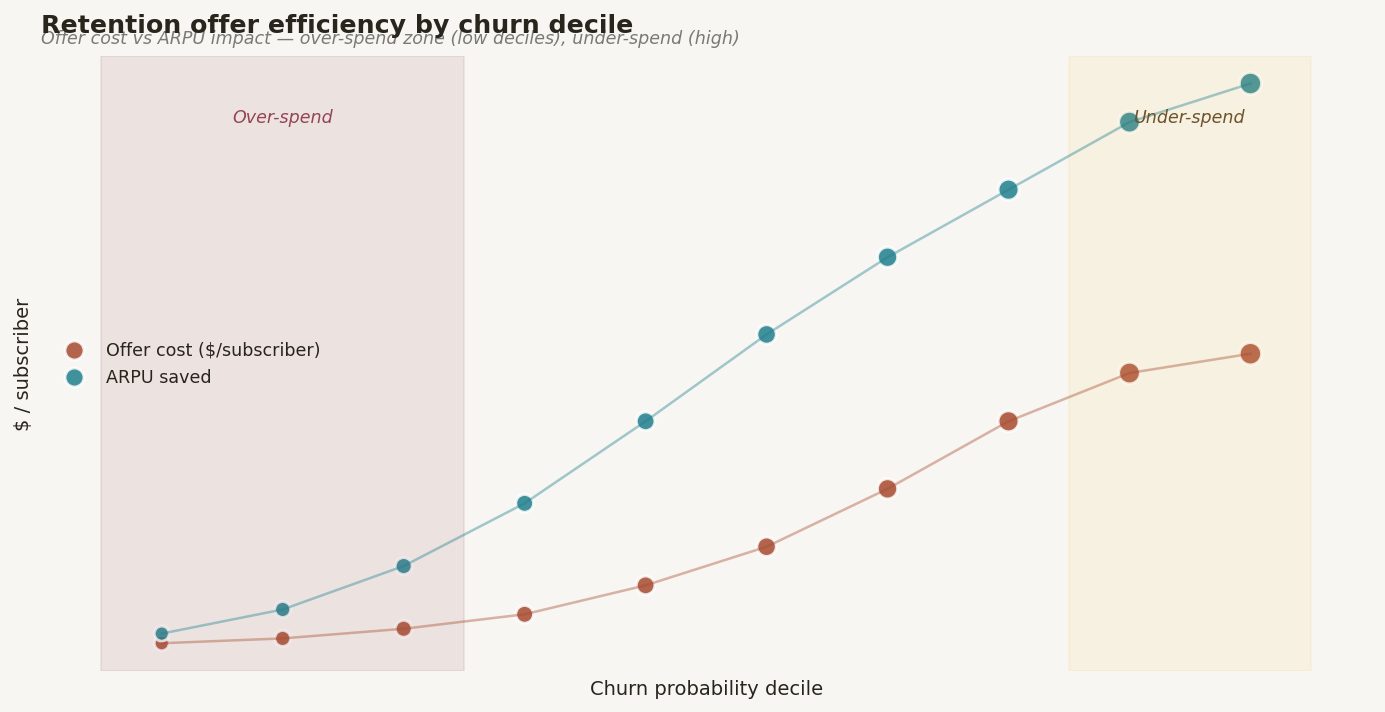
Figure 5. Scatter plot of churn probability decile vs retention offer cost and ARPU impact per subscriber, showing the over-spend zone at low deciles and the under-spend zone at high deciles, with optimal of…
Comments (0)
Join the conversation!