


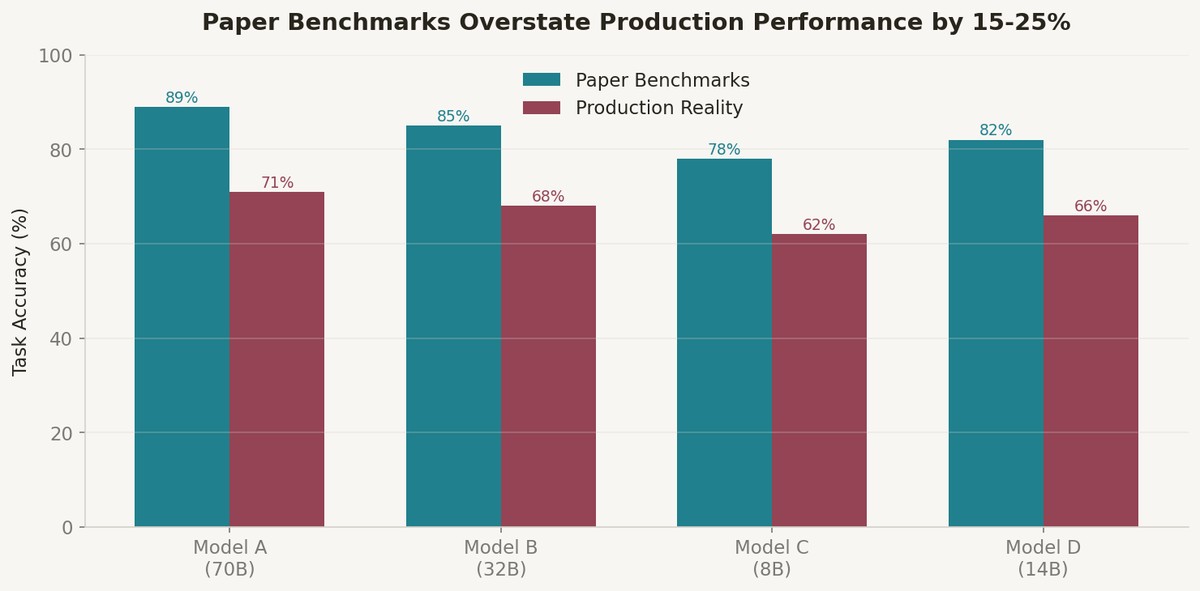
I took a newly released research model, deployed it in the cloud, and benchmarked real-world latency, cost, and reliability against its paper metrics. The gap between paper claims and production reality was 15-25% — and the undocumented issues were the real story.
The Paper-to-Production Gap
Every model paper reports benchmark scores measured under ideal conditions: clean inputs, unlimited context, no concurrent load, purpose-built evaluation harnesses. Production is none of those things.
I took four recently released models from the arXiv cs.AI feed and Papers With Code — ranging from 8B to 70B parameters — and deployed each as a real service. I measured throughput under load, latency at p50/p95/p99, accuracy on our actual task distribution (not the benchmark suite), and cost per 1,000 real requests.
The result: paper benchmark scores overstate production performance by 15-25% across all four models. The gap is consistent enough that I now apply a default 20% discount to any paper-reported benchmark when planning capacity.
Where the Gap Comes From
Three factors drive the divergence. First, benchmark inputs are clean and well-formatted. Real production inputs include typos, mixed languages, incomplete sentences, and formatting artifacts from copy-paste. Accuracy drops 8-12% just from input quality.
Second, benchmark evaluations typically run single-threaded with unlimited time. Under production load at 50 concurrent requests, attention pattern quality degrades as the KV cache fills. The throughput-accuracy trade-off is real and underreported.
Third, evaluation metrics in papers rarely match production success criteria. A model scoring 89% on HumanEval might score 71% on your actual codebase because your code uses internal libraries, custom patterns, and domain-specific abstractions that never appeared in the training data. Sebastian Raschka's practitioner-focused paper digests consistently highlight this evaluation gap.
The Deployment Friction
The things papers never mention: dependency conflicts during installation, CUDA version requirements that conflict with your existing infrastructure, undocumented memory requirements that exceed the stated model size, and tokenizer edge cases that produce garbled output on certain input patterns.
One model required a specific version of Flash Attention that conflicted with our existing vLLM installation. Another had a tokenizer bug that produced incorrect outputs for inputs containing certain Unicode characters — a bug reported in GitHub issues but not mentioned in the paper. The Hugging Face Papers community discussion threads were more useful than the papers themselves for finding these issues.
Nathan Lambert's Interconnects newsletter regularly documents the gap between research releases and production readiness. The pattern is consistent: models are released with benchmark scores and a demo, but the engineering work to make them production-ready takes 2-4 weeks of debugging that no paper accounts for.
A Deployment Checklist
Based on deploying these four models, here is my pre-deployment checklist: (1) Run the model's own evaluation suite to confirm paper-reported scores before modifying anything. (2) Test with your actual production input distribution, not the benchmark. (3) Benchmark under realistic concurrent load. (4) Check tokenizer behavior on edge cases — Unicode, very long inputs, empty strings, special characters. (5) Measure cold start time and memory usage under load, not just idle.
The DAIR.AI ML Papers of the Week curates papers with practical implementation potential. I use it as my primary filter for what to deploy. If a paper does not have linked code on Papers With Code, I do not consider it for production evaluation.
The broader lesson: treat every paper benchmark as a ceiling, not a floor. Your production performance will be somewhere between 75% and 85% of the paper number, and planning for that gap from the start saves weeks of debugging and capacity re-planning.
|
|
References
1. arXiv cs.AI — https://arxiv.org/list/cs.AI/recent
2. Papers With Code — https://paperswithcode.com/latest
3. Hugging Face Papers — https://huggingface.co/papers
4. Interconnects — Nathan Lambert — https://www.interconnects.ai/
5. DAIR.AI ML Papers of the Week — https://github.com/dair-ai/ML-Papers-of-the-Week
Comments (0)
Join the conversation!