


Construction firms that deployed AI for project scheduling, estimating, and document management are reporting working-capital benefits that substantially exceed the direct productivity gains that motivated the original investment. A 17-day reduction in days sales outstanding and $24 million in working capital released at a mid-size general contractor represent treasury outcomes, not technology outcomes — and they explain why the treasurer, not the CIO, is becoming the primary buyer and advocate for construction AI investment.
|
DSO REDUCTION 17 days ↓ 30 days → 13 days on AI-managed billing cycles |
WORKING CAPITAL RELEASED $24M ↑ mid-size GC ($800M revenue), first 18 months |
|
PROJECT OVERRUN REDUCTION 6% ↓ on AI schedule-managed projects vs baseline |
PAYBACK PERIOD 12 mo ↓ on integrated PM/AI platform investment |
The Working-Capital Math That Wasn't in the Business Case
Construction is a working-capital-intensive business by structural necessity. General contractors are simultaneously managing multiple projects in different billing cycles, funding subcontractor payment chains that extend 30-90 days beyond owner billing, and carrying retainage balances that can represent 5-10% of contract value for 12-24 months. The industry average days sales outstanding is approximately 60-75 days — materially above other sectors — and the working capital required to fund that receivables position is a permanent drag on return on equity.
When construction firms began deploying AI for project management and estimating, the investment thesis was productivity: faster scheduling, better cost control, reduced rework. Those benefits materialized. McKinsey's Capital Projects practice documented a 6% reduction in project cost overruns at firms with AI-assisted scheduling, and the productivity improvements in estimating — reduced time to produce bids, higher bid accuracy, better scope definition — are well-documented in IDC's Construction Tech analysis.
The working-capital benefit was not in those original business cases. It emerged from a combination of three mechanisms that AI deployment enabled: faster billing cycle triggering, more accurate pay application preparation, and earlier identification of change order entitlement. Together, they produced a 17-day DSO reduction that translated to $24 million in working capital release for a mid-size general contractor with $800 million in annual revenue — a figure that is larger than the direct productivity savings from any AI feature the firm originally purchased.
Billing Cycle Automation: The Primary Driver
The largest component of the DSO improvement is billing cycle speed. In construction, billing is triggered by the completion of defined schedule milestones or the preparation of monthly pay applications. Both require documentation — progress photos, field reports, inspector sign-offs — that has historically been assembled manually, introducing delays between physical completion and billing date.
AI-powered project documentation platforms — systems that aggregate field reports, mobile photo uploads, and inspector comments into structured completion records — reduce the documentation assembly time from an average of 8 days per billing cycle to approximately 2 days. At a monthly billing frequency, this is a 6-day improvement in billing date per cycle, which directly translates to a 6-day improvement in DSO at steady state.
Bain's Infrastructure practice estimates that billing cycle documentation is responsible for 35-40% of the DSO gap between construction and other sectors. Firms that automate documentation assembly recapture the largest single component of that gap without changing payment terms or owner relationships.
Change Order Management and Revenue Leakage
IDC's Construction Tech 2025 analysis identifies change order management as the second major working-capital lever in AI construction deployments. Change orders — modifications to the original contract scope — are a universal feature of construction projects, representing 5-15% of original contract value on average and far more on complex projects. They are also the primary source of billing disputes, payment delays, and ultimately bad debt in construction.
The delay mechanism is documentation-driven. Change order claims require concurrent documentation of the triggering event (owner-directed scope change, unforeseen site condition, design conflict), the cost impact, and the schedule impact. In manual environments, this documentation is assembled after the fact — sometimes weeks or months after the change event — which weakens the legal and contractual basis for the claim and gives owners grounds to dispute or discount payment.
AI-assisted project management systems that capture field events in real time and automatically generate preliminary change order documentation — linking field observations to contract language, cost code structures, and schedule impact analysis — produce claims that are documented contemporaneously with the event. McKinsey's analysis found that change orders documented contemporaneously settle 22 days faster than those documented after the fact, a finding that directly translates to DSO improvement on the change order revenue stream.
The Retainage Optimization Dimension
Retainage — the 5-10% of contract value withheld by owners until substantial completion and punch list clearance — is the least liquid current asset on a contractor's balance sheet. For a firm with $800 million in revenue, retainage balances can represent $30-50 million in working capital that earns no return and is released only when the punch list process concludes.
AI-assisted punch list management — systems that use computer vision on field photos to identify deficiency items and track correction status — have demonstrated a 30-40% reduction in time from substantial completion to final retainage release. Bain's Infrastructure research found that the average time from substantial completion claim to final retainage payment is 67 days under manual punch list management and 41 days under AI-assisted management. The 26-day reduction, applied to a $40 million retainage portfolio, represents a $2.8 million working capital improvement — modest in isolation, but additive to the DSO gains from billing and change order acceleration.
The 12-Month Payback: Components and Conditions
IDC's Construction Tech analysis models the 12-month payback on integrated AI project management platforms — systems that combine scheduling, document management, change order management, and billing workflow into a unified platform rather than point solutions for each function. The payback reflects platform licensing of approximately $1.2-2 million annually for a mid-size GC, against working capital improvements that generate economic value through reduced line-of-credit utilization.
A firm that reduces DSO by 17 days on $800 million in annual revenue reduces its average receivables balance by approximately $37 million. At a revolving credit facility cost of 7.5%, that receivables reduction generates $2.8 million in annual interest cost savings. Add the direct productivity savings from estimating and scheduling efficiency — McKinsey documents 15-20% reductions in estimating labor cost and 8-12% reductions in scheduling management cost — and the payback on a $2 million platform investment is achievable in 10-14 months, with the midpoint at 12 months.
The condition attached to that payback is integration depth. Point-solution deployments — deploying AI scheduling without connecting it to the billing workflow, or deploying AI document management without integrating it into change order management — capture individual efficiency benefits but do not generate the working-capital compounding that drives the 12-month payback case. The integrated platform approach is more complex to implement and more expensive to license; it is also the only approach that produces the treasury outcome.
The Takeaway
Construction firm CFOs and treasurers should reframe AI project management investment as a working-capital optimization program, not a technology program, and engage treasury leadership directly in the platform selection and implementation process. The 12-month payback and $24 million in working capital release are conditional on deploying an integrated platform with genuine billing and change order workflow automation — not point solutions for individual productivity use cases. CFOs who are not involved in the platform selection are likely to see their firms purchase productivity tools that fail to produce the treasury outcomes that justify the investment.
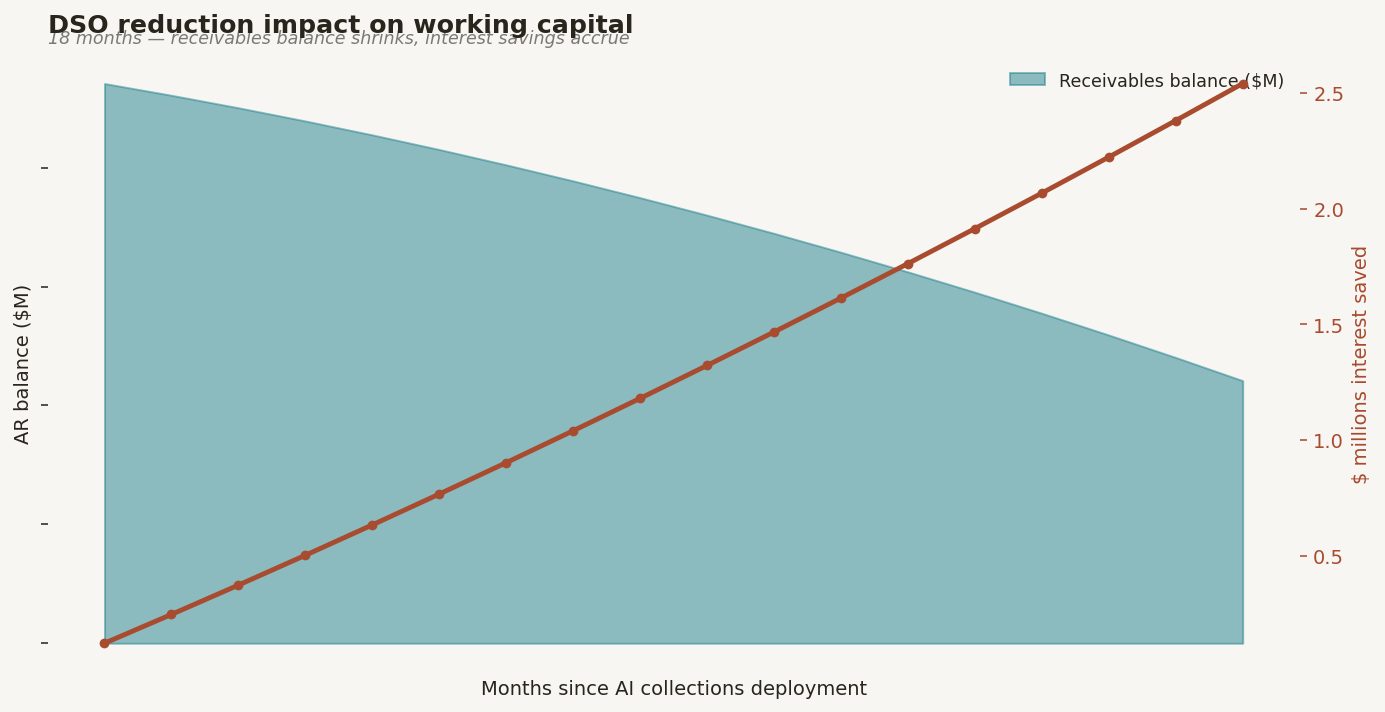
Figure 9. Cash flow timeline showing DSO reduction impact on receivables balance over 18 months, with working capital release amount and line-of-credit interest savings labeled at each stage, and payback per…
Comments (0)
Join the conversation!