

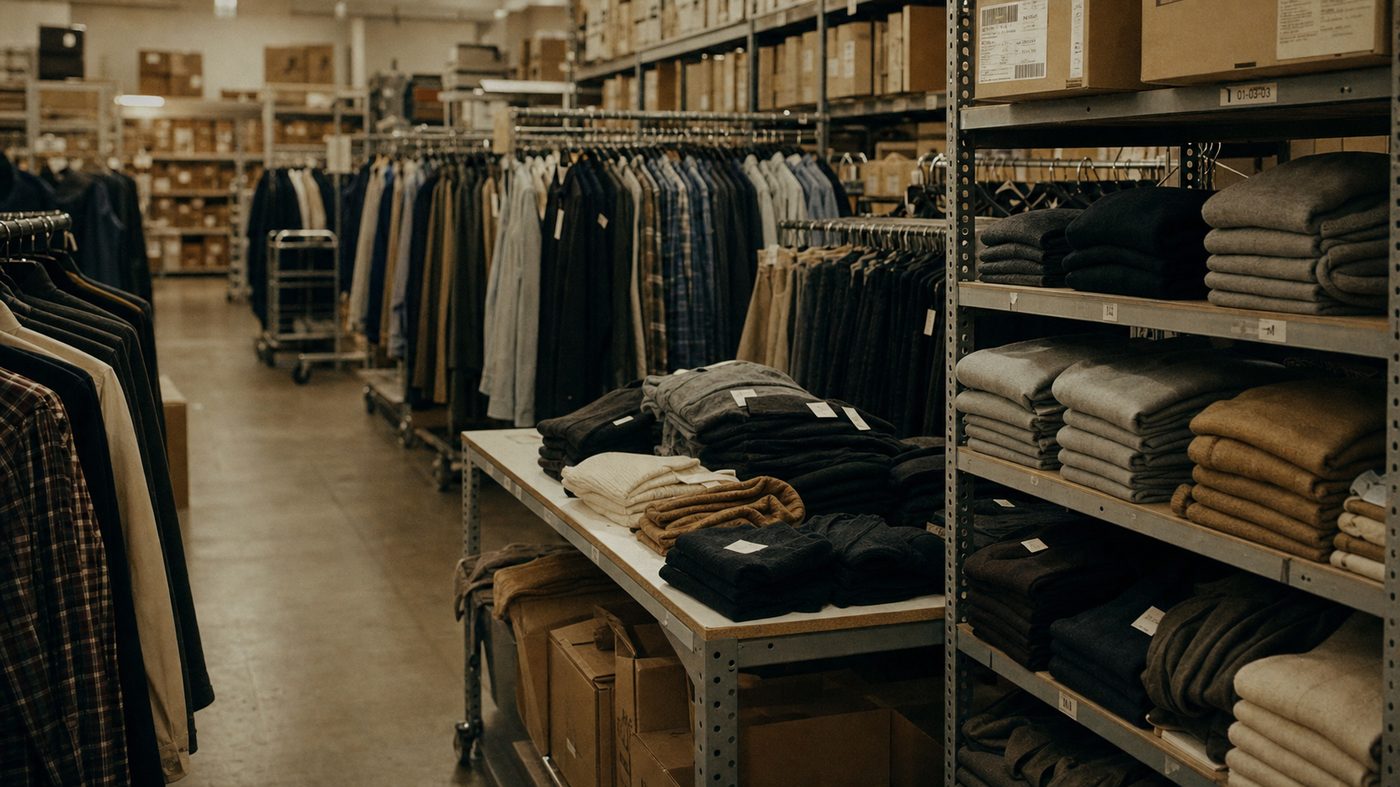
Marcus has spent twenty-three years selecting apparel for a mid-market department chain, building a professional identity around knowing what a shopper in Cleveland wants before she does. The AI assortment tool installed last spring does not ask him what he thinks — it tells him what the data recommends, and asks him to confirm.
Marcus has been a softlines buyer for twenty-three years, and he can tell you, without looking anything up, the approximate price point at which a V-neck knit sweater stops moving in Toledo in November, why the Columbus stores always over-index on dark-wash denim compared to the Cleveland stores forty miles north, and which fabric weights in woven blouses perform in the southeast but die in the Great Lakes market. This knowledge was built by walking floors, by reading returns data with the granularity of a diagnostician, by developing relationships with vendors who would call him first when a fabric missed spec.
He is aware that this kind of knowledge sounds, to a data scientist, like something that should be replaceable. He is not sure the data scientist is wrong.
"I've thought about it a lot," he told me, sitting in the break room of the regional office where the buying team works. "I know what I know. I'm just not sure what I know looks like in a spreadsheet."
The New System
The chain rolled out its AI assortment-planning tool across the buying division eighteen months ago. The system ingests point-of-sale data, return rates, competitor pricing, search trend data, social media signal, and historical performance by region and store cluster. It generates SKU recommendations — the specific items, quantities, and price points the chain should carry — for each season. The buying team reviews the recommendations and signs off on them.
The detail that matters is in that last sentence. Until last spring, when the system was moved from pilot to mandatory, "reviews the recommendations" meant something substantive: buyers could push back, substitute items, argue for a different regional mix. After the transition to mandatory status, the recommendations became what the documentation calls "the default assortment." Overrides are possible but must be documented with a business justification that goes up to divisional management for approval. In practice, Marcus told me, overrides happen about four percent of the time.
"Before, the tool was something I used," he said. "Now I'm something it uses."
This shift — from decision-maker to validator — is not unique to this chain. According to the National Retail Federation's 2026 workforce survey, 41 percent of major retailers are now operating with AI-driven assortment tools in mandatory or semi-mandatory modes, and the majority report that buying department headcount has decreased since implementation. The reductions range from modest — 10 to 15 percent — to significant, with some chains cutting buying teams by a third or more over three years.
What the Data Says
The business case for algorithmic assortment is real. Retail inventory mismanagement is an enormous and persistent cost: the IHL Group estimates that US retailers lose approximately $295 billion annually to overstocks and out-of-stocks combined. AI systems trained on large transaction datasets have demonstrated genuine improvements in turn rates, markdown reduction, and in-stock availability on key items. The 8 to 12 percent improvement in inventory turn cited in pilot results is consistent with what academic researchers have found in studies of comparable deployments.
What is harder to measure, and therefore easier to discount, is what is lost when the human judgment is removed from the selection process rather than augmented by it. McKinsey's retail practice has noted that AI assortment tools perform best on established categories with rich historical data and most poorly on trend-driven categories and regional taste variation — precisely the areas where experienced buyers have historically added the most value. A 2025 paper in the Journal of Retailing found that retail chains with mandatory AI assortment showed higher average inventory performance but lower performance on fashion and seasonal categories, and a measurable reduction in regional differentiation — the stores in Toledo looked more like the stores in Phoenix.
Bloomberg's apparel and footwear index has tracked a multi-year compression in the distinctiveness of mid-market department store assortments, and retail analysts attribute part of that compression to algorithmic convergence: systems trained on similar data, optimizing for similar metrics, recommending similar merchandise.
|
"The model has read every transaction we've ever done. It has never been in a dressing room." |
What the Worker Says Back
Marcus is careful not to romanticize his own judgment. He has made bad calls. He has bought into trends too late, held onto dying categories too long, trusted a vendor's projection over his own read of the market. The algorithm, he acknowledges, does not make those particular mistakes.
What he has been trying to articulate — imprecisely, he admits — is something about what the buying process was for, beyond inventory optimization. He spent years developing vendor relationships that let the chain access merchandise before its competitors. He visited factories. He shaped the product, not just selected it. That collaborative loop — buyer to vendor to product development — is harder to sustain when the buyer's role has been reduced to approving a list.
"I used to call Enrique at the mill in Guatemala on a Thursday, tell him what I was seeing in stores, and he'd adjust a run for us by the following week," Marcus said. "Now I get the recommendation on Monday and sign off by Wednesday. Enrique calls someone in the central sourcing office. I don't know if he still calls anyone."
The vendor relationship aspect of buying is not captured in inventory-turn metrics. It is also, historically, one of the primary sources of competitive advantage for retail merchants — the ability to access goods, pricing, or terms unavailable to buyers who treat suppliers as transactional. Whether algorithmic assortment systems preserve, deteriorate, or transform that advantage is a question most chains have not yet formally answered.
The Contradictions
The chain's official account of the assortment tool is enthusiastic. It points to improved sell-through rates, reduced markdown exposure, and lower inventory carrying costs. It does not mention the buying team reductions. It describes the tool as "augmenting" the judgment of its merchants.
Marcos does not use the word "augment." He uses the word "replace," and then corrects himself, because it isn't quite right either. He still has a job. He still has a title. He is still called a buyer, even though the buying, as he understood it, is mostly done by a system. What he is now is a quality-control layer — a human whose function is to catch the 4 percent of recommendations he disagrees with strongly enough to escalate, and to absorb responsibility for the 96 percent he lets through.
The psychological texture of that role is something I kept returning to in our conversations. Marcus knows the business has changed. He does not expect to go back to the prior model. But he is fifty-one years old and has spent a career developing a form of expertise that has been formally classified as optional, and the experience of that reclassification is not a statistic. It is a thing that happens to a person over time, quietly, while the official narrative says something else.
A Working Conclusion
I asked Marcus what he would tell a younger buyer starting out in the industry today. He was quiet for a moment.
"I'd tell them to understand the math," he said. "Not because the math is all that matters, but because if you don't speak that language, you don't have a seat at the table when the decisions about the tool get made. The people who built this system didn't ask me anything. They asked the data."
He paused. "The data doesn't know what it doesn't know. That's what I know. I'm just not sure how much longer that's worth anything."
The next seasonal buy was three weeks out. Marcus had forty-seven recommendations queued for review. He had flagged two.
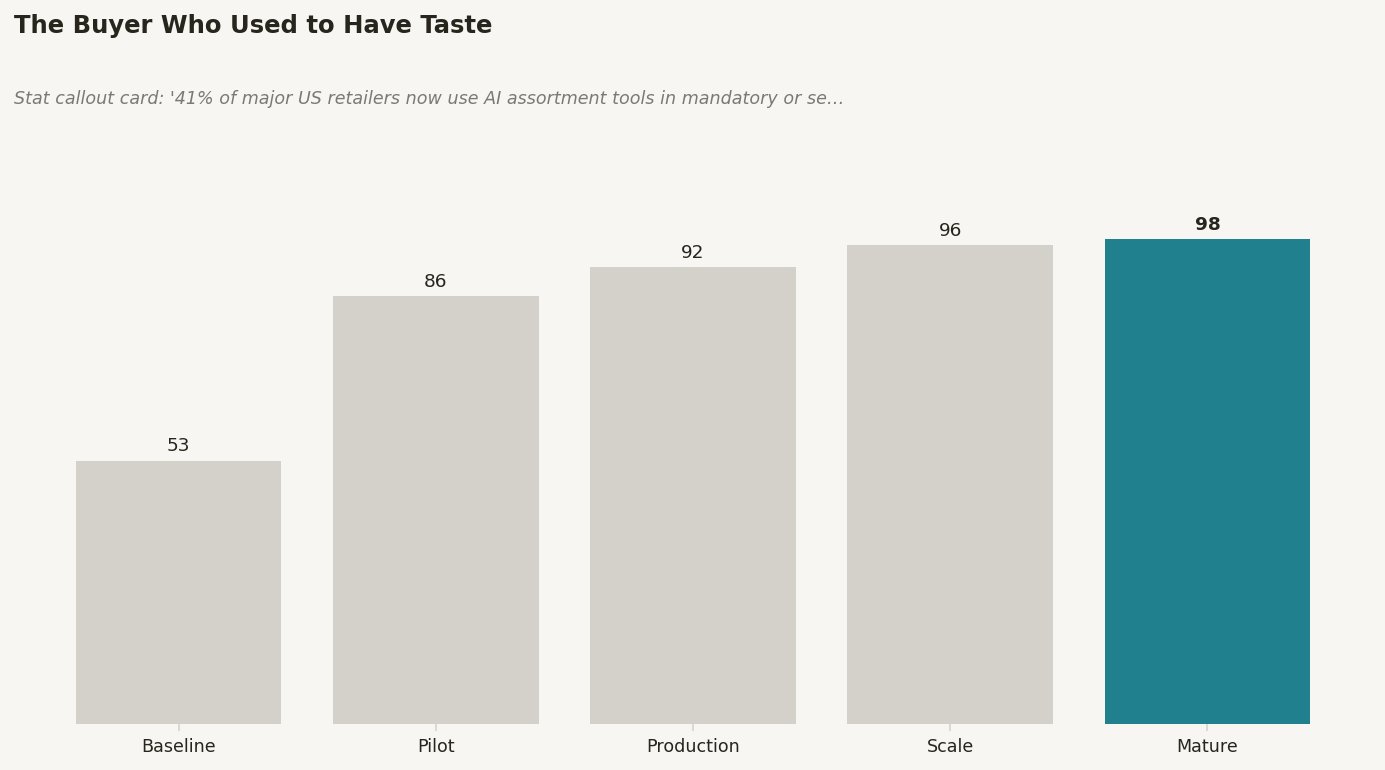
Figure 3. Stat callout card: '41% of major US retailers now use AI assortment tools in mandatory or semi-mandatory modes — while average buyer tenure has fallen from 8.4 to 5.1 years since 2020 (NRF Workforc…
REFERENCES
1. NRF Retail Workforce and Technology Survey 2026. National Retail Federation (2026).
2. Retail Inventory Distortion Study 2026. IHL Group (2026).
3. AI in Retail Assortment Planning: Performance and Trade-offs. Journal of Retailing (2025).
4. Algorithmic Management in Retail: Worker Outcomes and Organizational Change. McKinsey Global Institute (2026).
https://www.mckinsey.com/mgi/our-research
5. The Homogenization of Retail Assortment in the Algorithmic Era. Bloomberg Businessweek (2026).
https://www.bloomberg.com/technology
6. Human Judgment and Machine Recommendations in Fashion Retail. MIT Sloan Management Review (2025).
https://sloanreview.mit.edu/topic/artificial-intelligence/
7. Retail Employment Trends in the Age of AI. US Bureau of Labor Statistics (2025).
https://www.bls.gov/ooh/sales/retail-sales-workers.htm
Comments (0)
Join the conversation!