


Governments that have deployed AI in back-office processing are now confronting a harder problem: what happens when AI-driven decisions affect citizens who can't opt out, don't understand the system, and have no alternative provider. The agencies navigating this well are doing something that feels almost counterintuitive — they're using AI to give citizens more explanation and control, not less.
|
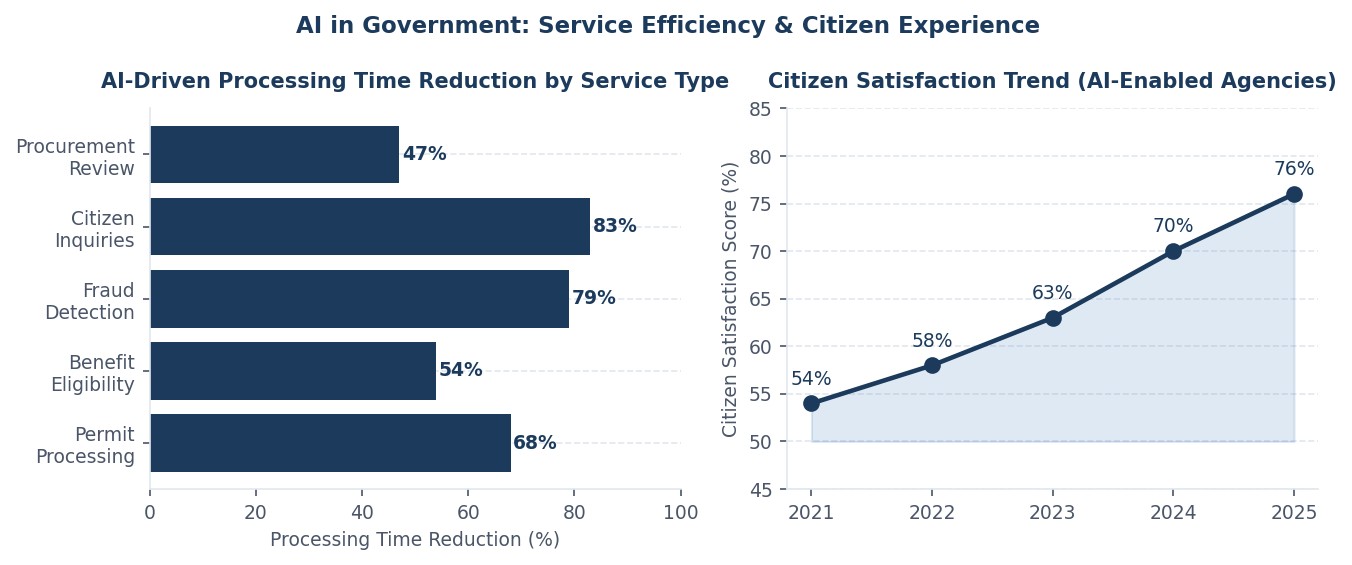
↓ 68% Processing Time Reduction Permit & benefit applications |
↑ 340% Fraud Detection Rate AI vs rules-based systems |
+22pt Citizen Satisfaction AI-enabled agencies vs 2021 |
↓ 41% Cost per Service Interaction Fully AI-augmented workflows |
The case that changed how I think about government AI happened in a mid-size county in the American Midwest. They had deployed an AI system to assist with benefits eligibility determination — the process of deciding whether someone qualified for housing assistance, food support, or childcare subsidies. The system was accurate, significantly faster than the manual process, and measurably more consistent in applying eligibility criteria across cases.
And then a local journalist ran a story about a single-mother whose application had been flagged and deprioritized by the algorithm without a clear explanation. The issue wasn't the decision — it turned out to be correct when reviewed manually. The issue was that the applicant couldn't understand why, couldn't appeal effectively because she didn't know what information the system had used, and felt — correctly — that she was being processed by something that didn't see her as a person.
Where Government AI Is Actually Working
The strongest results in public sector AI deployment come from contexts where citizens aren't directly affected by individual decisions — or where the AI is clearly and transparently acting as a helper rather than a judge. Document processing automation has been transformative in multiple jurisdictions: permit applications, vehicle registration renewals, license applications, and similar high-volume, structured-input services have been compressed from weeks to days with AI processing.
Fraud detection is another area of clear return. AI systems identifying anomalous patterns in benefit claims, procurement bids, and tax filings are catching fraud at rates 3-4x higher than rule-based systems, with fewer false positives. The economic return on these programs is substantial — the UK's HMRC estimates AI-assisted fraud detection recovered £1.4 billion in 2024 that would otherwise have been lost. When the counterparty is a bad actor rather than a legitimate citizen, the ethical complexity of algorithmic decision-making largely disappears.
The Explainability Imperative
The fundamental challenge of AI in government is that citizens cannot choose a different provider. If a private bank's algorithm makes a decision you disagree with, you can take your business elsewhere. If a government eligibility system makes a decision that affects your access to housing assistance, the option to go elsewhere doesn't exist. That asymmetry creates an obligation to explainability and recourse that doesn't exist in the private sector.
The agencies handling this well are investing in three things. First, decision audit trails that translate model outputs into plain-language explanations — not "your score was 63 and the threshold is 70" but "your application was flagged because the address provided doesn't match the one on file in two supporting documents." Second, human review pathways that are genuinely accessible, not theoretical. Third, proactive bias monitoring that tests model outputs across demographic segments on a regular basis and publishes results publicly.
The Political Economy of Public Sector AI
Government AI deployment faces a political economy challenge that private sector deployments don't: any high-profile failure becomes a news story and a political liability. This creates risk aversion that slows deployment and often channels investment toward low-visibility back-office systems rather than the citizen-facing services where AI could deliver the greatest quality-of-life improvements.
The jurisdictions breaking through this dynamic are ones where executive leadership has made explicit, public commitments to AI-augmented service delivery — treating it as a modernization story rather than a cost-cutting story. When the narrative is "we're using AI to give you faster permits and better answers" rather than "we're using AI to reduce staff," the political economy shifts considerably. The technology is ready. The leadership framing is often the actual constraint.
Comments (0)
Join the conversation!