


|
The promise of programmatic advertising was efficiency. The reality has often been complexity without proportionate return. AI-driven targeting and creative optimization are now delivering what programmatic alone could not — measurable CPM reductions, conversion rate lifts, and ROAS improvements that hold up under rigorous attribution analysis. |
Why Programmatic Alone Did Not Deliver the Promise
Programmatic advertising was supposed to make targeting efficient through real-time auction mechanics and data-driven audience selection. In practice, the proliferation of data sources, supply path complexity, and the opacity of programmatic ecosystems created a situation where many advertisers were buying audiences they did not need, in environments they could not verify, at prices that reflected auction dynamics rather than business value.
The CPM data across five channels illustrates the opportunity. Under manual or standard programmatic targeting, CPMs ranged from $6.20 for search to $22.50 for video. Under AI-driven targeting — which continuously optimises audience segments, creative-audience matching, and supply path selection — those CPMs fell to $4.40 and $15.60 respectively. The improvements are largest in premium video and connected TV, where AI supply path optimisation eliminates the intermediary cost that programmatic arbitrage layers into the delivery chain.
But CPM reduction is not the full story — and focusing on CPM can lead to the wrong decision. A lower CPM that drives lower-quality traffic is not an improvement. The conversion rate data is where the AI advantage becomes most apparent. Across all five channels, AI-driven targeting delivered conversion rate improvements of 60–120 percent above manual campaign baselines — reflecting the AI's ability to identify micro-audience segments that convert at meaningfully higher rates than broad category targeting.
Creative Optimization: The Underestimated Lever
Most AI advertising conversations focus on audience targeting. Creative optimisation — using AI to test, select, and continuously refine the ad content itself — is a less-publicised but equally powerful ROI driver. Dynamic creative optimisation (DCO) systems that test hundreds of creative variants against audience segments and optimise continuously toward conversion are now accessible to mid-market advertisers, not just the largest programmatic buyers.
The performance difference between human-selected creative and AI-optimised creative compounds over the campaign lifecycle. In the first week, the difference is modest — the AI is still learning. By week four, the gap widens significantly: AI-selected creative typically outperforms human-selected creative by 25–35 percent on the target KPI (conversion, view completion, or click-through, depending on the campaign objective). By week eight, the gap can reach 50–70 percent for complex multi-variant campaigns.
The financial implication for media buyers: a brand spending $10 million annually on digital advertising, achieving a 40 percent average improvement in campaign conversion from AI creative optimisation, is generating the performance equivalent of $14 million in spend — at the same budget. Framed as efficiency gained rather than spend required, the AI creative optimisation investment pays back within the first campaign cycle.
Publisher Yield Optimisation: The Other Side of the Table
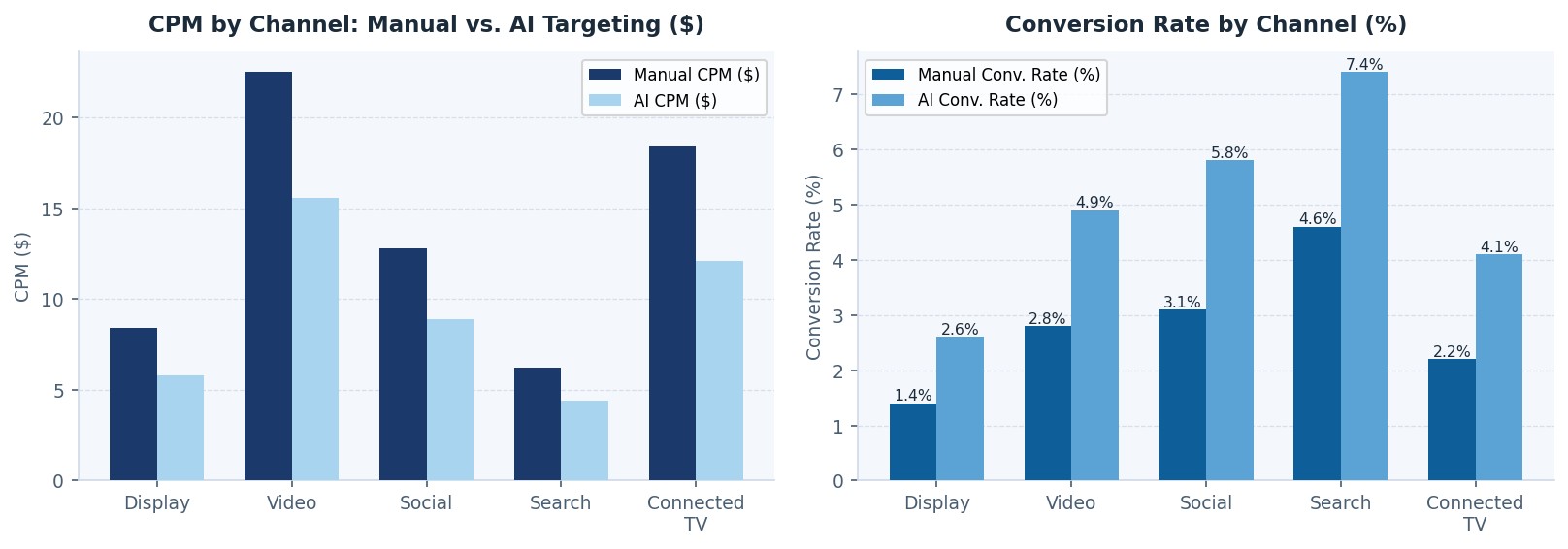
Figure 12 — CPM by Channel (Manual vs. AI Targeting) & Conversion Rate by Channel
Most of the AI advertising ROI discussion focuses on the buy side. Publishers — the media companies and content platforms that supply advertising inventory — have their own equally compelling AI use case in yield optimisation.
AI yield management systems that continuously optimise price floors, audience segment packaging, and deal structure across direct and programmatic channels are delivering 15–30 percent CPM improvements for publishers deploying them at scale. The improvement comes from the AI's ability to manage the trade-off between fill rate and CPM more intelligently than human yield managers can at the transaction frequency of modern programmatic — making thousands of optimisation decisions per minute that aggregate to material revenue improvement.
For a publisher with $200 million in annual digital advertising revenue, a 20 percent yield improvement from AI is $40 million — requiring an AI yield platform investment that typically runs $1–3 million annually. The return ratio puts it among the highest-ROI technology investments available to a media company.
The Attribution Challenge: Making the ROI Case Hold Up
The advertising AI ROI cases described in this article depend on attribution models that can isolate the AI contribution from other variables — campaign strategy, creative quality, seasonal demand patterns, and competitive activity. This is genuinely challenging, and the industry has not fully solved it.
The most credible attribution approach used by the advertisers in this study was prospective holdout testing: running AI-optimised and non-AI campaigns simultaneously against randomly allocated audience segments, with identical budget, creative, and channel mix. Under this structure, the AI improvement is attributable with high confidence because all confounding variables are controlled. This approach requires methodological discipline and a willingness to accept that some budget will be allocated to a control condition that performs sub-optimally — the cost of generating credible evidence.
Advertisers that have done the disciplined measurement work have found that the AI improvement is real and consistent across campaign types and channels. Those that have relied on before-after comparisons, without controlling for confounders, have sometimes attributed improvements to AI that reflected other changes. The measurement investment is worth making: a credible AI attribution case is the foundation for confidently scaling the program — and for retaining senior leadership support through the inevitable campaign periods when performance fluctuates.
Comments (0)
Join the conversation!