


AI churn prediction is a revenue machine for telecom operators. But when the model decides which customers are worth keeping, the least profitable are quietly left behind.
Priya Desai is a customer care agent at a mid-size telecom provider. Every morning, her screen populates with a ranked list of customers to contact, sorted by an AI-generated “churn risk score.” High-value customers flagged as likely to leave get premium retention offers—discounted plans, upgraded devices, personal account managers. Customers at the bottom of the list—those the model calculates as low-value and unlikely to leave—get nothing. Some, Priya noticed, never appear on anyone’s outreach list at all.
The Revenue Logic
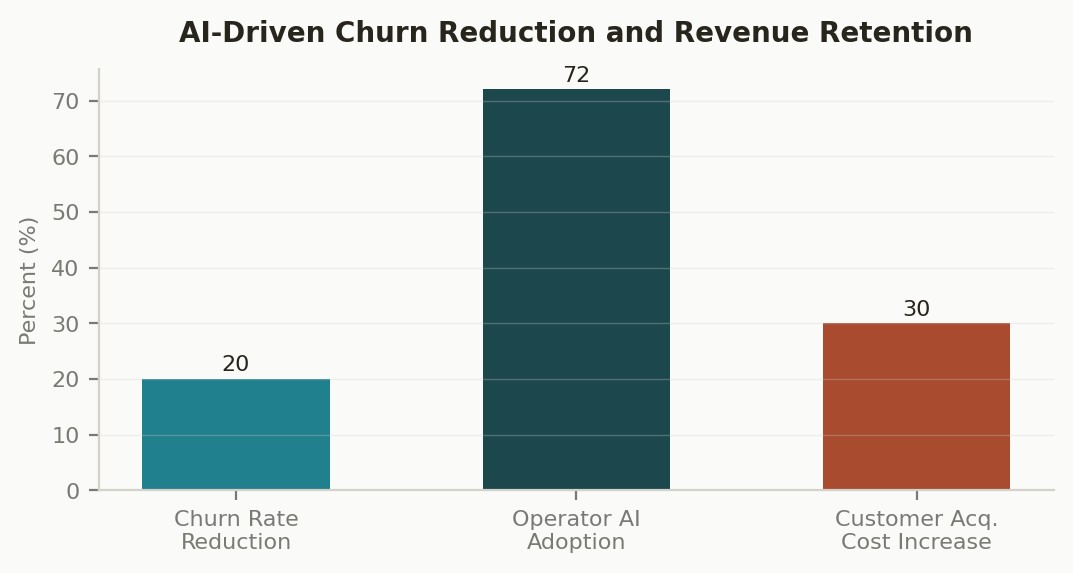
Churn prediction is one of the highest-ROI applications of AI in telecommunications. McKinsey’s TMT practice estimates that AI-driven retention programs reduce churn rates by 15 to 25 percent at operators that deploy them at scale, generating $50 million to $300 million in annual revenue retention for large carriers. GSMA Intelligence’s 2025 operator AI survey found that 72 percent of Tier 1 operators now use machine learning for customer lifetime value scoring and retention targeting.
TeleGeography’s analysis of the global telecom market shows that customer acquisition costs have risen 30 percent over five years, making retention economically critical. The math is straightforward: keeping a high-value customer costs a fraction of acquiring a replacement. AI makes that calculus faster and more precise.
The Digital Divide Within
But precision in optimization can become cruelty in practice. When churn models sort customers by value, they inevitably deprioritize those who spend the least—often elderly subscribers on basic plans, low-income households, and rural customers whose limited data usage makes them algorithmically “unimportant.” These are the customers who receive slower support response times, are routed to lower-tier agents, and never see a proactive retention offer.
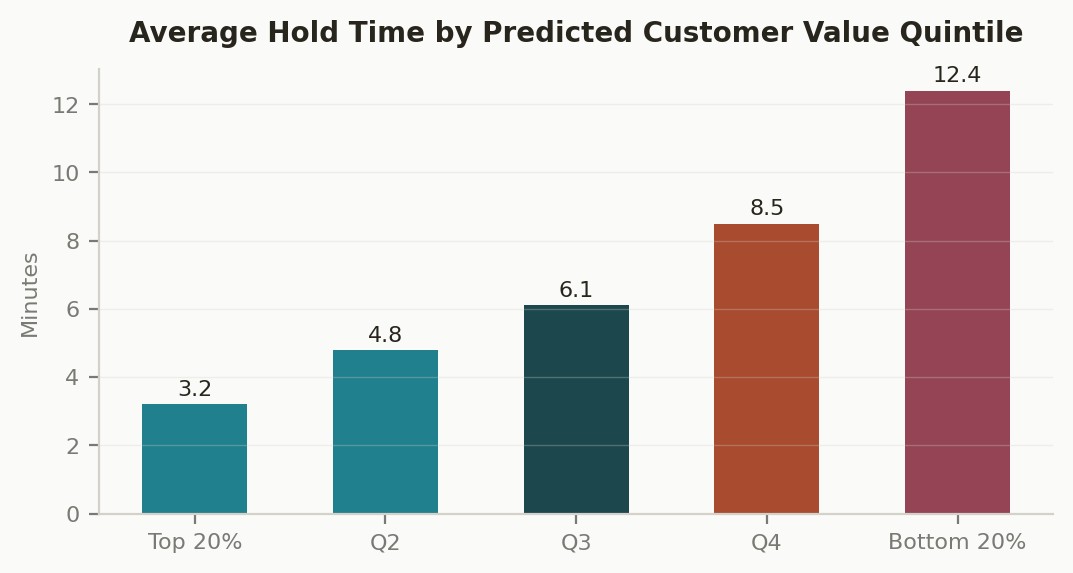
Light Reading’s investigation into AI-driven customer care found that average hold times for customers in the bottom quintile of predicted lifetime value were 2.4 times longer than for top-quintile customers at the same carrier. The disparity was not a deliberate policy—it was an emergent outcome of optimizing resource allocation by predicted value. But the effect is a two-tier service system that rewards the profitable and neglects the rest.
Toward Fairness in Retention
Some operators are beginning to build fairness checks into their churn models. This means setting minimum service-level guarantees that apply regardless of predicted customer value, conducting regular bias audits of retention targeting, and creating appeal mechanisms for customers who feel they have been deprioritized. The GSMA’s AI ethics framework, released in late 2024, recommends that operators adopt transparency guidelines so customers can understand how AI shapes the service they receive.
What This Means for You
If you are a telecom customer:
• If you feel you are receiving slower or lower-quality service than you once did, ask your provider to explain their service-level commitments. You may be interacting with a system that has quietly deprioritized you based on your spending patterns.
If you are a telecom executive:
• Set service floors that are independent of customer value scores. Regulators are watching, and the reputational cost of a “two-tier service” headline is far greater than the cost of treating every customer with baseline dignity.
If you are a regulator:
• Require operators to disclose how AI influences service levels and retention decisions. Algorithmic deprioritization of low-income customers in an essential service is a digital-divide issue that existing telecom frameworks were not designed to address.
REFERENCES
1. TeleGeography, "Global Telecom Market Research" — https://www.telegeography.com/research-services/commsupdate/
2. GSMA Intelligence, "Operator AI Strategy Survey 2025" — https://www.gsma.com/intelligence/
3. McKinsey & Company, "TMT Insights: Telecom AI ROI" — https://www.mckinsey.com/industries/technology-media-and-telecommunications/our-insights
4. Light Reading, "AI in Telecom Customer Care" — https://www.lightreading.com/artificial-intelligence