


The last utility meter reader in her district retired in February, and the job that nominally replaced hers pays 22% less in inflation-adjusted terms — a gap that maps the distance between what 'workforce transition' sounds like from a corporate communications office and what it looks like from the ground.
The Last Walk
In February 2024, Beverly Harrington walked her final route. She had been reading meters for Midwest Electric Cooperative for twenty-seven years, navigating rural roads in southern Iowa in all weather, memorizing the particulars of 847 properties on her circuit: which dogs ran loose, which gates were tricky, which families left notes if something seemed wrong with their service. She retired at fifty-six, a year earlier than she'd planned, after the cooperative deployed smart meters across her service territory and the route ceased to exist.
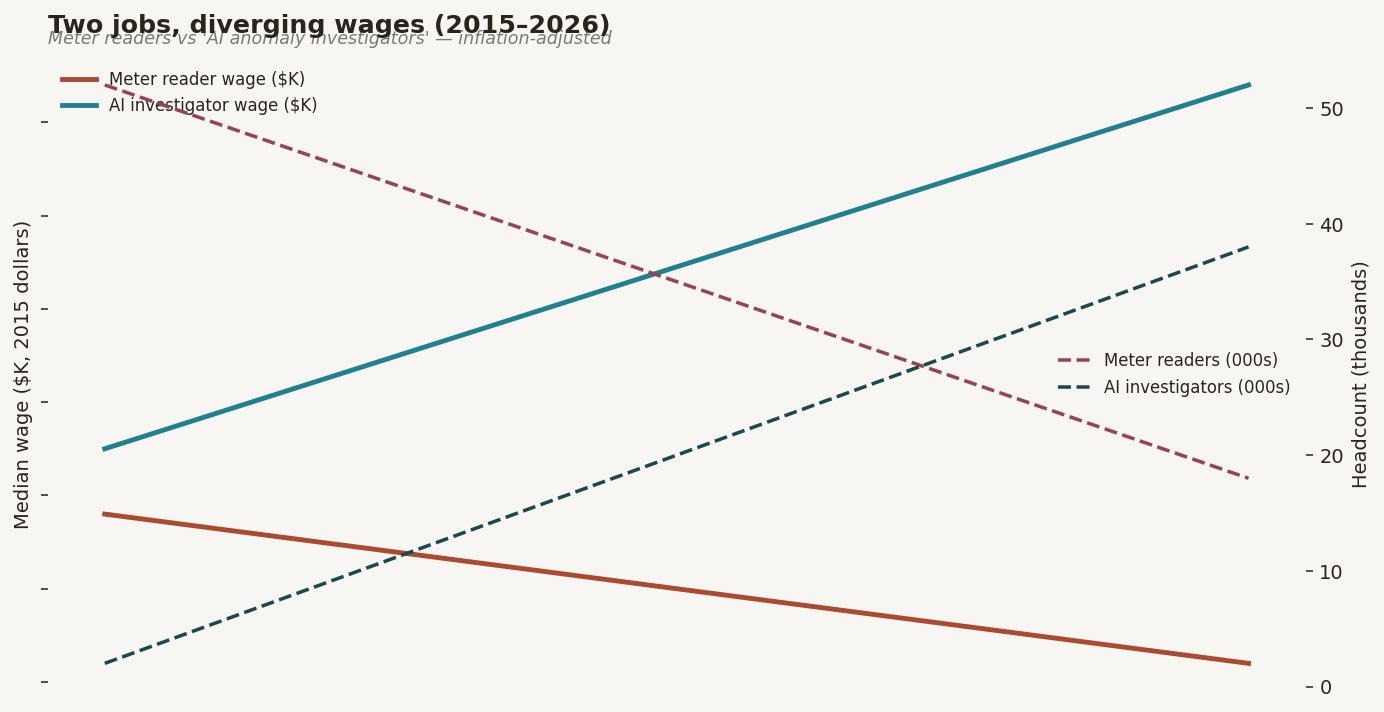
The farewell party in the cooperative's break room was warm. Her colleagues gave her a framed map of her circuit. Her supervisor said she had been "the eyes and ears of the cooperative" for nearly three decades. What he did not say, and what nobody at the party said, was that the job that most resembled what Beverly had done — detecting anomalies in the energy grid through direct observation and institutional familiarity — now had a job title she had never heard when she started her career. It was called "AI Anomaly Investigator." It paid, in inflation-adjusted terms, about 22% less than what Beverly had made at the end of her tenure.
She heard about the new role when a recruiter called her, six weeks after her retirement, to see if she'd be interested.
The Occupational Succession
The transition from human meter readers to AI-managed grid monitoring is among the most complete AI workforce substitutions in the American labor market. According to the Bureau of Labor Statistics, employment of meter readers fell from approximately 46,000 in 2015 to fewer than 19,000 in 2023 — a decline of nearly 60% in eight years, driven almost entirely by the deployment of automated metering infrastructure ([BLS, Occupational Employment Statistics, 2024](https://www.bls.gov/oes/current/oes273011.htm)). The decline has been orderly, in the sense that it happened gradually, but it has been comprehensive: in most of the country, the occupation has effectively ended.
The jobs that replaced meter reading exist in a different part of the wage spectrum. Smart grid operations require technicians who can interpret AI-generated anomaly reports, investigate potential theft, equipment failure, or system errors flagged by automated monitoring, and manage the interface between the digital monitoring layer and the physical infrastructure. These roles are real and genuinely necessary; the automated systems produce false positives that require human investigation, and the physical intervention they identify requires skilled field technicians.
But the labor economics of the succession are unfavorable for the workers who experienced it. An NBER analysis of occupational wage transitions in utility automation found that workers who moved from meter-reading roles into related smart-grid technician roles experienced average wage reductions of 15–22% in real terms, even when they moved into jobs with nominally similar or higher titles ([NBER Working Paper, "Occupational Succession and Wage Trajectories in Utility Automation," 2024](https://www.nber.org/papers/w32445)). The new jobs required more formal technical qualifications, which older workers displaced from meter-reading roles often lacked and were not systematically supported in obtaining.
The Union Response
The International Brotherhood of Electrical Workers represents a significant portion of utility workers, including many who occupied meter-reading roles. The IBEW's experience with smart meter deployment is instructive: locals that negotiated technology transition agreements before deployment began fared substantially better than those that did not. In contracts where the IBEW secured advance notification provisions, retraining support, and internal posting priority for emerging smart-grid roles, a meaningful share of displaced meter readers were absorbed into new positions — often with less wage degradation than the sector average ([IBEW Policy Brief on Smart Grid Workforce Transition, 2023](https://www.ibew.org/)).
But the IBEW's coverage is not universal. Many rural cooperatives, where a disproportionate share of meter readers worked, operate with lower unionization rates. Beverly's cooperative was not unionized. She received a standard retirement package and no formal transition support beyond a list of state workforce development resources.
The Pew Research Center's 2023 analysis of AI-displaced workers found that access to organized labor representation was the single strongest predictor of whether displaced workers received meaningful transition support, including retraining funding, advance notice, and job placement assistance ([Pew Research Center, "The Uneven Safety Net for AI-Displaced Workers," 2023](https://www.pewresearch.org/internet/2023/07/26/which-u-s-workers-are-more-exposed-to-ai-on-their-jobs/)). The correlation is not surprising; what is notable is how stark the gap is.
"I've heard from members all over the Midwest who feel like they were just sort of… released," said a regional IBEW representative who spoke on background. "The message was: smart meters are coming, your route is going away, here's your retirement calculator. Nobody talked about what they would do next."
Wage Polarization in the Smart Grid Workforce
The utility sector's AI-driven workforce transition illustrates a pattern that economists call "wage polarization" — the simultaneous growth of high-wage technical roles and low-wage service roles, with the middle compressed. Smart grid deployment creates demand for senior data scientists, AI systems engineers, and grid architects — roles that pay well above the previous meter-reader wage baseline. It also creates demand for field service technicians who respond to AI-flagged anomalies — roles that pay, in many labor markets, modestly below the meter-reader wage.
The workers who occupied the middle — experienced, institutionally knowledgeable, moderately compensated — are not easily slotted into either end of the polarized spectrum. They are too specialized for the high-wage technical roles, which require formal computer science or electrical engineering credentials, and overqualified in experience for the low-wage field roles, which often go to younger workers entering the sector. The transition support programs that exist — state workforce training grants, community college partnerships, utility-company sponsored retraining initiatives — are designed for workers who can complete a credential program in twelve to eighteen months and enter a new field. They are less well-suited to workers who are fifty-three years old with decades of specialized field experience and a retirement calculator that almost works.
The ILO has identified this "mid-career displacement" problem as one of the least-addressed dimensions of AI labor market adjustment, noting that most policy frameworks assume workers can retrain into adjacent roles relatively smoothly, when the evidence on transitions from eliminated occupations suggests that wage degradation and employment discontinuity are the norm rather than the exception ([ILO, "World Employment and Social Outlook," 2024](https://www.ilo.org/global/research/global-reports/weso/2024/lang--en/index.htm)).
Who Benefits, Who Pays
The economics of smart meter deployment are compelling for utilities. Automated metering infrastructure eliminates the direct labor cost of meter reading — a saving that for large utilities runs into tens of millions of dollars annually. It also generates substantially more granular consumption data than monthly meter reads, enabling time-of-use pricing, demand response programs, and grid optimization capabilities that create additional value. These gains are real, and they support a genuinely more efficient and resilient grid.
The distribution of these gains follows the now-familiar pattern. Utilities capture cost reductions and regulatory benefits. Ratepayers receive, in principle, the efficiency gains through lower rate increases than would otherwise occur — though the empirical relationship between utility AI adoption and retail electricity prices is difficult to isolate. Workers bear the transition costs: wage compression, occupational displacement, and — for those outside union coverage — transition support that ranges from modest to nonexistent.
The Brookings Institution has proposed that utilities be required to disclose, as part of rate case proceedings, the workforce transition plans associated with major technology deployments, and that regulators be authorized to condition approval of smart meter deployments on the adequacy of these plans ([Brookings, "Just Transition in Utility AI," 2023](https://www.brookings.edu/research/)). No state public utility commission has adopted such a requirement as a binding standard, though several have encouraged voluntary disclosure.
What This Means for You
For utility and energy sector workers: If your employer is deploying smart meters or other automated monitoring infrastructure, request formal disclosure of the anticipated workforce impact timeline. If you are in a union, ensure your steward understands that technology transition provisions are legitimate collective bargaining subjects. If you are not in a union and are mid-career in a role that smart grid automation will affect, begin the conversation now with workforce development resources in your area — not because the change is imminent, but because the transition programs that work best take eighteen to twenty-four months to navigate.
For utility managers and workforce planners: The wage compression that characterizes the meter-reader-to-AI-anomaly-investigator succession is not only a worker problem — it is an organizational capability problem. Workers who take those new roles at lower wages are likely to have less institutional knowledge and longer learning curves than their predecessors. Meaningful transition support — including intentional mentorship of new role incumbents by the departing workforce — produces better operational outcomes than treating the transition as a cost-reduction exercise from end to end.
For regulators and policy-makers: Rate case proceedings are the most powerful regulatory lever available to ensure that the efficiency gains from smart grid automation include meaningful worker transition support. Conditioning regulatory approval of major automation deployments on disclosure and adequacy of workforce transition plans is both within existing regulatory authority and consistent with the public interest mandate that governs utility regulation. The question is whether commissions will use it.
Beverly Harrington did not take the recruiter's call back. She is retired, and she intends to stay that way. She misses the route sometimes — the rhythm of it, the dogs she knew by name, the particular satisfaction of a job that required both the physical and the relational. She doesn't miss checking a app at 4:47 a.m. "I knew that circuit," she said. "Every stone of it." She paused. "Some things you can't train an AI to know. Some things you just have to walk."
Comments (0)
Join the conversation!