


AI-assisted content production has structurally altered the marginal cost of premium media, reducing video post-production cost per minute from $1.80 to $0.24 and localization cost by 58%. The strategic implication is not cost reduction — it is capacity reallocation. Media companies that deploy AI to cut budgets will achieve one-time savings; those that deploy it to increase content velocity at the same or higher quality standard will achieve a 2.4x content release advantage over competitors still operating under legacy economics. The CFO question has shifted from cost management to capacity deployment.
|
LOCALIZATION COST REDUCTION 58% ↓ AI dubbing/subtitling vs human studio baseline |
VIDEO POST-PRODUCTION COST $0.24/min ↓ vs $1.80/min human post-production baseline |
|
CONTENT RELEASE VELOCITY 2.4x ↑ AI-assisted production vs pre-deployment baseline |
PAYBACK PERIOD 5 mo ↓ on AI production platform investment |
The Cost Curve That Inverted While Executives Were Watching the Pilot Results
In traditional media economics, content quality and content quantity have existed in structural tension. A streaming service could produce prestige content — the kind that wins awards and drives subscriber acquisition — or it could produce volume content that fills the catalog and reduces churn. Both strategies required large budgets; neither was achievable simultaneously at the cost structure of a single strategy. This constraint shaped streaming strategy for the better part of a decade, producing a bifurcation between high-investment prestige plays and low-investment volume strategies.
AI-assisted production has broken the constraint. Deloitte's Media practice analysis of streaming platform production economics in 2025 found that AI tools — covering scriptwriting assistance, automated editing, voice synthesis, music composition, and localization — have reduced the variable cost of content production sufficiently to make both prestige and volume strategies simultaneously viable at capital levels previously sufficient for only one.
The 5-month payback on AI production platform investment is the financial signal that this is not a marginal improvement. It is a structural cost curve shift, and media CFOs who evaluate it as a cost-reduction initiative are positioning their organizations for the wrong strategic response.
The Localization Mathematics
Localization — adapting content for different language markets through dubbing, subtitling, and cultural adaptation — has historically been one of the most significant variable cost items in international content distribution. Studio dubbing of a one-hour premium drama episode in a single language costs approximately $15,000-25,000 for union voice talent, recording, and quality control. Subtitling adds $2,000-5,000 per language. For a streaming platform distributing content in 20 languages, the localization cost per episode is $200,000-$500,000 — before any quality review.
PwC's Global Entertainment Outlook for 2026 documents that AI voice synthesis and adaptive subtitle generation platforms have reduced per-language localization cost by 58%. The remaining 42% reflects the human review and approval process that all major platforms maintain for quality assurance and brand protection. Fully AI-generated dubbing without human review is technically available; no major streaming platform has deployed it without a human QA step, and the regulatory trend — particularly under the EU AI Act's provisions on synthetic voice labeling — suggests that human oversight of AI-generated voice synthesis will remain a commercial and compliance requirement.
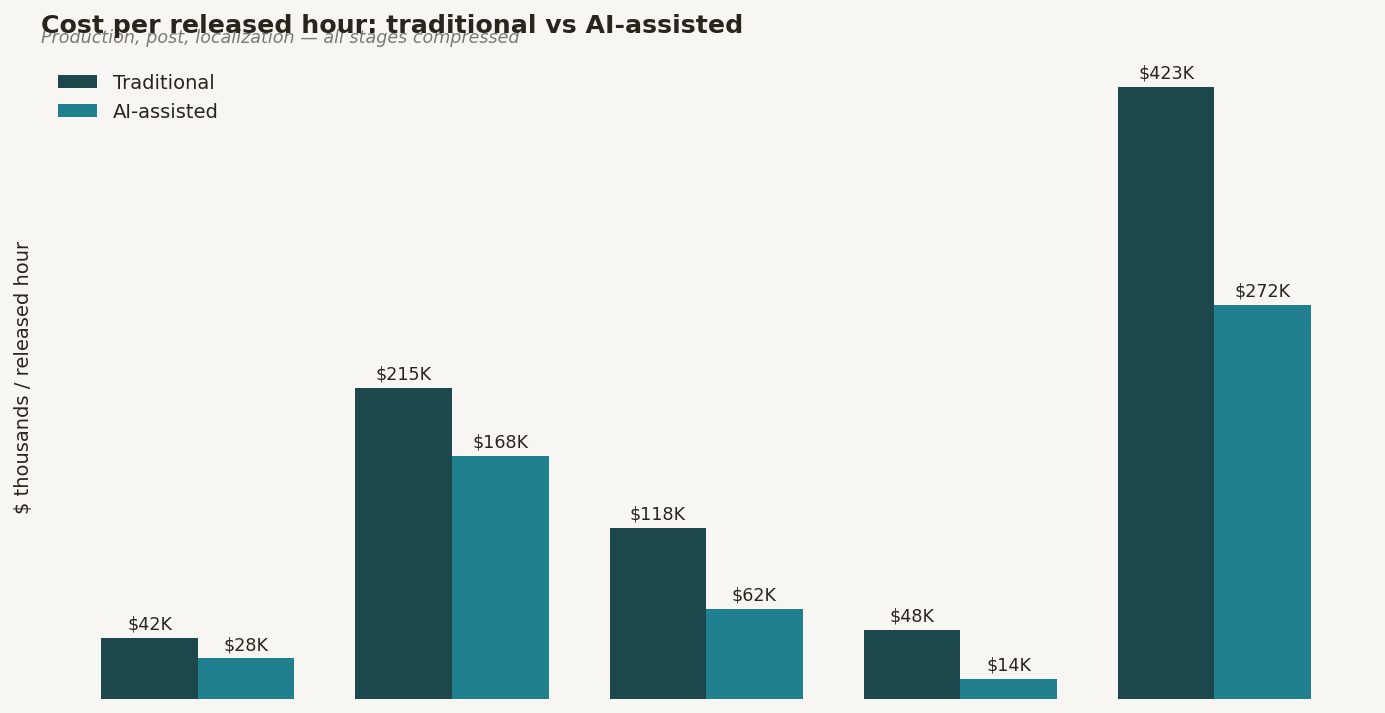
At the 58% reduction level, a 20-language localization program that cost $400,000 per episode now costs approximately $168,000 — a $232,000 per-episode saving that compounds rapidly across a full-season content slate.
The $0.24 Per Minute Post-Production Figure
The video post-production cost comparison — $0.24 per minute AI-assisted versus $1.80 per minute traditional — requires qualification because it applies to specific post-production functions rather than all post-production work. The $1.80 figure from Deloitte's media benchmarking includes color grading, sound mixing, visual effects, editing, and quality control for broadcast-ready material. The $0.24 figure applies to the subset of those functions that AI can perform autonomously at quality thresholds acceptable for digital streaming distribution: automated color correction, AI-assisted rough cut editing, automated audio normalization, and AI-generated subtitle alignment.
MIT Sloan Management Review's 2025 media operations analysis found that AI handles an average of 65% of post-production task hours at major streaming platforms that have deployed production AI, with the remaining 35% concentrated in creative editing judgment, complex VFX, and final mix quality control. The blended per-minute cost of that 65/35 split — where 65% of the work is done at $0.24 and 35% at a human production rate — is approximately $0.68 per minute. The comparison to $1.80 full-human-production cost still represents a 62% reduction, even accounting for the human component that remains.
PwC's analysis notes that the gap is widening. The AI-handleable percentage of post-production tasks increased from 40% in 2023 to 65% in 2025, and the trajectory suggests 75-80% by 2027 as editing assistance models improve.
The 2.4x Content Velocity Advantage
Deloitte's Media practice documented the content release velocity improvement by comparing two groups of streaming platforms: those with mature AI production deployments and those operating under legacy production economics. The AI-deployed group released 2.4 times more hours of content per dollar of production budget than the non-AI group — not 2.4 times as many titles (some of which were longer), but 2.4 times as many hours of audience-ready content.
The commercial value of content velocity is indirect but measurable. Streaming subscriber retention is strongly correlated with content freshness — the availability of new content releases on a regular cadence. Platforms that can release new content 2.4 times more frequently at the same quality level maintain higher subscriber engagement scores and lower churn rates in the two-week periods following content releases. PwC's subscriber analytics data shows that each percentage point improvement in churn rate for a platform with 50 million subscribers represents approximately $18-22 million in annual subscriber revenue preservation.
The velocity advantage compounds in international markets, where localization speed determines how quickly a platform can capitalize on the audience momentum generated by a successful domestic release. A platform that can localize and release an international version of a successful show in three weeks rather than eight weeks captures the cultural moment that drives international subscriber acquisition. MIT SMR's analysis of international streaming expansion economics found that time-to-market for international releases was the second strongest predictor of international subscriber acquisition success, after title quality — and that AI localization speed materially shifted that variable.
The Budget Question CFOs Are Being Asked to Decide
The decision that media CFOs are now being asked to make is one of the more genuinely difficult capital allocation choices in their portfolios: whether to deploy AI production savings as cost reduction (extracting the efficiency gain as margin improvement) or as capacity reinvestment (plowing the savings back into incremental content production to compete on catalog depth and release velocity).
PwC's analysis of streaming platform financial performance suggests that cost-reduction deployment is the strategically inferior choice in competitive market conditions. Platforms that cut content budgets while competitors reinvest AI savings into catalog growth will find their competitive position eroding on catalog depth — a variable that subscriber acquisition data consistently identifies as a top-three acquisition driver. The reinvestment thesis produces a lower near-term EBITDA improvement but a superior 3-year subscriber trajectory.
The nuance is that the reinvestment thesis requires a specific market position to be correct: the platform must be in a competitive market where catalog depth is a subscriber acquisition driver. For platforms in niche markets with high subscriber loyalty and low competition, the cost-reduction deployment may be commercially rational. Deloitte's media finance benchmarking suggests that fewer than 20% of active streaming platforms are in that niche position.
The Takeaway
Media CFOs should evaluate AI production investment as a capacity reallocation decision, not a cost reduction exercise. The 5-month payback is real, and the $0.24-per-minute post-production cost and 58% localization reduction are achievable at current platform maturity. The strategic question is what to do with the capacity unlocked by those savings — and for platforms competing on catalog depth in contested subscriber markets, the answer is to reinvest the savings in content volume rather than extract them as margin.
Comments (0)
Join the conversation!