


The electrical grid is one of the most complex real-time optimization problems in existence, and for decades it has been managed by a combination of human expertise, legacy SCADA systems, and conservative operating margins designed to absorb uncertainty. AI is beginning to close the gap between what the grid could optimize and what it actually does.
|
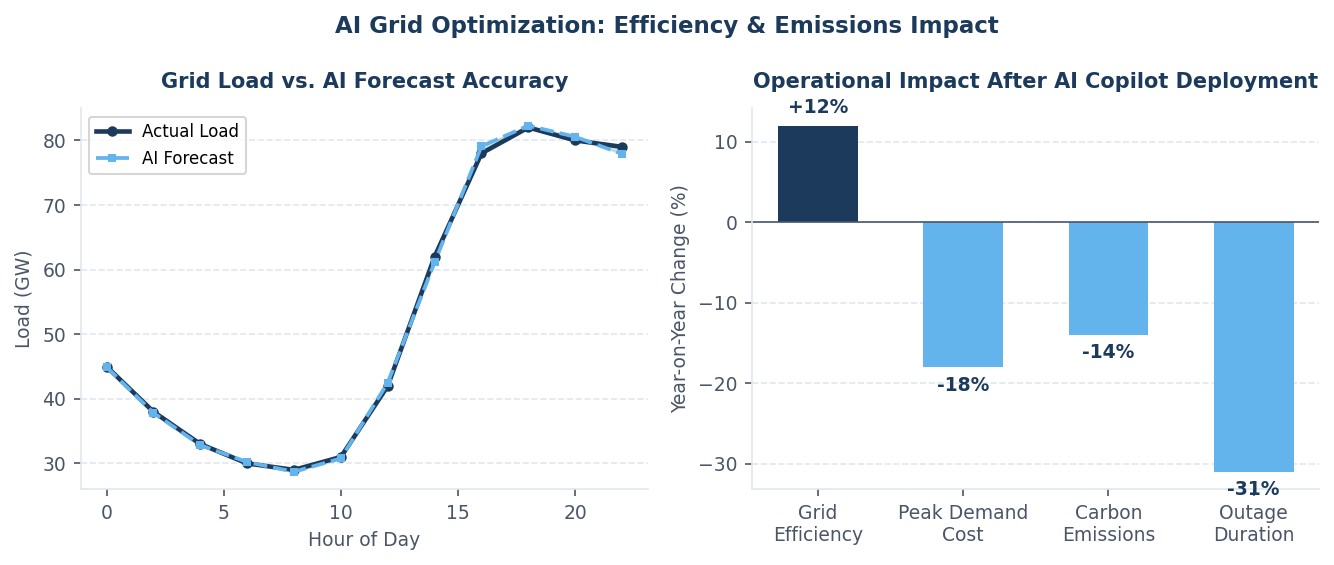
+12% Grid Efficiency Improvement ↑ Peak period optimization |
↓ 14% Carbon Emissions Reduction Via renewable dispatch priority |
↓ 31% Outage Duration Reduction AI anomaly detection |
↓ 18% Peak Demand Cost Savings AI-optimized dispatch |
The idea started with a frustration. Working with EIA (U.S. Energy Information Administration) open data on grid dispatch, it becomes immediately apparent that real-time electricity markets are rife with inefficiency. Renewable generation gets curtailed because the dispatch algorithm doesn't prioritize it fast enough. Peaker plants fire up 30 minutes before they're needed because operators are working with 15-minute forecast intervals instead of 5-minute ones. Storage assets sit idle because the optimization layer doesn't have visibility into the full picture of what's happening across the network.
The copilot prototype addressed a narrow slice of this: load forecasting at 5-minute intervals for a distribution substation, combined with a recommendation engine that suggested dispatch tweaks based on forecast uncertainty. Not a grid controller — a co-pilot in the literal sense: something that presents better information faster, and makes a recommendation a human can approve with a single click.
Why Grid AI Is Hard
Three things make power grid AI substantially harder than enterprise AI deployments in most other sectors. First, reliability requirements are extreme. A software bug that crashes an inventory forecasting app is embarrassing. The equivalent failure in grid management software can cascade into a blackout affecting hundreds of thousands of people. Safety margins that would be considered paranoid in any other domain are entirely appropriate here.
Second, data access is fragmented. Most distribution utilities operate a patchwork of SCADA systems from different vendors and eras, with proprietary data formats and APIs that were never designed for third-party integration. A startup trying to build grid AI needs to solve a data plumbing problem of considerable complexity before it can build anything interesting.
Third, regulatory structure creates procurement asymmetries. Large utilities buy technology through multi-year procurement cycles with detailed performance specifications. A two-person team with a credible prototype can't easily enter that sales cycle — not because the technology isn't viable, but because the procurement process isn't designed for it.
Where the Returns Are Actually Being Captured
The utility companies capturing the clearest AI returns today are doing so in three areas. Predictive maintenance of transmission and distribution infrastructure — AI models trained on LiDAR surveys, weather data, and historical failure records are identifying at-risk infrastructure components with sufficient accuracy to prioritize inspection cycles, reducing both emergency repair costs and wildfire ignition risk. Grid-scale battery dispatch optimization — AI systems managing large battery installations are outperforming rule-based dispatch by 8-14% in energy arbitrage value, compounding across the lifetime of a storage asset. And demand response optimization — algorithms that model customer response to price signals and incentives are improving the economics of demand response programs significantly.
The copilot prototype demonstrated that a small team can build a credible proof of concept. Getting from proof of concept to a product that a utility will deploy in production requires solving the regulatory, data access, and reliability problems that make this sector genuinely hard. That's not an argument against starting. It's an argument for going in with a clear understanding of where the moat is.
Comments (0)
Join the conversation!