


AI is making government services faster and cheaper. But when an algorithm triages a benefits appeal before any human sees it, the promise of efficiency collides with the demand for due process.
Carmen Rios filed an appeal of her disability benefits determination on a Wednesday morning. She had documentation from two physicians, a detailed employment history, and a letter from her former employer. Under the old system, a caseworker would have reviewed her file within ten business days. Under the new AI-first triage system her county had deployed six months earlier, an algorithm scored her case, assigned it a priority level, and routed it to a queue. Carmen’s case was scored as “low complexity” and placed at the back of a line she did not know existed. She waited eleven weeks for a human to look at her file.
The Efficiency Case
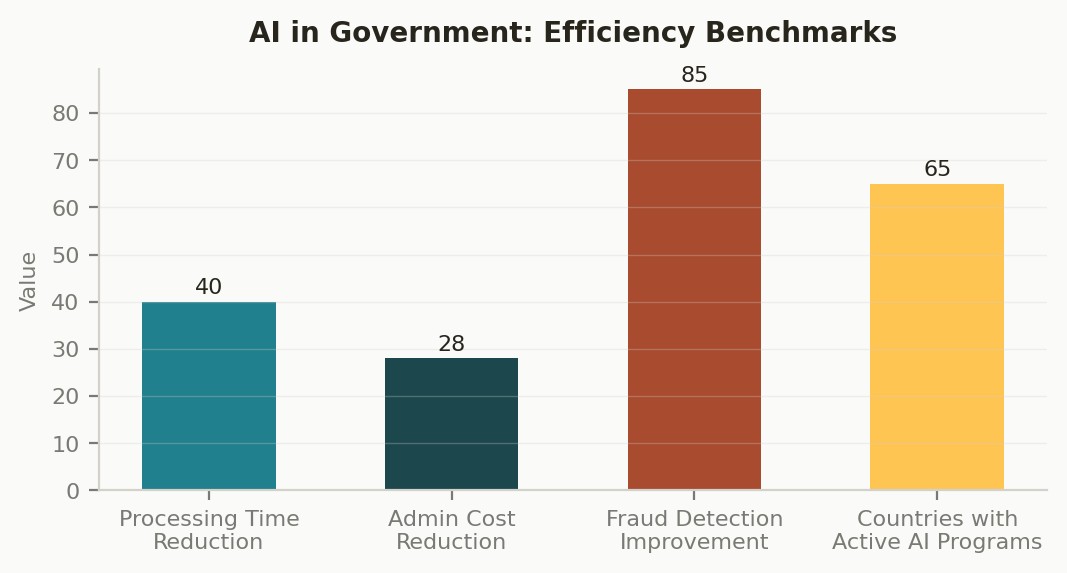
The fiscal pressure driving AI adoption in government is intense and legitimate. Deloitte’s Center for Government Insights reports that AI-enabled citizen services reduce average case processing times by 30 to 50 percent and cut administrative costs by 20 to 35 percent in municipalities that have implemented them. GovTech’s 2025 survey of state and local government IT leaders found that 61 percent are now using or piloting AI in at least one citizen-facing service.
The IBM Center for the Business of Government documented AI deployments that processed benefits applications 3x faster, detected fraudulent claims with 85 percent greater accuracy, and freed caseworkers to focus on complex cases requiring human judgment. Oxford’s Government AI Readiness Index ranks 65 countries as having “active” government AI programs, up from 38 just three years ago.
Due Process in the Queue
But speed is not justice. When an algorithm triages cases, it makes consequential decisions about whose needs are urgent and whose can wait—decisions that were previously made by human caseworkers who could read between the lines of a file, notice when someone was in crisis, and exercise discretion. Carmen’s case was not simple. It was complex in ways the algorithm was not trained to recognize.
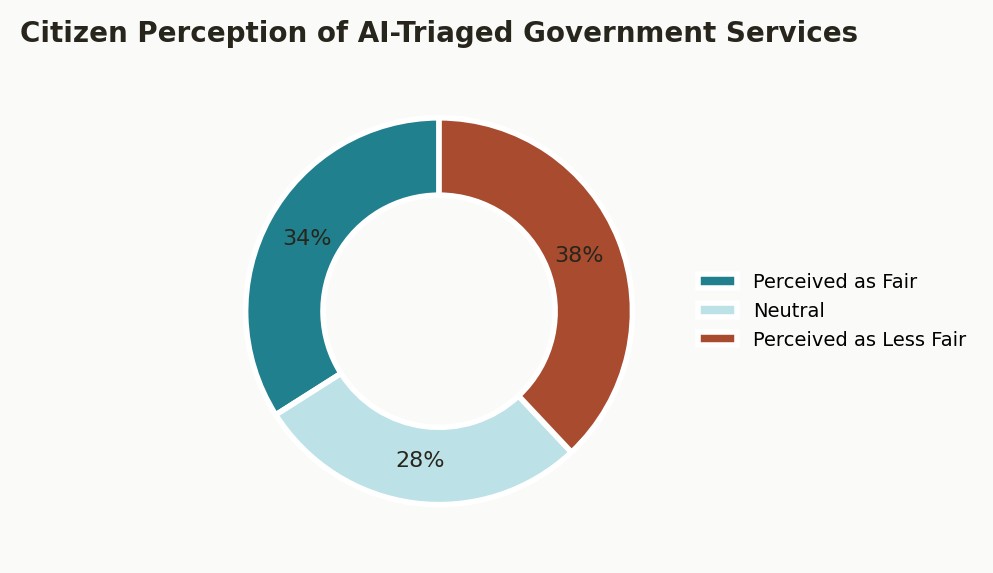
Deloitte’s government AI research found that 38 percent of citizens whose cases were triaged by AI felt the process was “less fair” than human-led processes, even when outcomes were similar. The perception of fairness matters as much as the outcome, because public trust in government services is the foundation on which democratic legitimacy rests.
A Framework for Accountability
The municipalities getting this right are building what the IBM Center calls “algorithmic accountability frameworks”: mandatory human review for any AI decision that denies or significantly delays a benefit, transparent notification to citizens that AI is involved in their case, regular bias audits of triage algorithms published publicly, and community input mechanisms that give residents a voice in how AI is used in their services. These frameworks add cost. They also add legitimacy—which is the one thing government services cannot function without.
What This Means for You
If you are a resident:
• You have the right to know whether AI is involved in decisions about your benefits, your housing, or your interactions with government. Ask. If the answer is unclear, that itself is information worth escalating.
If you are a public official:
• Implement algorithmic impact assessments before deploying AI in citizen services. Publish the results. The political cost of transparency is far lower than the cost of a scandal involving an opaque algorithm that harmed vulnerable residents.
If you are a government technologist:
• Build override mechanisms into every AI triage system. A caseworker who spots a case the algorithm misjudged must have the authority and the interface to intervene immediately.
REFERENCES
1. Deloitte, "Center for Government Insights: AI Case Studies" — https://www.deloitte.com/us/en/pages/center-for-government-insights/topics/ai-government.html
2. GovTech, "AI in State and Local Government 2025" — https://www.govtech.com/artificial-intelligence
3. IBM Center for the Business of Government, "AI Governance Reports" — https://businessofgovernment.org/topic/artificial-intelligence
4. Oxford Insights, "Government AI Readiness Index" — https://www.oxfordinsights.com/government-ai-readiness
Comments (0)
Join the conversation!