


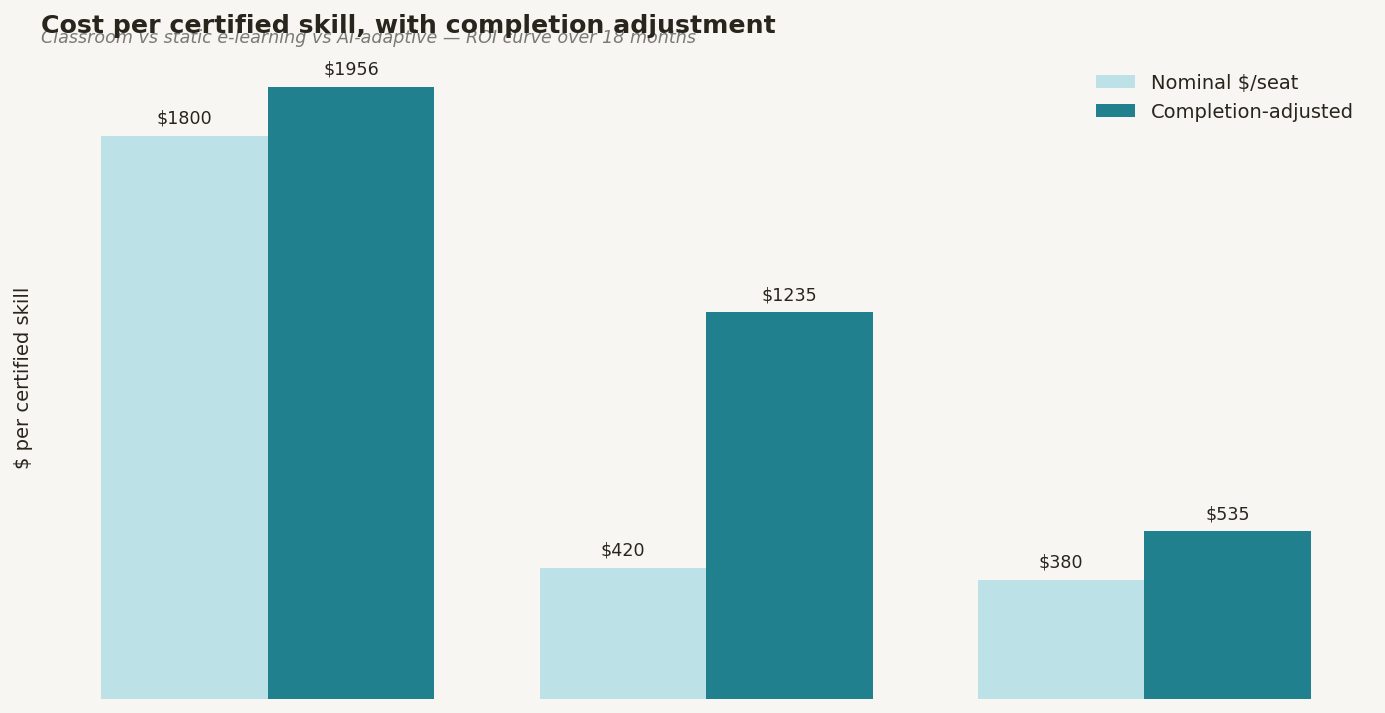
AI tutoring platforms in corporate learning and development are generating skill-certification completion rates and time-to-competency reductions — 61% faster on average — that have created a data-driven investment thesis where none previously existed. The CFO case is harder than the HR case because it requires connecting skill acquisition to workforce productivity metrics that most companies do not currently measure at sufficient granularity. Organizations that build that measurement infrastructure are finding a $1,800 cost-per-certified-skill versus a $4,200 classroom equivalent, and a 9-month payback on platform investment.
|
TIME-TO-COMPETENCY REDUCTION 61% ↓ AI tutor vs blended classroom baseline |
COST PER CERTIFIED SKILL $1,800 ↓ vs $4,200 classroom/instructor-led |
|
PAYBACK PERIOD 9 mo ↓ on L&D platform investment at 1,000+ employee scale |
COMPLETION RATE IMPROVEMENT 27% ↑ AI-adaptive vs static e-learning modules |
The L&D Measurement Problem That Preceded AI
Corporate learning and development has operated for decades under an uncomfortable epistemological condition: the outcomes it produces are genuinely difficult to measure, and the difficulty has been used — by L&D leaders and HR departments alike — to resist the rigorous ROI analysis applied to other capital expenditures. Training budgets were justified by satisfaction surveys, completion rates, and anecdotal manager feedback. Causality between training investment and business outcome was almost never demonstrated.
AI tutoring platforms are changing this not primarily because they are better at teaching, but because they are better at measurement. Platforms built on adaptive learning architectures — systems that adjust content sequence, pacing, and assessment difficulty based on learner response patterns — generate granular performance data that allows skill attainment to be certified with far greater precision than a course completion record. Gartner's L&D Technology Hype Cycle for 2025 placed AI-adaptive learning at the Peak of Inflated Expectations, which typically signals that the technology is generating both genuine results and inflated vendor claims simultaneously.
The distinction matters for CFOs: the platforms generating 61% time-to-competency reductions and 27% completion rate improvements are generally those with genuine adaptive architectures and skill-graph-based assessments, not those relabeling linear e-learning modules with AI marketing language. Vendor due diligence on the assessment methodology is more important than the platform feature comparison.
The $1,800 vs $4,200 Cost Comparison
Bersin by Deloitte's 2026 corporate learning benchmark defines the cost-per-certified-skill metric as the fully loaded cost to bring an employee from baseline proficiency to a defined competency standard that the organization can verify and rely upon — not the cost to complete a course. The distinction is significant. Many corporate training programs produce completions; fewer produce verifiable competency.
The $4,200 figure for classroom or instructor-led training reflects instructor costs, facility costs, participant time valued at average loaded compensation, and the travel component present in many corporate training programs. The $1,800 figure for AI tutoring reflects platform licensing, content development or licensing costs, and participant time — which is the dominant cost component and is reduced by the 61% time-to-competency improvement.
LinkedIn Learning's Workforce Report 2026 found that the time-to-competency improvement drives the majority of the cost differential. If an employee's fully loaded compensation is $80,000 annually, each hour of training consumes approximately $38 in participant time cost. A skill that takes 48 hours to develop through classroom instruction and 18 hours through AI-adaptive tutoring saves $1,140 in participant time alone — a figure that makes up the majority of the $2,400 cost-per-skill differential.
The 9-month payback on platform investment reflects a deployment of approximately 1,000 active learners. At smaller scales, the per-learner licensing cost increases and the payback extends; at larger scales, enterprise licensing structures compress the payback to 6-7 months.
The Completion Rate Problem That Invalidates Most L&D Benchmarks
The 27% completion rate improvement over static e-learning is, in some ways, the most commercially significant figure in AI tutoring deployments — because static e-learning completion rates are so low that they effectively nullify the cost comparison. An e-learning module priced at $200 per learner that achieves a 30% completion rate has an effective cost-per-completion of $667, not $200.
LinkedIn Learning's 2026 data shows enterprise e-learning completion rates averaging 31% for non-mandatory content. Gartner's research on AI-adaptive platforms shows completion rates averaging 58% — still not universal, but sufficient to change the economics materially. The driver is the adaptive nature of the content: learners who receive content calibrated to their current knowledge level and preferred learning pace are less likely to disengage from difficulty mismatches, which is the primary abandonment driver in static e-learning.
Bersin by Deloitte's analysis weights the completion rate improvement as the primary driver of CFO credibility for AI L&D investments. A platform that can demonstrate higher completion rates on auditable skill assessments — not self-reported satisfaction — is making a financial claim that finance departments can verify against workforce planning models.
Building the Measurement Infrastructure
The CFO case for AI tutoring is harder than the HR case precisely because it requires connecting learning outcomes to business performance metrics. HR can justify the investment on engagement, retention, and talent development grounds without requiring the causal link to revenue or productivity. Finance requires the link.
The organizations making the strongest CFO cases are those that have built three measurement components. First, skill inventories: a baseline census of current employee competency levels across roles and business units, establishing the starting point against which improvement is measured. Second, productivity-skill correlation: statistical analysis of the relationship between specific skill certifications and job performance metrics (quality, throughput, error rate) in roles where those metrics exist. Third, attrition reduction attribution: quantifying the portion of employee attrition attributable to lack of development opportunity, and assigning the avoided replacement cost to successful L&D investments.
Gartner estimates that only 23% of companies with AI L&D deployments have built all three measurement components. Those that have are reporting payback periods that finance departments accept; those that have not are funding the investment from HR budgets on qualitative grounds and remain vulnerable to cost reduction reviews.
The Vendor Consolidation Trend
LinkedIn Learning's 2026 report documents that corporate L&D vendor lists are shrinking. The average large enterprise was managing 8.3 L&D platform relationships in 2023; by 2025 that number was 4.1, and the trend toward consolidation is accelerating. The driver is CFO pressure to eliminate non-measured spend and consolidate around platforms that can demonstrate skill certification outcomes.
The consolidation dynamic is favorable for CFOs because the surviving platforms are competing on outcome data, not feature lists. Vendors that cannot produce independently auditable skill certification rates and time-to-competency benchmarks are losing enterprise accounts. Bersin by Deloitte's vendor analysis identifies this outcome-data competition as structurally beneficial for buyers: the market is self-selecting for platforms whose claims are verifiable.
The Takeaway
CFOs evaluating AI L&D platform investments should make the measurement infrastructure — skill inventories, productivity correlation analysis, and attrition attribution modeling — a precondition for deployment, not a post-hoc validation exercise. The $1,800 cost-per-certified-skill is achievable and the 9-month payback is real, but both figures require a measurement framework that most L&D departments do not currently operate. Building that framework before the platform goes live is the investment that makes the ROI conversation with the board credible.
Comments (0)
Join the conversation!