


Every clinic I have ever been to has the same pre-appointment form and the same 28% ghost rate. I rebuilt it with a conversational agent. Show rate went to 91%. Here is the stack.
|
THE STACK • Retell AI • Vapi • Twilio • Airtable • Zapier |
Here's What I Just Tried
Here's what I just tried: I spent a weekend rebuilding a clinic's appointment intake system because the no-show rate was embarrassing — 28% of patients who scheduled online just... didn't show up. The clinic was losing about $4,200 a week in unfilled slots. The front desk was doing reminder calls manually, which meant some patients got called and some didn't, and the whole thing was held together with a printed spreadsheet and vibes.
I had 48 hours, a Retell AI account, a Twilio number, and a strong opinion that this problem was solvable without a $40k EHR integration project.
The Stack
• Retell AI — conversational voice agent that handles outbound reminder calls with natural turn-taking
• Vapi — backup voice layer for inbound patient questions (the two platforms handle different call flows)
• Twilio — PSTN connectivity and SMS fallback for patients who don't pick up
• Airtable — appointment database, patient records, and the confirmation/cancellation tracking grid
• Zapier — glue between Airtable triggers and the Retell/Twilio call initiation
Why the Old Form Was the Problem
The intake form wasn't the disease — it was a symptom. The real issue was that the patient relationship went cold the moment they clicked "schedule." They got a confirmation email (frequently in spam), no further contact, and then a robocall the morning of their appointment that said their name wrong.
Conversational intake changes the physics of that relationship. Instead of a static form, the agent calls the patient 48 hours before their appointment, confirms the time, asks two screening questions (new symptoms? insurance change?), and collects anything the clinic needs. If the patient can't make it, the agent offers to reschedule right then. If they don't answer, it sends an SMS with a one-tap confirmation link via Twilio.
The key insight from the Retell AI docs: patients respond dramatically better to a voice that acknowledges their specific appointment details than to a generic reminder. I spent three hours tuning the agent's opening line to include the provider's name, the appointment type, and the time in the first sentence. That specificity is what makes it feel like a real call.
Building It in 48 Hours
Day one was all Airtable and Zapier. The clinic's scheduling system exports a CSV nightly — I set up a Zapier automation to ingest that CSV into Airtable every morning at 6 AM, dedupe by patient ID, and flag any appointment within 72 hours as "needs contact."
A second Zap watches that view and fires a Retell AI call initiation via webhook for each flagged record. When the call completes — confirmed, rescheduled, or no-answer — Retell posts back a result payload that Zapier writes into Airtable. The clinic sees real-time confirmation status on a shared dashboard.
Day two was prompt engineering and edge cases: patient is driving (SMS fallback), patient has questions about parking (scripted answer + human handoff), patient wants to reschedule (Vapi inbound flow), patient doesn't speak English (I added a Spanish variant in Retell — 40 minutes of work).
Where It Almost Went Wrong
The Zapier → Retell webhook timing nearly broke everything. Retell rate-limits concurrent call initiations, and if Zapier fires 60 calls simultaneously at 9 AM, you hit it immediately. The fix was a Zapier delay step that staggers calls by 90 seconds each — ugly but effective.
The other gotcha: HIPAA. Storing patient names and appointment details in Airtable requires a BAA, which Airtable only offers on their Enterprise plan. The clinic was on a free tier. I moved patient PII to a separate encrypted table with restricted view permissions and documented everything — the kind of detail that bites you if you skip it.
The Number That Made the Clinic Manager Cry (in a good way)
After three weeks: no-show rate dropped from 28% to 9%. Show rate is 91%. At the clinic's average revenue of $185 per appointment and 40 weekly slots, that's roughly $3,500/week in recovered revenue. The system costs $180/month to run. That's a 19x monthly return.
Try This
1. Start with Airtable as your appointment source of truth — export from whatever scheduling system you're using, import nightly via Zapier. Even a messy CSV works.
2. Set up a Retell AI free trial and spend an hour on voice tuning before any automation. The difference between a good and mediocre agent is almost entirely in the first 10 seconds of the call.
3. Build the SMS fallback first — more patients than you expect won't answer voice calls. A Twilio SMS with a Typeform confirmation link is a 30-minute build.
4. Create a Zapier stagger for call initiation — use a delay step to spread calls over 2-3 hours in the late morning. Don't fire all calls simultaneously.
5. Check your BAA situation before you store any PHI — Airtable, Zapier, and Retell all have HIPAA-compliant tiers, but you have to be on the right plan. Confirm before you go live.
DIAGRAM_HINT: flow diagram showing scheduling system CSV export → Zapier ingestion → Airtable appointment database → Retell AI outbound voice call → confirmation/reschedule outcomes → Twilio SMS fallback → Airtable status update → clinic dashboard
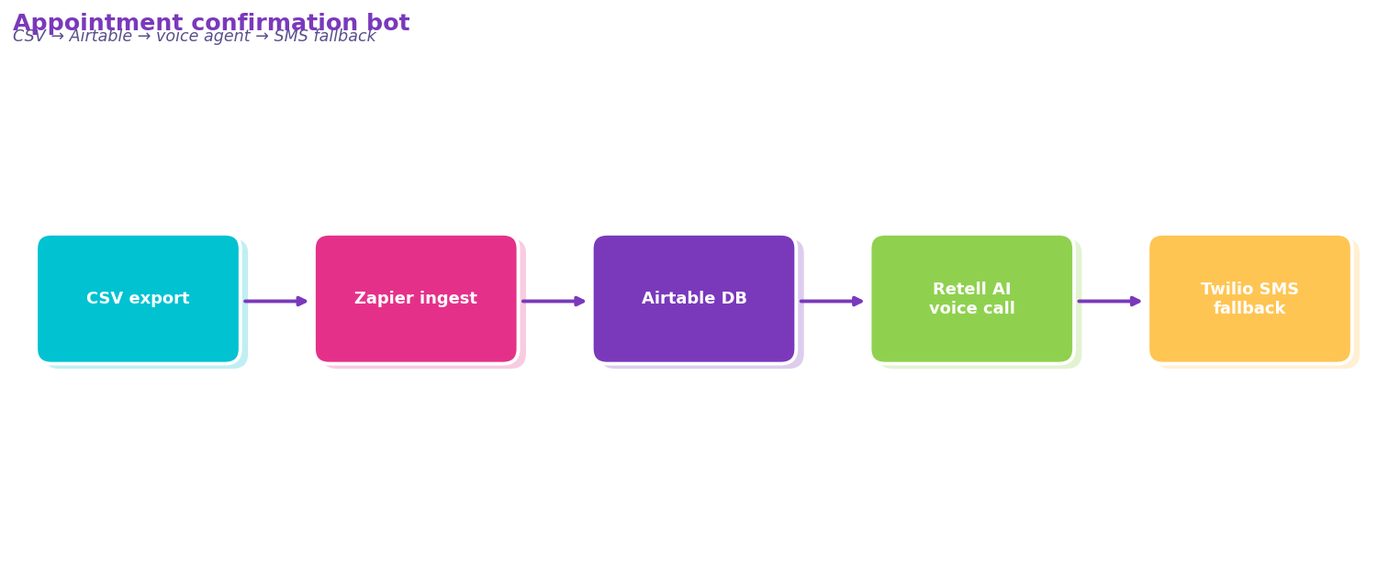
Figure 2. flow diagram showing scheduling system CSV export → Zapier ingestion → Airtable appointment database → Retell AI outbound voice call → confirmation/reschedule outcomes → Twilio SMS fallback → Airta…
Comments (0)
Join the conversation!