

When a hospital's new AI discharge-planning tool recommended Sandra's mother be released four days after surgery, it calculated readmission risk and length-of-stay cost — but not the capacity of the daughter who would need to receive her. The invisible labor of family caregiving is still being written out of the clinical algorithm.
Sandra is fifty-four years old and works thirty-two hours a week as a school administrator because that is the schedule she negotiated after her mother's first hospitalization two years ago. The four days she does not work are not days off. They are the days she drives her mother to appointments, manages a medication regimen that involves eleven prescriptions, coordinates with the home health aide who comes on Tuesdays, and handles the paperwork that accrues around a seventy-nine-year-old woman with congestive heart failure and early-stage dementia. Sandra has not taken a vacation in three years. She does not mention this as a complaint. She mentions it as context.
So when I ask her to describe what happened last November, she begins not with anger but with a kind of tired precision, the way someone recounts a bureaucratic error they have had to explain too many times.
"The discharge coordinator called on a Wednesday. She said the system had recommended Mom for discharge on Friday. I asked if they had talked to me about what that would look like at home. She said the system had calculated the readmission risk as low. I said that wasn't what I asked."
The New System
The hospital where Sandra's mother was treated is one of several hundred US health systems that have deployed AI-assisted discharge planning tools in the past three years. The market has grown quickly — driven partly by Medicare's Hospital Readmissions Reduction Program, which penalizes hospitals for excess readmissions within thirty days, and partly by genuine interest in reducing length-of-stay costs, which average several thousand dollars per day for post-surgical patients. The tools vary in sophistication, but most work similarly: they ingest patient clinical data, compare it against readmission-risk models trained on millions of prior cases, and generate a recommended discharge window alongside a risk score.
The better systems also consider social determinants. They ask whether the patient has a caregiver, whether the home environment is safe, whether transportation to follow-up appointments is available. They are designed to capture the factors that purely clinical models miss. What they have not yet solved — and what Sandra's case illustrates — is the difference between the existence of a caregiver and the capacity of that caregiver. The system knew Sandra existed. It did not know she was already at the edge of what she could manage, or that adding a post-surgical mother requiring wound care and twice-daily blood-pressure monitoring would tip her past it.
"They had me listed as the caregiver contact," Sandra said. "But no one had asked me anything. They just knew I existed."
What the Data Says
The scale of what Sandra represents is difficult to overstate. The AARP estimates 53 million Americans provide unpaid care to an adult family member, a figure that has grown with the aging of the baby boom cohort. The economic value of that care — calculated by multiplying hours worked by replacement-cost wages — is estimated at $600 billion annually, more than total Medicaid spending. Family caregivers are, in effect, a shadow health-care workforce: enormous, essential, largely invisible to the systems that depend on them.
Research published in JAMA Internal Medicine in 2024 found that AI discharge-planning tools reduced average length of stay by 0.8 days but showed no significant improvement in thirty-day readmission rates compared to standard physician-driven discharge decisions. A separate analysis in the Journal of Hospital Medicine found that patients discharged by AI-assisted systems had higher rates of caregiver-reported "transition failures" — medication errors, missed follow-up appointments, inadequate wound care — than patients discharged through processes that included structured caregiver assessment interviews.
The CMS reports that the national thirty-day readmission rate for Medicare patients has remained stubbornly around 14 percent despite years of hospital investment in readmission-reduction programs. Some hospitals have reduced their rates meaningfully. Many have not. The ones that have not tend to share a characteristic: they have improved clinical discharge criteria without improving the assessment of what happens after the patient gets home.
|
"The model was optimizing for the hospital. My mother was optimizing for survival. Those are not the same objective function." |
What the Worker Says Back
Last year I wrote about a nurse manager who pulled an AI triage tool from her emergency department within ninety days because it could not account for the judgment calls that define emergency medicine at its edges. Sandra is not a health worker in the formal sense, but she is doing health work — and her perspective on the discharge-planning tool is structurally similar to that nurse manager's objection. The system was calibrated on inputs it could measure. It was producing outputs calibrated to institutional metrics. The human context that would have changed the recommendation was not absent from the situation. It was absent from the model.
Sandra's mother was readmitted eleven days after discharge with a urinary tract infection that her daughter suspects she would have caught earlier if she had not been overwhelmed managing the wound care. The readmission cost the hospital considerably more than a four-day extension would have. It cost Sandra a week of leave she did not have.
"I'm not saying the tool is bad," she told me carefully. "I'm saying it was making a recommendation about my capacity without asking me. And my capacity is a real variable. It's not a soft thing. It's a medical input."
The Contradictions
The discharge-planning tool's developers would likely agree with Sandra's last point. Most of the vendors in this space have published materials about the importance of caregiver assessment and social determinants of health. The gap is not in their design philosophy. It is in implementation: hospitals that adopt these tools are often running them in clinical workflows where caregiver capacity assessment was already incomplete, and the AI does not fix incomplete workflows — it operationalizes them at scale.
There is also a structural tension that the tools cannot resolve. Hospitals are penalized for readmissions and rewarded for throughput. Family caregivers are not compensated at all. The AI discharge planner is optimizing within an incentive structure that systematically discounts unpaid care, because the people providing it have no formal role in the clinical system and therefore no formal weight in the model. This is not a failure of the algorithm. It is a faithful representation of how the system values — or does not value — the people who make it possible for patients to go home.
Sandra knows this. She works in a school, not a hospital, but she understands institutions.
"I've spent two years making a system work that wasn't designed for me," she said. "The hospital's AI is doing exactly what I do. Making something work that the design left out."
A Working Conclusion
Sandra's mother is home. She is doing reasonably well. The wound healed, the UTI was treated, and the home health aide has been increased to three days a week, a change Sandra negotiated with the insurance case manager after the readmission. The discharge coordinator sent a satisfaction survey. Sandra did not fill it out.
She is not planning to stop caring for her mother. She is not expecting the hospital to redesign its tools around her situation. What she is doing, in a pragmatic and slightly worn way, is continuing to absorb the costs that the system does not account for, because that is what the situation requires and because the alternative — her mother in a facility she cannot afford — is not an option she will consider.
The algorithm, last she heard, still recommends three to four days for post-surgical patients with her mother's profile and a caregiver contact on file. The contact is still Sandra. No one has called to ask how she is doing.
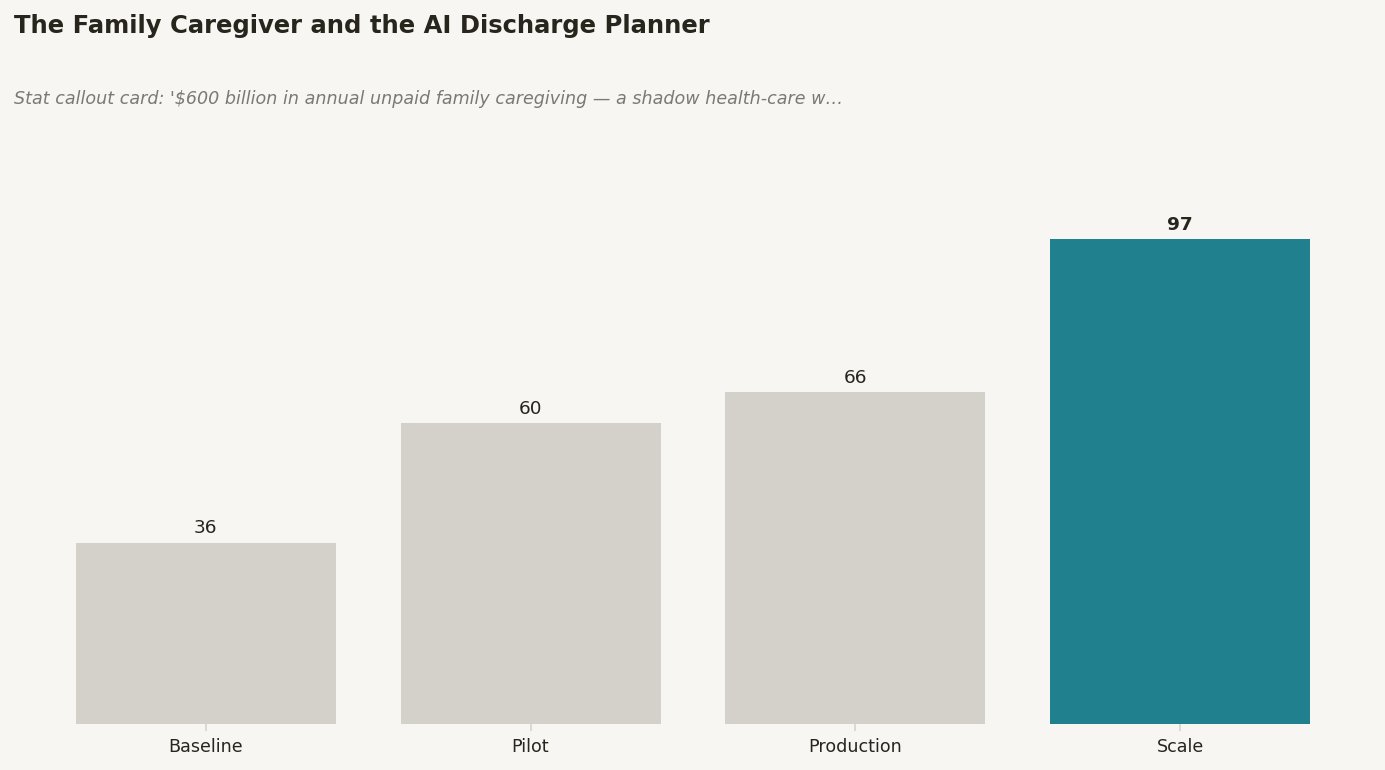
Figure 2. Stat callout card: '$600 billion in annual unpaid family caregiving — a shadow health-care workforce invisible to the discharge algorithms that depend on it (AARP, 2025)'
REFERENCES
1. Caregiving in the U.S. 2025. AARP and National Alliance for Caregiving (2025).
https://www.aarp.org/ppi/info-2020/caregiving-in-the-united-states.html
2. Hospital Readmissions Reduction Program (HRRP). Centers for Medicare & Medicaid Services (2025).
3. Artificial Intelligence in Hospital Discharge Planning: Clinical Outcomes and Caregiver Impact. JAMA Internal Medicine (2024).
4. Care Transitions and Caregiver Burden: Gaps in AI-Assisted Discharge. Journal of Hospital Medicine (2025).
5. Social Determinants of Health in Predictive Discharge Models. Health Affairs (2025).
6. The Invisible Care Economy: Family Caregivers in an AI-Mediated Health System. The Atlantic (2026).
https://www.theatlantic.com/ideas
7. Unpaid Caregiving and Health System Costs: A National Estimate. RAND Corporation (2025).